Whether a Mini Bernese Mountain Dog Is Healthier
A “mini Bernese Mountain Dog” may look like a smaller, easier-to-manage version of a Berner, but smaller size does not automatically mean better health. The label can refer to several different kinds of dogs, and their inherited risks depend on their parents, not just their height or weight. This guide explains what “mini” usually means, which health concerns may remain, and what to ask before choosing a dog.
What a Mini Bernese Mountain Dog Usually Is
The label does not describe one standardized breed
There is no single, universally defined miniature version of the Bernese Mountain Dog. A dog advertised as a “mini Bernese” might be a Bernese Mountain Dog mixed with a smaller breed, often a Poodle, or it might be a smaller-than-average purebred Berner. In some cases, the label is used broadly for a dog with Bernese-like coloring and appearance, even when its ancestry is different.
That distinction matters because “mini” does not tell you what health traits a dog inherited. A cross may inherit Bernese traits, traits from the other parent breed, or a combination of both. Even puppies in the same litter can differ in adult size, coat, temperament, and health risks. A projected weight or a cute puppy’s current size cannot reliably tell you which inherited conditions may emerge later.
If you are trying to work out what a breeder means by the term, ask for the breeds and generations involved. “Bernese Mountain Dog crossed with a Miniature Poodle” is more informative than “mini Berner,” but it still does not establish that the puppy will be small, healthy, or low-shedding. For a closer look at the terminology, see Whether a Mini Bernese Mountain Dog Is a Real Breed.
Smaller size can change some practical risks, but not erase inherited ones
A smaller dog may be easier to lift, fit into a car, or help onto a sofa. Its lower body weight can also mean less force on joints than a much heavier dog experiences. Those are practical advantages, and they can make daily care more manageable for some households.
But size is only one part of health. It does not remove a dog’s inherited susceptibility to cancer, heart or eye conditions, joint problems, or other diseases. A smaller dog with Bernese ancestry is not automatically protected from conditions associated with that ancestry. Nor does a smaller frame guarantee that the dog’s joints, spine, or overall structure developed soundly.
It is also worth separating “smaller than a standard Berner” from “miniature.” A purebred puppy may grow to the smaller end of the breed’s typical range, while another puppy from similar-looking parents may grow larger. If a breeder promises a particular adult size, ask what that estimate is based on and how often dogs from previous litters reached it. The breed’s size range and expected structure are discussed in The Size Range the Bernese Mountain Dog Standard Allows.
Are Mini Berners Healthier Than Standard Bernese Mountain Dogs
The answer depends on the individual dog and its family history
There is no dependable rule that mini Bernese dogs are healthier than standard Berners. A smaller dog may be less likely to face some problems that are more strongly affected by body mass, but that does not cancel inherited conditions. A dog’s health depends on its parents’ health, family history, body structure, environment, and veterinary care—not on the “mini” label alone.
Bernese Mountain Dogs are known for concerns that include certain cancers and orthopedic disease. A crossbred dog may inherit risk from its Berner parent, while the other parent may contribute separate risks of its own. For example, mixing breeds does not mean a puppy receives only the healthiest traits from each side. Inherited characteristics are not blended in a predictable, guaranteed way.
The same caution applies to claims that a cross is “healthier because it is a mix.” Greater genetic variety can sometimes reduce the chance that a puppy inherits the same harmful recessive variant from both parents. But that benefit is not automatic, and it does not prevent all inherited illness. A cross can still inherit a dominant condition, a risk that appears in either parent breed, or two different sets of health vulnerabilities. The broader question of mixed-breed risk is explored in Whether a Bernese Mountain Dog Mix Escapes the Cancer and What Crossing a Bernese Mountain Dog Changes.
Being lighter may help joints, but it is not a joint-health guarantee
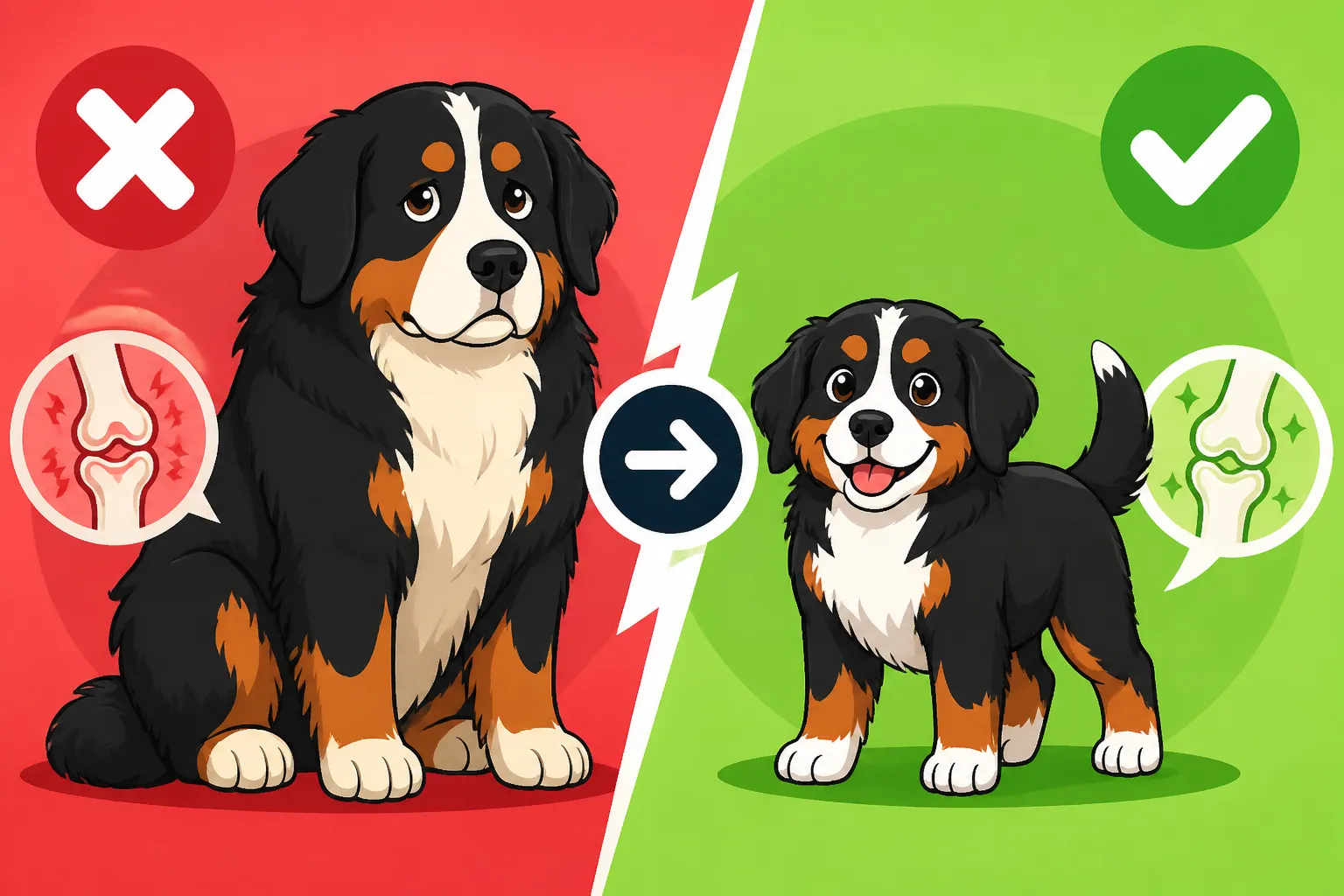
A smaller adult body can be easier to support than a very large one, especially for an older dog or a dog already dealing with mobility problems. Keeping a dog at a lean, healthy body condition can also reduce unnecessary strain on joints. However, dogs can develop joint disease at different sizes, and a smaller frame does not correct poor hip or elbow structure, an injury, or a family history of orthopedic problems.
Growth and body condition matter too. A rapidly growing puppy that becomes overweight may place extra load on developing joints, whatever its eventual adult size. On the other hand, intentionally restricting a puppy’s food to make it “mini” is not a safe way to control growth. Puppies need an appropriate diet and regular monitoring, rather than improvised feeding changes designed to produce a smaller dog.
Ask the breeder how the parent dogs were evaluated for relevant orthopedic conditions and whether those results can be independently checked. Ask your veterinarian to assess your puppy’s growth and body condition at routine visits. If you want to understand why size, weight, and joint health are connected—but not interchangeable—Every Pound a Bernese Mountain Dog's Hips Carry provides useful context.
| What the “mini” claim may mean | What it does not prove | What to ask |
|---|---|---|
| A cross with a smaller breed | That the puppy will stay small | Which breeds and generations are involved |
| A purebred Berner expected to be smaller | That it is a separate miniature breed | The parents’ adult sizes and relatives’ sizes |
| A puppy selected for a compact appearance | That its structure is sound | What health evaluations were done on both parents |
| A breeder’s estimate of adult size | That the estimate is guaranteed | How previous puppies from the same pairing matured |
| A cross promoted as healthier | That inherited disease risks are lower | Which breed-specific tests were completed and why |
How to Evaluate Health Claims Before Choosing a Puppy
Ask about tests for both sides of the cross
A responsible health discussion starts with the actual parent dogs, not a broad claim about the breed or cross. Ask which tests are appropriate for each parent’s breed and family history, who performed them, and whether you can see the results. If a breeder says “the parents are healthy,” ask what that means in practice: a veterinary checkup, screening for inherited conditions, or both?
Testing needs to match the dog. Bernese Mountain Dogs have recommended health clearances that may include evaluations of hips, elbows, eyes, and heart, along with relevant genetic testing. The other parent breed may call for its own screenings. A Poodle’s size variety and lineage can affect which tests are relevant, so a generic “DNA panel done” answer is not enough on its own. A DNA panel may identify particular variants; it cannot certify that a dog will never develop cancer, arthritis, or another complex disease.
Look for documented results rather than a verbal assurance or a screenshot without identifying details. Ask whether the results can be found through an independent registry or confirmed with the testing organization. A useful starting point for understanding breed-focused clearances is The Bernese Mountain Dog Health Panel, alongside Which Tests a Bernese Mountain Dog Breeder Should Show. The right questions may differ for a cross, but the principle is the same: evidence should relate to the actual parents.
A breeder should also be willing to talk about illness and longevity in the family, not only the show ring or the puppies currently available. Ask about parents, grandparents, siblings, and dogs from earlier litters. No family history can predict an individual dog’s future with certainty, but evasive answers are a reason to slow down. Reading Longevity Into a Bernese Mountain Dog Pedigree explains why ages and health patterns in relatives can add context without acting as a guarantee.
Watch for vague promises and pressure to decide quickly
Words such as “healthier,” “hypoallergenic,” “perfect apartment size,” or “guaranteed mini” can sound reassuring, but they need specific explanations. Ask what evidence supports each claim. A cross with Poodle ancestry, for example, is not guaranteed to have a low-shedding coat, and coat type does not establish health. Likewise, a smaller puppy’s appearance at eight weeks cannot reliably settle its adult size.
It is reasonable to ask to meet the mother, learn about the father, and see how the puppies are raised. If an in-person visit is not possible, ask what records and live conversations the breeder can offer. Find out what happens if a puppy develops a serious inherited condition and whether the breeder stays in contact with families. Written health terms should be clear enough that you can understand what they cover and what they do not.
Be cautious if a seller refuses to identify the parent breeds, will not share relevant test results, describes every puppy as free of genetic risk, or urges you to pay before you can ask questions. A responsible breeder cannot promise a disease-free dog. They can explain what they screened for, what remains uncertain, and how they make breeding decisions.
Caring for a Mini Bernese With Realistic Expectations
Build a routine around the dog in front of you
Whether your dog is a cross or a purebred, preventive veterinary care is more useful than relying on a size label. Keep a record of vaccinations, screening results, medications, changes in appetite, new lumps, persistent limping, unusual fatigue, and shifts in behavior. A brief note on when a symptom began can help your veterinarian assess what is happening.
Ask your veterinarian how often your dog should have routine examinations and which screening tests make sense based on age, breed ancestry, and family history. If you notice a new lump, a persistent change in movement, or a sudden decline, contact the clinic rather than assuming it is a normal feature of being a “mini.” Early assessment does not guarantee a particular outcome, but it can help distinguish a minor issue from one that needs prompt attention.
Food and body condition are part of that routine. Use your veterinarian’s advice to select an appropriate diet and adjust portions as your dog grows or changes activity level. If you buy food through Chewy or another retailer, keep the packaging or a clear record of the exact formula and bring that information to your appointment when discussing diet. Retail listings can help you identify a product, but they cannot determine what is medically appropriate for your individual dog.
Plan for grooming, mobility, and the full cost of care
A Bernese-like coat can need regular brushing, and a Poodle-influenced coat may have different grooming demands. Coat type is unpredictable in some crosses, so ask what grooming the parents need and prepare for more than one possibility. Brush gently and check behind the ears, under the collar, and around the legs for tangles or debris. If you use Chewy to find basic grooming tools, choose them for your dog’s coat and comfort rather than assuming one tool works for every “mini Berner.”
Smaller size may make lifting easier, but it does not mean a dog will never need help getting into a vehicle or navigating slippery floors. Keep pathways clear, consider rugs where a dog slips, and ask your veterinarian about safe exercise if mobility changes. For a larger cross—or a dog with orthopedic problems—a well-fitted harness or ramp may be useful. When comparing mobility supplies through Chewy, check measurements and fit carefully, and ask your veterinarian whether the item suits your dog’s condition.
Finally, budget for ordinary care as well as the possibility of illness. A smaller dog may eat less than a standard Berner, but routine veterinary visits, grooming, medications, diagnostics, and emergency care can still be significant. Chewy can be one place to compare everyday food and care supplies, but no shopping choice replaces veterinary guidance or a financial plan for unexpected treatment. Before bringing home any Berner-type dog, consider whether the breed’s needs, lifespan, and possible health concerns fit your household; Whether a Bernese Mountain Dog Is Right for You can help frame that decision.
Disclaimer
This article is for general informational purposes only and does not constitute professional advice. Laws, prices and regulations vary by location and change over time. Consult a qualified professional for guidance on your specific situation.