Which Tests a Bernese Mountain Dog Breeder Should Show
A Bernese Mountain Dog puppy can look healthy while carrying inherited risks that only careful screening may uncover. That makes breeder paperwork worth reviewing before you put down a deposit—not as a guarantee of a long, healthy life, but as evidence that the parents were assessed thoughtfully. This guide explains which tests to ask about, how to check the results, and what gaps to treat as reasons for more questions.
Which health tests should a Bernese Mountain Dog breeder show
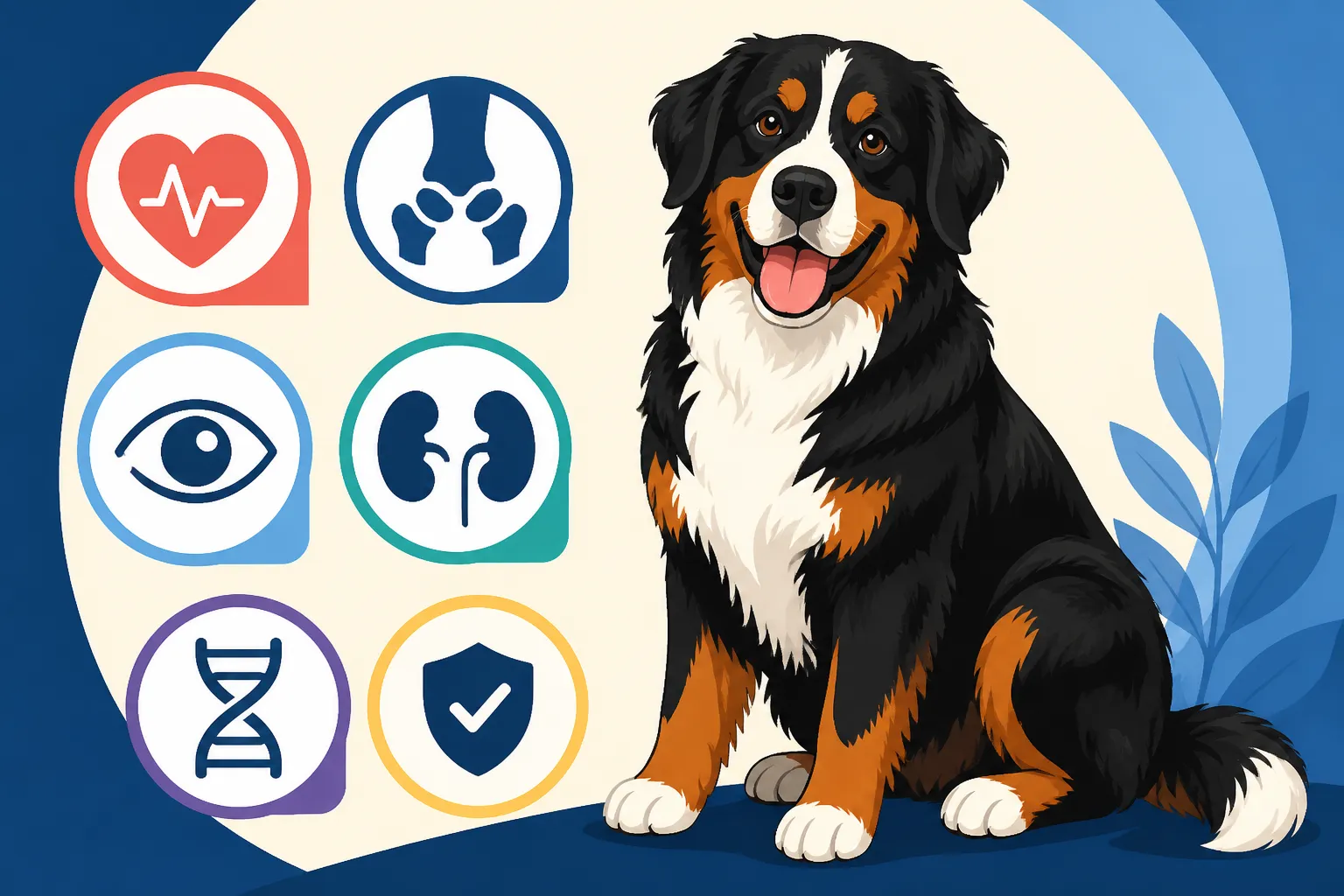
A responsible breeder should be able to identify the health tests performed on both parents and provide verifiable results, not just say that the dogs are “vet checked” or “healthy.” For Berners, the central screening picture usually includes hips, elbows, heart, eyes, and genetic testing for degenerative myelopathy. The exact recommendations and interpretation can depend on the test and the dog’s age, so ask for the actual documentation and clarify anything you do not understand.
| Screening area | What it assesses | What to ask the breeder for |
|---|---|---|
| Hips | Signs of hip dysplasia and joint structure | Official evaluation result and the dog’s identifying details |
| Elbows | Signs of elbow dysplasia | Official evaluation result and the dog’s identifying details |
| Heart | Evidence of selected cardiac problems | Type of exam, examiner, date, and result |
| Eyes | Inherited or other eye conditions visible on examination | Exam result from a veterinary ophthalmologist and date |
| Degenerative myelopathy DNA | SOD1 risk variants associated with DM | Laboratory report and explanation of the result |
| Family health history | Patterns of illness and longevity among relatives | Ages, causes of death when known, and relevant diagnoses |
These screenings do not test for every condition a Bernese Mountain Dog might develop. In particular, there is no simple set of routine parent tests that can rule out all cancers or guarantee a puppy will avoid them. Health testing helps breeders make more informed decisions; it cannot promise an outcome.
Hip and elbow evaluations
Hip and elbow screening looks for orthopedic problems that can affect comfort and mobility. These issues matter in a large breed because a dog’s build and weight can make joint problems especially consequential. Ask whether each parent has an official evaluation, and request the result rather than relying on a verbal description such as “great hips.”
Check the dog’s registered name or identifying number on the organization or database shown in the paperwork. That helps confirm that the result belongs to the parent being advertised. Ask whether the evaluation is final or preliminary, since preliminary imaging and a final certification are not interchangeable. If a dog is young, the breeder should explain what type of assessment was done and whether a final result is still pending.
A clear result is useful information, but it does not guarantee that every puppy in the litter will have healthy joints. Genetics, growth, body condition, activity, and other factors all contribute. For more context on orthopedic screening, see The Four OFA Clearances on a Bernese Mountain Dog and Reading a Bernese Mountain Dog's Hip Certificate.
Heart and eye examinations
Heart screening is not simply a claim that a veterinarian listened to the dog’s chest once. Ask what kind of cardiac exam was performed, who performed it, when it took place, and what the written result says. A basic examination and more detailed cardiac testing are not identical, so ask the breeder to explain which was used and why it fits the screening plan.
For eyes, ask for a documented exam by a veterinary ophthalmologist. The report should identify the dog and include the exam date and result. Because some eye findings can change over time, an older certificate may not tell the whole story; ask whether the breeder follows the recommended schedule for repeat examinations and how recently each parent was checked.
A breeder may have a strong reason for choosing a particular type of screening, but they should be comfortable explaining it in plain language. If the answer is vague—“the vet said everything was fine”—ask for the report. A willing breeder should not treat a request to see health records as an insult.
Degenerative myelopathy DNA testing
Degenerative myelopathy, or DM, is associated with a genetic risk variant in the SOD1 gene. A DNA test can help identify whether a dog has two copies, one copy, or no copies of the tested risk variant. Ask for the laboratory report, not just a shorthand label, and have the breeder explain how the result informed the pairing.
A DNA result is not a diagnosis. It does not establish that a dog will develop DM, and a result associated with increased risk does not mean signs are inevitable. Likewise, a “clear” result for the tested variant does not mean the dog is free of all neurological disease. Testing is one piece of a broader health assessment, not a crystal ball.
The mating matters too. A knowledgeable breeder can discuss how each parent’s result contributes to the puppies’ possible inherited status and why the pairing was chosen. For a closer look at the test and its limits, read The SOD1 Test for a Bernese Mountain Dog and Genetic Testing Before Breeding a Bernese Mountain Dog.
How to verify the breeder's test results
A folder of certificates is helpful, but verification matters. Results should be traceable to the specific sire and dam, with names or registration details that match the breeder’s paperwork. If a breeder gives you a link to an online record, check that it refers to the same dog listed in the litter details. If a dog has multiple names or a call name that differs from its registered name, ask the breeder to connect them for you.
Check public health records
For many evaluations, public databases can help confirm recorded results. Search using the registered name or identifying number, and compare what you find with the documents supplied by the breeder. A result that is absent from a database is not automatically proof that the breeder is dishonest: records may be listed differently or not appear as expected. Treat it as a reason to ask for clarification and original documentation.
Do not stop at the word “clear.” Find out what was tested, who evaluated it, and when. Check that the result belongs to the parent—not a littermate, grandparent, or another dog with a similar name. The same careful approach applies to a DNA report: verify the dog’s identity and make sure the document names the test performed.
You can learn how to search relevant records in Looking Up a Bernese Mountain Dog on the OFA Website and Searching Berner-Garde Before Buying a Bernese Mountain Dog. These records can also help you see whether the breeder’s description lines up with information available for the dog and its relatives.
Ask about dates, examiners, and follow-up
A certificate is a snapshot, and its value depends partly on what it measures and when it was completed. Ask the breeder to explain whether a test is intended to be repeated and whether the parents’ records are current for the type of screening involved. That is particularly useful for examinations where findings can change or where the examiner’s qualifications matter.
If something in the paperwork is unclear, ask a specific question: “Was this a final hip evaluation or a preliminary one?” or “Was the eye exam performed by a veterinary ophthalmologist?” Those questions are much easier for a responsible breeder to answer than a general request to prove the dogs are healthy.
A breeder may not have every record displayed on a website, but they should be able to provide the documentation or show you how to verify it. If a result is missing, ask why. A transparent explanation is different from pressure to stop asking.
What the test results cannot tell you
Even excellent screening cannot make a puppy risk-free. Tests focus on particular conditions, and some health problems have complex causes or appear later in life. A puppy’s parents can have reassuring results and still produce a puppy that develops a medical condition. Good breeding practices reduce avoidable risks; they do not erase uncertainty.
No test guarantees a cancer-free Berner
Cancer is a significant concern for many Bernese Mountain Dog owners, but routine pre-breeding screening cannot rule out every cancer risk in a parent or puppy. A breeder who promises that a litter is “cancer-proof” or guarantees a particular lifespan is offering certainty that health testing cannot provide.
Ask instead about the health history of close relatives. How old were the parents, grandparents, and siblings when they died? If a cause of death is known, what was it? Are there patterns of cancer or other serious disease in the family? A breeder may not know every detail, particularly for distant relatives, but they should be willing to discuss what they do know and how they keep track of health information.
Family history is not a precise prediction for an individual puppy. It is context that can help you judge whether the breeder is paying attention to health beyond the certificates. For more on gathering that context, see Whether a Breeder Should Show a Bernese Mountain Dog Line's Ages and Reading Longevity Into a Bernese Mountain Dog Pedigree.
A normal puppy exam is not the same as parent screening
The puppy’s own veterinary check is important, but it does not replace health testing of the parents. A young puppy may appear normal at an examination even though inherited risks are not visible yet. Conversely, the parents’ health clearances do not mean you can skip routine veterinary care after bringing the puppy home.
Ask what veterinary care the puppies have received, what records will travel with the puppy, and what the breeder expects you to arrange next. A thoughtful breeder should be able to explain the difference between a puppy wellness check, vaccinations or parasite care, and inherited-disease screening in the parents.
You can also ask how the breeder supports buyers if a health problem is later diagnosed. Read the agreement carefully, especially the wording about veterinary findings, reporting requirements, and any health guarantee. A written agreement is not a substitute for responsible testing, but it can clarify expectations. What a Bernese Mountain Dog Breeder Puts in Writing offers more on the paperwork to review.
Questions to ask before choosing a Bernese Mountain Dog breeder
You do not need to become a genetics expert to have a useful conversation. A short, practical set of questions can reveal whether a breeder understands the results and is willing to be transparent. Bring the questions with you if you feel nervous; it is easy to forget details when you are excited about a litter.
Use clear, specific questions
Ask the breeder to show the health results for both parents and explain what each result means. Then ask whether any screening is preliminary, whether an exam should be repeated, and how the results shaped the breeding decision. If the breeder uses a term you do not recognize, ask them to define it rather than pretending to understand.
It can help to keep your questions focused:
- What evaluations were completed for the sire and dam?
- Can I see the reports or look up the results using the dogs’ registered names?
- Who performed the heart and eye examinations, and when?
- What are the parents’ SOD1 test results, and how does the pairing affect the puppies’ possible results?
- What health conditions have appeared among close relatives, and how old were they?
- What happens if my puppy develops a serious inherited condition?
Listen not only to the answers but to how the breeder responds. A responsible breeder may not know every answer instantly, but should be willing to find accurate information. They should not make you feel foolish for asking reasonable questions.
Notice red flags without expecting perfection
Be cautious if a breeder refuses to share records, substitutes a general veterinarian check for the requested parent screenings, or insists that their dogs have no health risks at all. Other warning signs include mismatched dog names on certificates, pressure to pay quickly before you can review documents, or claims that testing is unnecessary because the parents “look healthy.”
At the same time, a missing online listing is not by itself proof of a problem. Ask for the original report and give the breeder an opportunity to explain. What matters is whether the information can be verified and whether the breeder responds openly. You are looking for evidence of careful decisions, not a flawless guarantee.
A good breeder should also ask you questions. They may want to understand your home, expectations, and plans for veterinary care because responsible placement is part of responsible breeding. Health paperwork is one important part of choosing a puppy, alongside the breeder’s practices, the dogs’ temperament, and your ability to care for a giant breed.
Keep the paperwork for your puppy’s records
Once you choose a puppy, save copies of the parents’ health documents, the puppy’s veterinary records, registration information, and the purchase agreement. Put them somewhere easy to find, whether in a physical folder or a clearly labeled digital file. If your puppy later needs specialist care, having the parent records available can help your veterinarian understand the family background.
Keep the breeder’s contact information as well. A conscientious breeder may want updates about the puppy’s health over time, and those updates can contribute to better knowledge of the line. Consider sharing relevant diagnoses and major health changes, even if they occur years later.
Ultimately, the best answer to “Which tests should the breeder show?” is not merely a list. Look for documented hip, elbow, cardiac, eye, and DM screening; confirm that results belong to the actual parents; and ask about family history and the limits of testing. That combination gives you a more honest basis for making a decision than any promise that a puppy will never become ill.
Disclaimer
This article is for general informational purposes only and does not constitute professional advice. Laws, prices and regulations vary by location and change over time. Consult a qualified professional for guidance on your specific situation.