Whether Bernese Mountain Dog Breeders Track Cancer
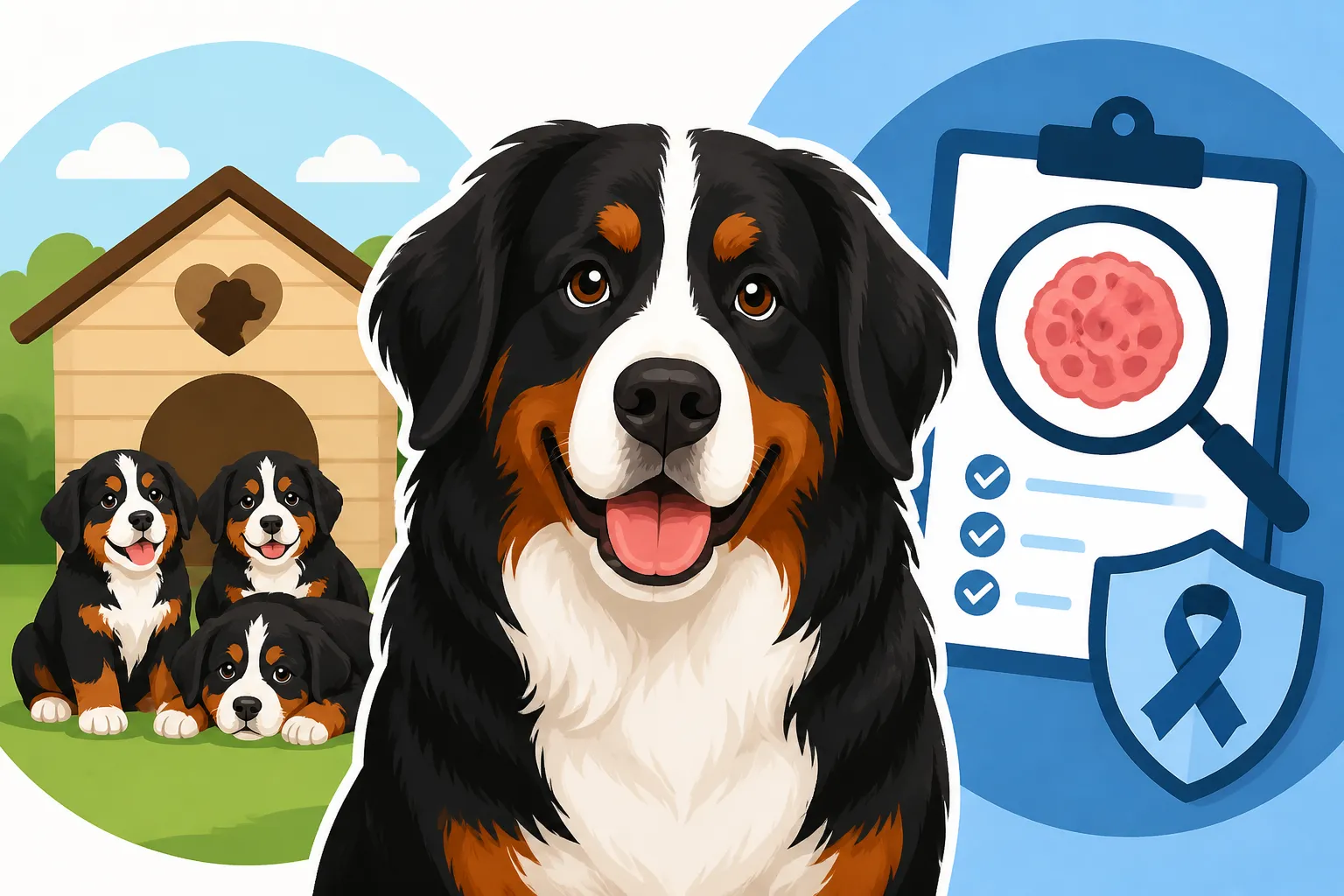
A breeder may know that cancer appears in a Bernese Mountain Dog’s family, but that does not mean every diagnosis is formally recorded or passed along to puppy buyers. Health histories can be incomplete, and no simple test predicts which puppy will develop cancer. This guide explains what breeders can track, how buyers can assess their records, and what questions help reveal a family’s health history.
What cancer tracking means in a Bernese Mountain Dog breeding program
Records are only as useful as the information behind them
Tracking cancer usually means gathering health information about dogs in a breeding line: parents, grandparents, siblings, aunts and uncles, and sometimes offspring from earlier litters. A breeder may record a dog’s diagnosis, age when signs appeared, type of cancer if confirmed, treatment, and outcome. That information can help reveal patterns across relatives and generations.
But there is no single, complete record for every Bernese Mountain Dog. A breeder may have detailed histories for dogs they own and much less information about dogs placed in other homes. Owners may move, lose contact, or not know the final diagnosis. A lump might be removed and identified as benign, while another may be called “cancer” without a biopsy or clear veterinary record. These differences matter when someone tries to compare family histories.
Cancer tracking also does not automatically mean a breeder can prevent cancer. The point is to gather information that supports more informed breeding decisions and honest conversations with puppy buyers. It is one part of evaluating a line, alongside longevity, temperament, structure, and other health concerns. For background on heredity and uncertainty, see Whether Cancer Is Bred Into the Bernese Mountain Dog.
What details a breeder should try to collect
A useful family health record goes beyond a simple note that says “died of cancer.” It should distinguish, where possible, between a suspected tumor and a confirmed diagnosis. It should also note the dog’s age at diagnosis, since a cancer appearing late in life may have a different significance for breeding decisions than one diagnosed unusually young.
A breeder may ask owners for permission to share relevant veterinary information, such as a pathology report or a summary from the treating veterinarian. That does not mean the breeder should collect or circulate a dog’s entire medical file without consent. It means they should have a practical, respectful way to learn what happened and record enough detail to make the information meaningful.
| Record detail | Why it helps | What a buyer can ask |
|---|---|---|
| Dog’s identity and relationship to the litter | Shows where the dog fits in the pedigree | Which relatives are included in your health history? |
| Cancer type, if confirmed | Avoids treating all tumors as the same condition | Was the diagnosis confirmed by testing or a veterinarian? |
| Age at diagnosis | Helps put the event in family context | At what age were affected relatives diagnosed? |
| Treatment and outcome | Adds context to the health history | Do you know how the dog did after diagnosis? |
| Source of information | Helps distinguish confirmed details from reports | Is this based on a veterinary record, owner report, or other source? |
| Date the record was updated | Shows whether the history is being maintained | When did you last check in with owners of older dogs? |
A breeder will not always have every answer. A thoughtful “I don’t know, and I’ll try to find out” is more useful than a confident but unsupported claim that a line is cancer-free.
How breeders gather and share cancer information
Communication with puppy owners matters
Many breeders learn about health problems through ongoing relationships with the families who buy their puppies. They may check in as dogs grow older, ask owners to report major diagnoses, or invite them to share health updates voluntarily. This is especially important because a dog’s later health may not be visible to the breeder unless an owner gets in touch.
Buyers can help make that communication easier. Ask how the breeder prefers to receive updates and whether they follow up with past puppy families. If a dog develops a serious illness, sharing the confirmed diagnosis and age—while protecting the owner’s privacy—can help the breeder improve the family record. That information may also help other owners who are trying to understand risks in related dogs.
Good recordkeeping is not the same as publicizing private medical information. Breeders should explain what they record, how they use it, and whether they share information with other breeders or databases. If an owner is uncomfortable sharing a report, a brief summary may still be useful, provided it is clearly labeled as an owner report rather than a confirmed diagnosis.
Databases can add context, but they cannot fill every gap
Berner-Garde is a breed-focused database that can help people research Bernese Mountain Dog pedigrees and health information. Its value depends on what has been submitted and how complete the entries are. A missing diagnosis does not prove that a dog was healthy; it may simply mean that no information was entered or that the dog’s history was never reported. For a closer look at its role and limitations, read What the Berner-Garde Database Records.
A database is most helpful when used alongside direct questions to a breeder. Search for the sire and dam, then look at relatives and older generations where records are available. Pay attention to ages and reported conditions, but do not treat one entry as a diagnosis for every related dog. The same caution applies when interpreting a family’s lifespan: a pedigree gives clues, not guarantees. Reading Longevity Into a Bernese Mountain Dog Pedigree explains why age information should be considered in context.
You can also ask whether the breeder contributes health information to a database and whether they encourage puppy owners to submit updates. If you have records for your own dog and want to understand how they may be shared, Submitting a Bernese Mountain Dog's Records to Berner-Garde is a relevant next step. A database works best as a collective record, not as a substitute for a veterinarian’s assessment or a breeder’s direct knowledge of their line.
How to evaluate a breeder’s answers before choosing a puppy
Ask clear questions without expecting a guarantee
It is reasonable to ask a breeder whether cancer has occurred among close relatives of the litter, what types were reported, and at what ages. Ask how they know: did an owner report a diagnosis, did a veterinarian confirm it, or is it based on a formal test result? These questions are not an accusation. They help you understand what the breeder knows and how carefully they handle uncertainty.
Listen for the quality of the explanation, not just a reassuring phrase. “There is no cancer in this line” may sound comforting, but it can be hard to support if the breeder has not followed dogs into older age or checked in with previous owners. A more credible answer may describe known cases, explain which details are uncertain, and say how that information affects future breeding choices.
Useful questions include:
- Have any close relatives of this litter been diagnosed with cancer?
- What type of cancer was reported, and was it confirmed?
- How old were the affected dogs when diagnosed?
- Do you keep health updates from previous puppy owners?
- Do you check family health information in Berner-Garde?
- How does what you learn influence your breeding decisions?
- Are there relatives whose later health history is unknown?
If you are comparing breeders, look at cancer history as one part of a broader evaluation. Health testing is important, but it does not provide a cancer-free guarantee. Which Tests a Bernese Mountain Dog Breeder Should Show can help you understand the distinction between screening for specific conditions and predicting cancer.
Notice whether transparency continues after the sale
A breeder’s willingness to discuss health history before a puppy goes home is useful, but so is their approach afterward. Do they invite families to share updates? Do they respond thoughtfully when an owner reports a serious diagnosis? Are they willing to correct or update information when new details emerge? Those behaviors show whether health tracking is an ongoing practice or simply a claim made during the sales conversation.
Be cautious if every concern is dismissed, if questions about affected relatives are treated as unreasonable, or if the breeder promises that a puppy will never develop cancer. No pedigree or screening process can promise that. A breeder may reasonably describe what is known about the family while being clear that the future health of an individual dog cannot be guaranteed.
You might also keep your own records from the beginning. Save veterinary summaries, test results, dates of major symptoms, and pathology reports if a tumor is investigated. If you purchase food, medication, or routine supplies through Chewy, its order confirmations may help you reconstruct purchase dates, but shopping records are not medical records and should not replace your clinic’s documentation. A simple folder with the veterinarian’s paperwork and a dated health timeline is more useful for future care and any voluntary family-history update.
What cancer tracking can and cannot tell a puppy buyer
It can reveal patterns, not predict an individual dog’s future
A well-kept family history may help breeders and buyers notice repeated diagnoses, unusually early cases, or clusters among related dogs. That can inform conversations about a line and potentially influence whether a breeder repeats a particular pairing. It can also help owners recognize that a relative’s history is worth mentioning to their veterinarian.
However, a pattern is not proof that a puppy will inherit the same disease. Cancer is not one condition with one cause, and different tumor types have different biology. A family history may raise questions, but it cannot give an individual puppy a guaranteed outcome. For broader context on cancer risk in the breed, see The Cancer That Kills Half of All Bernese Mountain Dogs and Whether Breeders Can Screen Bernese Mountain Dogs for Cancer.
It cannot replace veterinary care or erase uncertainty
If your Bernese Mountain Dog develops a new lump, persistent swelling, unexplained lameness, or another concerning change, the breeder’s records are background information—not a diagnosis. Contact your veterinarian and ask what evaluation is appropriate. If a condition is confirmed, keep copies of relevant reports and ask your veterinarian what information is suitable to share with the breeder or a database.
For owners, a practical approach is to maintain a dated health file, share confirmed details with the breeder when comfortable, and avoid interpreting an online pedigree as a personal prognosis. If the breeder has incomplete information, that is not automatically evidence of wrongdoing; the important questions are whether they are candid about the gaps and whether they make a reasonable effort to learn from the dogs they have bred. Cancer tracking is most valuable when it is honest, specific, and treated as one tool in a careful, ongoing effort to understand breed health.
Disclaimer
This article is for general informational purposes only and does not constitute professional advice. Laws, prices and regulations vary by location and change over time. Consult a qualified professional for guidance on your specific situation.