Whether a Bernese Mountain Dog Chases Livestock
For many of us who adore Bernese Mountain Dogs, their gentle, calm nature is one of their most endearing qualities. Yet, when we consider bringing one into a home that might occasionally, or even regularly, interact with livestock – be it chickens in the backyard, goats in a hobby farm, or larger animals like sheep or cattle – a very real and understandable question arises: will my Bernese Mountain Dog chase them? It’s a concern born from responsibility, knowing that a dog's natural instincts, even those of a typically placid breed, can sometimes surprise us, potentially leading to stress for both your beloved Berner and the farm animals. This guide is here to unravel those instincts, explore common behaviors, and equip you with practical strategies to foster a safe and respectful environment for everyone involved.
Understanding the Bernese Mountain Dog's Historical Role on the Farm
When we think about a Bernese Mountain Dog's past, it's easy to picture them lounging serenely in an alpine meadow, perhaps with a cow nearby. While they certainly were (and still are) adept at that, their historical role on Swiss farms was more nuanced than just being a pretty face. Understanding this background is crucial to appreciating their potential reactions to livestock today.
More Drover and Farmhand, Less Hunter or Dedicated Herder
The Bernese Mountain Dog's ancestors were true multi-purpose farm dogs. They weren't bred for the intense, eye-stalking herding of a Border Collie, nor for the fierce, protective guardianship against predators that you'd expect from a Great Pyrenees or Anatolian Shepherd. Instead, their primary jobs involved carting milk and cheese to market, alerting farmers to strangers approaching the property, and sometimes, driving cattle from pasture to barn. This "driving" or "droving" work meant they interacted with livestock, but it was a managed interaction, guided by a farmer.
They were companions to farmers, alert watchdogs, and strong draft animals. The temperament required for these tasks was one of steadiness, intelligence, and a willingness to work alongside humans. Their job wasn't to "control" livestock by chasing or nipping in an aggressive manner, but rather to move them from point A to point B. This involved a certain level of comfort and familiarity with farm animals, but it rarely instilled a strong, independent "prey drive" aimed at bringing down or harming livestock. Their protection was primarily against human intruders, not against wolves or bears preying on sheep, which makes them quite distinct from traditional livestock guardian breeds. You can learn more about their original purpose in What a Bernese Mountain Dog Did on a Swiss Farm.
The Instinct to Move and Control
Despite not being high-drive herders, Bernese Mountain Dogs do possess an underlying instinct to move things. It's a fundamental part of their working dog heritage. This isn't necessarily a predatory urge, but rather a manifestation of their desire to be involved, to organize, and sometimes, to keep their "flock" (which to them, is often their human family) together. This instinct, when not properly channeled or understood, can sometimes translate into chasing behavior when confronted with moving animals.
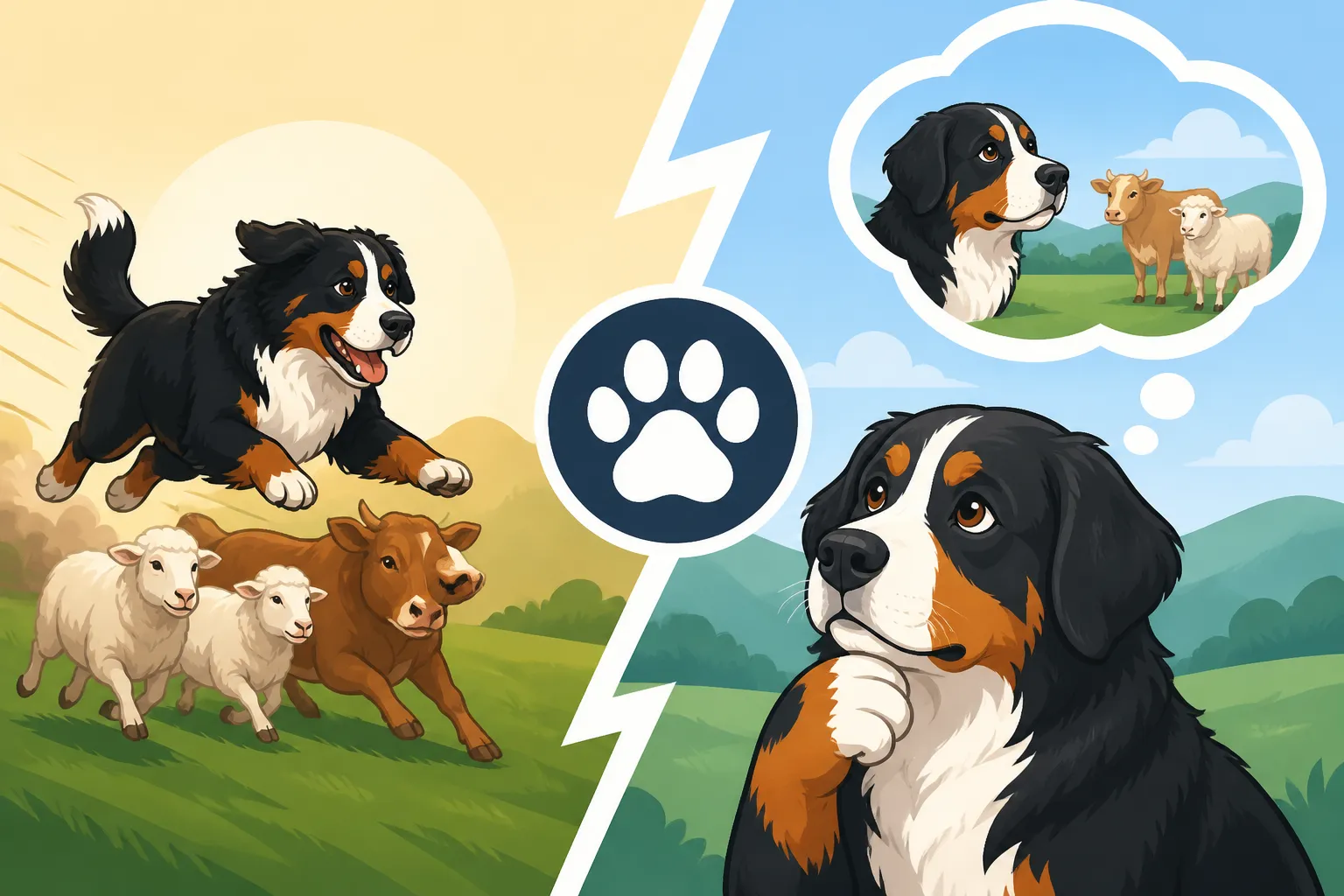
Imagine a group of chickens scattering, or a sheep bolting. For a Berner, especially a young one or one that hasn't been properly introduced, that sudden movement can trigger an innate response. It's less about wanting to catch and harm, and more about the thrill of the chase itself, or an attempt to "gather" what they perceive as loose elements of their environment. They might not know why they're chasing, only that the movement stimulates this ancient part of their brain. This is where the distinction between a working drive and a true predatory drive becomes important, but for the safety of livestock, the outcome can be similar if not managed. While they're generally described in The Bernese Mountain Dog Breed Standard as good-natured, this instinct needs careful guidance.
Common Bernese Mountain Dog Behavior Around Livestock
So, given their history, how do Bernese Mountain Dogs typically behave when they actually come face-to-face with a goat, a flock of ducks, or a pasture full of cattle? It's not always a clear-cut case of "chaser" or "non-chaser," and much depends on individual temperament, early experiences, and the specific animals involved.
Curiosity and Playfulness vs. Predatory Drive
Many Bernese Mountain Dogs, especially those who haven't been exposed to livestock, will initially display curiosity. They might approach cautiously, sniff, or wag their tails in a friendly manner. Their natural inclination is often one of gentle exploration rather than aggression. However, this curiosity can quickly shift gears if the livestock moves suddenly or runs away.
The sight of a fleeing animal can switch on a different part of the Berner's brain – the "chase" instinct. This isn't always true predatory drive, which aims to kill, but rather a deep-seated urge to pursue moving objects. For sheep, goats, or chickens, being chased by a large, powerful dog, even one that means no harm, is incredibly stressful and can lead to injury, exhaustion, or even death from fright or collision. A playful nip from a 100-pound Berner can be devastating to a smaller animal. It’s important to understand that while your Berner might just want to play with the running sheep, the sheep interprets this as a life-threatening chase. This is where the phrase "good intentions, bad outcome" often applies.
The Impact of Environment and Early Exposure
A Bernese Mountain Dog's behavior around livestock is profoundly shaped by their upbringing and early socialization. This is perhaps the most critical factor in determining how they will react.
- Farm-Raised Berners: A Bernese Mountain Dog puppy raised on a working farm, exposed to livestock from a young age under strict, positive supervision, is much more likely to understand and respect boundaries with those animals. They learn quickly that livestock are not playthings, and that chasing is not permitted. The key here is controlled exposure, where the farmer or owner intervenes immediately if the puppy shows inappropriate interest, redirecting their attention and rewarding calm behavior. This teaches them to exist harmoniously. It's not about letting them "figure it out" with the animals.
- Urban/Suburban Berners: A Bernese Mountain Dog that has grown up in a suburban home with no exposure to farm animals will have no inherent understanding of how to behave around them. Their instincts are raw and unrefined when it comes to cows, chickens, or sheep. Introducing such a dog to livestock as an adult is a much more challenging endeavor. Their natural curiosity, combined with a lack of learned boundaries, makes chasing a very real possibility. They haven't had the chance to develop the nuanced understanding that the farm-raised Berner has. This is also where a Berner might display what some refer to as a low-level herding instinct, as explored in Whether a Bernese Mountain Dog Still Has Herding Instinct. Without early guidance, this can manifest as disruptive chasing.
It's also worth noting that just because a Bernese Mountain Dog is good with the family cat (which also required careful introduction, usually, as discussed in A Bernese Mountain Dog and the Household Cat) doesn't automatically mean they'll be good with chickens or goats. The dynamic is often very different, and the response of the "prey" animal can vary wildly.
| Behavior Type | Bernese Mountain Dog Tendency | Traditional Herding Breed (e.g., Border Collie) | Livestock Guardian Breed (e.g., Great Pyrenees) |
|---|---|---|---|
| Instinct Towards Livestock | Curiosity, desire to move/gather, playful chase | Intense eye-stalk, directed herding, nipping heels | Protective bond, deterrent against predators |
| Response to Running Animal | Can escalate to chase for play/excitement | Triggers strong herding drive to control/gather | Alerts, positions self between threat and flock |
| Potential for Harm | High due to size/strength during play/chase | Low (control-focused, but can injure if untrained) | Very low (protective, non-aggressive towards flock) |
| Management Needs | Strict training, supervised exposure, prevention | Intensive training to channel instincts correctly | Proper imprinting, minimal training to "do nothing" |
| Primary Motivation | Interaction, companionship, guarding humans | Work (controlling flock) | Protect flock as part of family |
Managing and Training Your Bernese Mountain Dog Around Farm Animals
Given these nuances, how do you safely integrate your Bernese Mountain Dog into an environment with livestock, or prevent incidents if you encounter farm animals on a walk? It all boils down to diligent training, careful management, and a realistic understanding of your dog's instincts.
Foundation Training is Key
Before you even think about introducing your Berner to a sheep or a chicken, a strong foundation of general obedience is absolutely critical. This isn't optional; it's a non-negotiable safety measure. A responsive dog is a safe dog, especially one as large and powerful as a Bernese Mountain Dog.
- Reliable Recall: This is paramount. Your Berner must come back to you immediately, every single time, regardless of distractions. If your dog is halfway across a field, locked onto a moving animal, a hesitant recall isn't good enough. Practice in increasingly distracting environments. If your Bernese Mountain Dog struggles with this, consider getting professional help or an online program like BAXTER & Bella, which offers comprehensive training guides that can address this fundamental skill. A solid recall means you can interrupt a potential chase before it even fully begins. You can find more information on handling a poor recall in A Bernese Mountain Dog That Will Not Come When Called.
- "Leave It" Command: This command teaches your dog to disengage from whatever they are focused on. It's incredibly valuable for livestock interactions, as it allows you to tell your Berner to ignore the enticing movement of a chicken or the scent of a goat. Start practicing this with low-value items and gradually increase the difficulty, moving to more tempting distractions.
- Impulse Control: Training your Bernese Mountain Dog to have excellent impulse control will benefit them in all aspects of life, especially around livestock. Exercises like "stay," "wait," and not bolting through doors teach them to pause and look to you for guidance instead of reacting impulsively. This might include teaching them to Teaching a Bernese Mountain Dog to Lie Down and stay, even when exciting things are happening nearby. Remember, Berners are sensitive dogs, and training should be positive and consistent, as detailed in Training a Bernese Mountain Dog Without Breaking It.
Controlled Introductions and Supervision
Once your Bernese Mountain Dog has a rock-solid foundation in obedience, you can begin very carefully planned introductions to livestock. This process must always be supervised, and your dog should always be under physical control.
- Start Slow and Distant: Begin by simply having your Bernese Mountain Dog observe the livestock from a distance. Keep them on a leash, perhaps even a long line (a sturdy 15-30 foot leash available on Amazon is great for this, offering safety without too much restriction), where they can see but not interact. Reward calm observation. If they start to fixate or whine, move further away until they settle.
- Gradual Approach with Leash Control: As your dog remains calm, gradually decrease the distance. Your Berner should remain on a leash, with you maintaining positive control. If the livestock is calm and tolerant, that's ideal. Any signs of stress from either your dog or the farm animals mean you need to increase the distance again.
- Reinforce Calmness: Continually reward your Bernese Mountain Dog for calm behavior around the animals. Use high-value treats and praise. The goal is to create a positive association with the presence of livestock, rather than an exciting, chase-worthy one. Never allow off-leash interaction until you have many months, if not years, of proven, flawless behavior in controlled settings. Even then, continuous supervision is crucial.
Preventing Opportunities for Chasing
The best way to prevent a Bernese Mountain Dog from chasing livestock is to remove the opportunity entirely when you cannot actively supervise. This requires proactive management and secure containment.
- Secure Fencing: If you have livestock, ensure your property is securely fenced. Bernese Mountain Dogs are not typically escape artists, but a motivated dog can find weaknesses. Double-check gates and fence lines for weak spots. This might involve investing in sturdy fencing materials from a hardware store or an online retailer like Amazon, capable of containing a large, determined dog.
- Leash Protocol in Rural Areas: When walking your Bernese Mountain Dog in areas where livestock might be present (even if it's just a neighbor's chickens), keep them on a leash. Even if your Berner usually has perfect recall, the unexpected sight of a running animal can override training in an instant. Maintaining proper Leash Manners on a Hundred Pound Bernese Mountain Dog is essential for control.
- Confinement When Unsupervised: Never leave your Bernese Mountain Dog unsupervised with livestock, even if you believe they are "good" with them. Accidents happen, and it's simply not worth the risk to the animals or the potential legal and emotional fallout. When you can't be there to actively monitor, ensure your dog is in a secure run, kennel, or indoors. This is part of being a responsible owner, as discussed in What a Bernese Mountain Dog Asks of a New Owner.
By consistently implementing these training and management strategies, you can guide your Bernese Mountain Dog to coexist peacefully with livestock, ensuring the safety and well-being of all creatures on your farm or in your neighborhood.
Disclaimer
This article is for general informational purposes only and does not constitute professional advice. Laws, prices and regulations vary by location and change over time. Consult a qualified professional for guidance on your specific situation.