Whether a Bernese Mountain Dog Still Has Herding Instinct
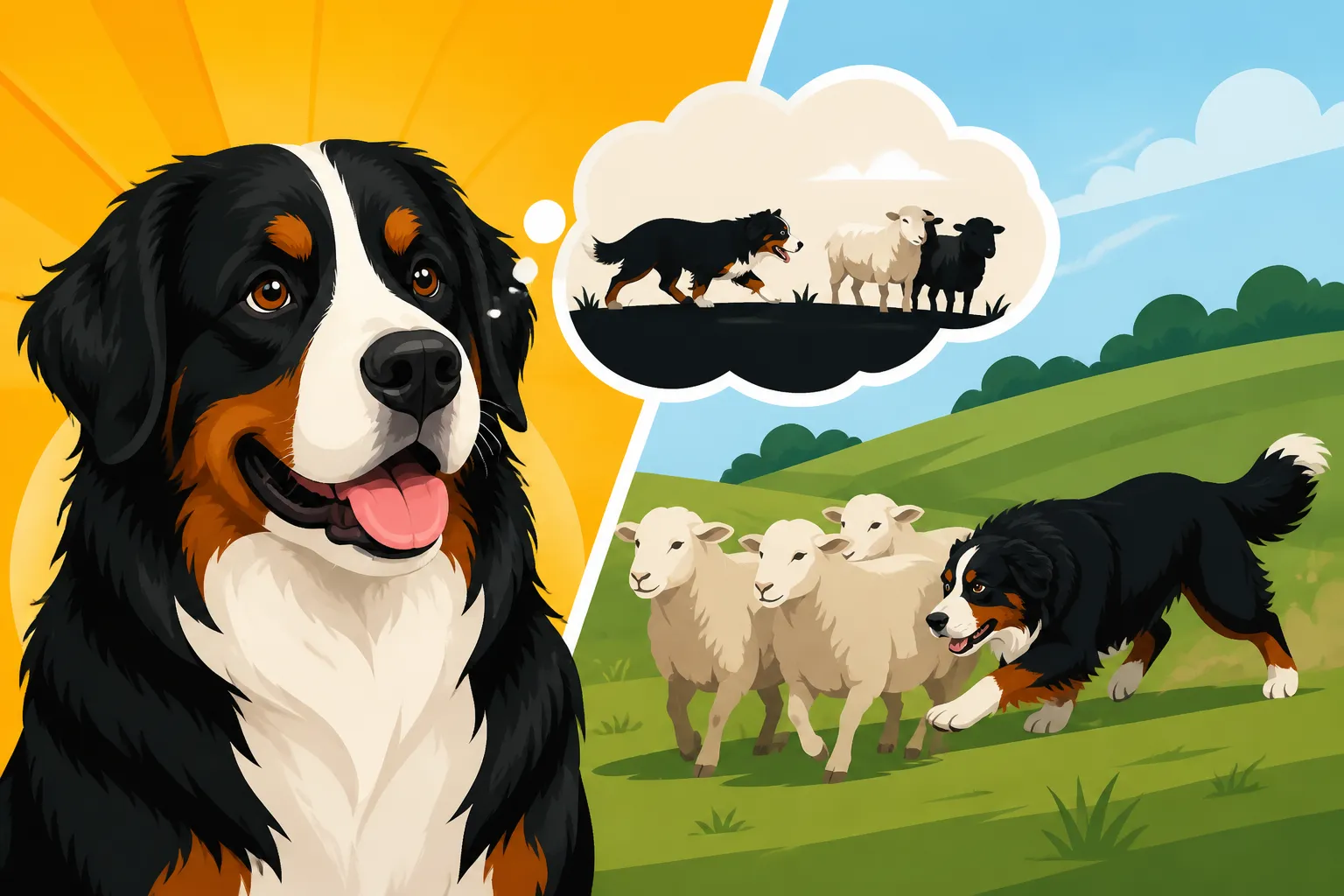
A Bernese Mountain Dog may circle children, nudge another dog toward the door, or stare intently at livestock, leaving you wondering whether a herding instinct is behind it. Berners were versatile Swiss farm dogs, but they are not specialist herders by default. This guide explains what those old working tendencies can look like today and how to respond safely.
What herding instinct means in a Bernese Mountain Dog
The Berner’s farm background
The Bernese Mountain Dog developed as a working farm dog in the Swiss canton of Bern. Farm life called for a capable, steady companion who could help with several practical jobs, rather than a dog trained for just one highly specialized task. Berners were used for work that included driving cattle, guarding, and pulling carts. The history behind What a Bernese Mountain Dog Did on a Swiss Farm and The Three Jobs One Bernese Mountain Dog Did helps explain why the breed can show a mix of watchfulness, physical confidence, and interest in moving animals.
Driving cattle is related to herding, but it is not quite the same as the precision work people often picture when they think of a Border Collie gathering sheep. A dog helping move cattle might encourage them to travel in a desired direction, keep them together, or follow a group along a route. The work did not necessarily require the same quick, controlled crouching, circling, and distance-based responses associated with specialist herding breeds.
That distinction matters in everyday life. A Berner may have inherited some tendencies that make movement interesting: following, positioning, nudging, or watching a group. But a dog’s heritage does not guarantee that it will naturally know how to herd, enjoy livestock work, or respond reliably around animals. If you want the broader historical picture, Cattle Droving and the Bernese Mountain Dog's Old Job and Whether Bernese Mountain Dogs Really Pulled Milk to Market explore different parts of the breed’s working past.
Instinct is not the same as trained herding
A herding instinct is a collection of tendencies, not a complete skill set. A dog might be drawn to moving animals or people and try to influence where they go. That does not mean the dog understands how to move livestock safely, can stop when called, or is ready to work around animals without guidance.
A trained herding dog needs more than interest. It must learn cues, manage its arousal, respond to the handler at a distance, and work with the particular animals in a controlled setting. A Bernese Mountain Dog that trots around the family while the children run may be showing a movement-related tendency, but it is not automatically displaying useful livestock-handling ability.
The difference becomes clearer when you look at the whole behavior. A Berner might follow a running dog, bark at a group of people, or place its body between a child and the rest of the family. Those actions can have several explanations: play, excitement, social attention, worry, or learned behavior. Calling everything “herding” can hide what the dog is actually communicating.
For that reason, avoid assuming that instinct alone will keep a dog safe around sheep, cattle, poultry, or horses. Even a calm, friendly Berner can frighten an animal by chasing or crowding it. If you are curious about actual working opportunities, Whether a Bernese Mountain Dog Can Herd is a useful companion topic, and What Drafting Meant for a Swiss Bernese Mountain Dog describes another historical skill that is distinct from herding.
Signs of herding-like behavior at home
Following, circling, and nudging
Some owners notice their Berner shadowing household members from room to room, standing in a doorway, or gently nudging someone who has wandered away from the group. These actions may look like attempts to gather the family. They can also be ordinary attention-seeking or a learned way of getting a response.
The context is your best clue. Does the dog do it mainly when people are moving quickly? Does it become more intense when children run or visitors arrive? Does the Berner relax when the household settles? A brief, soft nudge followed by a calm response is different from repeated circling, barking, or blocking that prevents someone from moving comfortably.
Try noticing what happens just before the behavior and what follows it. If your dog nudges you and you immediately talk, pet, or play, the behavior may continue because it reliably earns attention. If the dog circles a child who is running, movement itself may be exciting. A simple log can help: note the setting, who was present, what was moving, and whether the dog could respond to a familiar cue.
If the behavior feels intrusive, calmly call your dog away and reward it for coming to you or settling on a mat. Avoid scolding or chasing the dog, which can turn the moment into a more exciting game. A treat pouch and small rewards can make it easier to reinforce calm choices; pet-supply retailers such as Chewy carry common training supplies, but the important part is using them consistently.
Chasing and controlling movement
Chasing is not proof of herding instinct. A dog may chase a ball, a running child, a squirrel, or a bicycle for different reasons, and the behavior can become risky regardless of its origin. With a large, powerful dog, even playful chasing can knock someone over or frighten a smaller animal.
Watch for escalation. The dog may lock its gaze, become difficult to interrupt, accelerate after movement, bark repeatedly, or keep returning to the chase after being called away. Those signs tell you the situation needs more management, not that the dog should be given a chance to “work it out” around people or animals.
Make safety the priority. Use a leash or secure barrier where there is a chance your dog could chase livestock, wildlife, or people who are running. Around children, supervise closely and give the dog a calm place to rest away from active play. If the dog is becoming hard to redirect, seek help from a qualified reward-based trainer who can assess the behavior in context.
For a Berner who enjoys chasing toys, provide a safer outlet that includes clear start-and-stop cues. You can ask the dog to wait, release the toy, return to you, and settle before another round begins. The goal is not to encourage chasing people or animals; it is to build control around movement. A long line and appropriate training gear can help with practice in open areas, and retailers such as Chewy may offer basic equipment options to compare.
Barking, staring, or stepping between people
A Berner may watch movement closely without trying to chase. Some dogs bark when people run, position themselves between family members, or stand near a doorway as activity increases. These behaviors can come from alertness, uncertainty, excitement, or a desire to stay close to the group—not necessarily a clear herding purpose.
Notice whether your dog looks relaxed or tense. A loose body, easy disengagement, and response to your voice are reassuring signs. A stiff posture, fixed stare, repeated barking, growling, or inability to move away from the scene deserves more attention. If you are unsure, record the circumstances and discuss them with a veterinarian or qualified behavior professional, especially if the behavior is new or getting stronger.
Teach a practical alternative before the busy moment starts. For example, send the dog to a mat while children play, reward it for watching calmly, and provide a break behind a gate if it cannot settle. In a household where the dog gets overexcited, food puzzles or chew items can help occupy it in a separate, quiet space. Chewy is one place owners may look for enrichment supplies; choose items that fit your dog’s size and chewing habits, and supervise anything that could be swallowed or damaged.
How to manage and channel the behavior
Build reliable everyday control
A dog that may be interested in movement benefits from basic skills practiced when life is calm. Work on coming when called, walking on a loose leash, waiting at doors, leaving an object alone, and settling on a mat. Keep sessions short and rewarding. A Berner that can disengage from a moving toy in the backyard is better prepared to respond when something more distracting appears.
Start in a quiet place and add difficulty gradually. For example, practice “come” indoors, then in a fenced yard, then at a greater distance with a mild distraction. Do not test a new recall beside livestock or an open road. If your dog struggles, reduce the distraction and make the exercise easier before increasing the challenge again.
Reward the behavior you want to see: looking at a moving person and then turning back to you, walking past another dog calmly, or resting while the family is active. Keep your cues consistent across household members. If one person encourages the dog to chase and another tries to stop it, the mixed signals can make the behavior harder to manage.
A simple comparison can help you decide what to do next:
| What you notice | What it might mean | A sensible response |
|---|---|---|
| Following a family member from room to room | Social attachment, attention-seeking, or interest in movement | Reward settling and give the dog a predictable resting place |
| Circling or nudging during active play | Excitement, play, or movement-related behavior | Pause play, call the dog away, and reward calm disengagement |
| Chasing a person, animal, or vehicle | A potentially unsafe chase response, whatever its cause | Use distance, leash control, barriers, and professional guidance if needed |
| Watching movement but responding to you | Interest with some ability to disengage | Reward calm attention and practice easy cues |
| Fixating, barking, or ignoring familiar cues | High arousal, worry, or difficulty disengaging | Increase distance and get help if the pattern repeats or intensifies |
Offer suitable work without creating risky habits
Berners often enjoy having something purposeful to do, but it does not have to involve livestock. Sniffing games, obedience practice, carrying a light item where appropriate, and supervised activities can offer mental engagement. Choose tasks that suit your individual dog’s health, age, and fitness; a young, growing dog or an older Berner may need different limits.
A structured class can help you learn what your dog enjoys and how it responds to cues around distractions. Sports a Bernese Mountain Dog Can Do covers options beyond herding, while Whether a Bernese Mountain Dog Still Works in Switzerland offers more context about the breed’s working traditions today. If you are considering livestock work, look for an experienced instructor who can evaluate your dog and explain how to protect both dog and animals.
Do not use a backyard as an informal herding arena with a neighbor’s sheep or poultry. Animals can panic, dogs can be injured, and an uncontrolled chase can become a deeply rehearsed habit. Any livestock introduction should be planned and supervised by someone experienced with the animals and the training process. A naturally interested dog still needs boundaries, and a dog that shows little interest should not be pushed into work it dislikes.
Good enrichment also includes ordinary routines. Walks with time to sniff, simple search games, and calm training can meet a dog’s needs without encouraging it to chase. If your Berner becomes overexcited by toys, structure play with pauses and a clear finish. Chewy and other pet-supply shops may have puzzle feeders or training accessories, but choose based on safe fit and your dog’s actual interests rather than assuming a particular item will solve the behavior.
When to get help
Know when behavior needs professional attention
A little following or nudging may be manageable, but seek guidance if the dog repeatedly chases people or animals, blocks movement, cannot be interrupted, or causes someone to feel unsafe. Growling, snapping, or intense fixation should not be dismissed as harmless “herding.” Those behaviors need an individual assessment rather than a label based on breed history.
A veterinarian can help rule out health changes that may affect behavior, particularly if a previously calm dog becomes unusually reactive or restless. For training support, look for a qualified professional who uses humane, reward-based methods and has experience with large dogs and the specific behavior you are seeing. Share clear examples: what happened immediately beforehand, how the dog responded, and what helped it settle.
While arranging help, prevent opportunities to rehearse unsafe behavior. Use a leash, secure fencing, gates, and distance from triggers. Ask children not to run toward or tease the dog, and make sure they have an adult supervising interactions. Management is not a failure; it gives everyone a safer environment while you work on new skills.
Set realistic expectations for your Berner
The Bernese Mountain Dog’s working history helps explain why some individuals pay close attention to moving groups or try to stay near their people. It does not mean every Berner will herd, that every chase is herding, or that a dog can be trusted around livestock without training. Individual temperament, experience, age, and the situation all matter.
Focus on what your dog does and whether the behavior is safe, interruptible, and comfortable for everyone involved. If your Berner calmly watches movement and responds to you, reward that good judgment. If it becomes intense or hard to redirect, create distance and get professional help. The most useful question is not simply “Does my dog have herding instinct?” but “What is my dog doing, what is driving it, and how can I guide it safely?”
Disclaimer
This article is for general informational purposes only and does not constitute professional advice. Laws, prices and regulations vary by location and change over time. Consult a qualified professional for guidance on your specific situation.