Teaching a Bernese Mountain Dog to Lie Down
It’s a scene many Bernese Mountain Dog owners know all too well: you ask your beloved giant to lie down, perhaps so they don't block the hallway, or to settle by your feet at a friend's house, and you’re met with a blank stare, a casual sit, or even a determined stand. Teaching a large, sometimes stubborn, and often sensitive Bernese Mountain Dog to reliably lie down can feel like an uphill battle. This guide is here to walk you through understanding your Berner’s unique learning style and implementing effective, kind training methods to achieve that calm, comfortable 'down' command.
Understanding the Bernese Mountain Dog's Learning Style
Before we even get to the mechanics of teaching "lie down," it’s crucial to understand the magnificent creatures we’re working with. Bernese Mountain Dogs aren't like every other breed, and what works for a Border Collie might utterly fail with a Berner. Their temperament, growth rate, and even their physical build all play a role in how they learn and respond to training. Rushing or being too harsh can actually set you back significantly.
The Berner's Gentle Nature and Sensitivity
Bernese Mountain Dogs are, at their core, incredibly gentle souls. They often form deep bonds with their families and are known for their affectionate, devoted personalities. This wonderful trait also means they can be surprisingly sensitive. A sharp tone, a sudden movement, or a forceful correction can easily make a Berner shut down. Instead of learning, they might become anxious, confused, or even resistant. You might notice them avert their eyes, lip-lick, or simply walk away from the training session.
When teaching a command like "lie down," which requires them to be vulnerable on the ground, a sensitive dog needs reassurance and positive motivation. They need to feel safe and that they’re choosing to perform the action, not being compelled to. This means that yelling, pushing, or repeatedly yanking on a leash will be counterproductive. We want to build their confidence, not erode it, and make training a fun, rewarding experience for both of you.
Patience is Key for a Growing Giant
One of the most common frustrations for new Bernese Mountain Dog owners is their seemingly slow rate of maturation. While physically large, many Berners retain a puppy-like exuberance and mental immaturity well into their second or even third year. This means that what might be an easy concept for a mentally mature dog could take your Berner much longer to grasp consistently. It's not that they're unintelligent; it's simply that their brains are still developing, and their attention spans might be shorter than you expect for such a large dog. As I've discussed in Why a Bernese Mountain Dog Stays a Puppy Until Three, these dogs are often still quite goofy and puppyish long after other breeds have settled into adulthood.
Given their size and prolonged puppyhood, short, frequent training sessions are far more effective than long, drawn-out ones. A five-minute burst of focused training, three or four times a day, will yield better results than one exhausting thirty-minute session. Furthermore, their sheer size means that physically manipulating them into a 'down' position can be awkward for you and uncomfortable for them. Imagine trying to gently guide a hundred-pound dog to the floor without them feeling forced – it’s a delicate dance! Patience isn't just a virtue here; it's a necessity for successful Bernese Mountain Dog training.
What Motivates a Bernese Mountain Dog
Understanding what truly motivates your individual Bernese Mountain Dog is the cornerstone of effective training, especially for a command like "lie down." While some dogs are perfectly happy with a simple "good boy!" and a pat, many Berners are highly food-motivated. This isn't a bad thing; it's a powerful tool! You'll want to experiment to find your dog's "high-value" treats – those irresistible morsels that they’ll do almost anything for. This might be small pieces of cooked chicken, cheese, hot dogs, or specially made soft training treats.
Beyond food, praise and gentle affection can also be strong motivators. A happy, enthusiastic "Yes!" followed by a scratch behind the ears can be incredibly reinforcing. Some Berners also enjoy playing with specific toys, so a quick game of tug or fetch after a successful 'down' can be a great reward. The key is to make the reward immediate and highly desirable so your Berner clearly understands that their action (lying down) led to something wonderful. When you know what makes your Bernese Mountain Dog tick, as explored in What a Bernese Mountain Dog Will Actually Work For, training becomes a positive partnership rather than a chore.
Step-by-Step: Teaching "Lie Down" with Positive Reinforcement
Now that we understand your Berner's learning style, let's dive into the practical steps for teaching the "lie down" command using methods that build trust and enthusiasm. Positive reinforcement is the name of the game here – rewarding desired behaviors to make them more likely to happen again.
Lure and Reward: The Foundation
The lure-and-reward method is incredibly effective for teaching new physical behaviors like "lie down," especially with a large dog where physical manipulation is impractical. You'll use a treat to guide your Bernese Mountain Dog into the desired position.
Start with your Berner in a sitting position, ideally in a quiet area with minimal distractions. Hold a high-value treat close to their nose. Slowly move the treat straight down towards the floor between their front paws, then smoothly slide it slightly forward, away from them. As you do this, your dog's nose will follow the treat, lowering their head. To continue following the treat, their body will naturally shift, and their elbows should eventually hit the ground. The instant their elbows touch the floor, praise them enthusiastically ("Yes!" or "Good down!") and give them the treat.
The timing of that reward is absolutely critical. You want to mark the exact moment they are in the 'down' position. If you wait even a second too long, they might think they’re being rewarded for looking up, or standing up, rather than lying down. Repeat this process many, many times in short, upbeat sessions. Don't worry about adding the verbal command yet; focus on getting the physical motion fluid and automatic with the lure. Training Sessions Short Enough for a Bernese Mountain Dog emphasizes this short, sweet approach which is perfect for teaching new skills. If you're looking for structured guidance, platforms like BAXTER & Bella often provide excellent video tutorials that demonstrate this exact luring technique, making it easier to visualize and replicate at home.
Adding the Verbal Cue and Hand Signal
Once your Bernese Mountain Dog is consistently following the lure into the 'down' position about 80-90% of the time, it's time to introduce the verbal cue and a hand signal. Consistency is paramount here.
Choose your verbal cue – "Down," "Lie Down," or "Settle" are all common choices. Decide on one and stick with it. Now, just before you perform the lure, say your chosen verbal cue ("Down!"). Immediately follow with the lure and reward as before. Do this for several sessions. The idea is for your dog to associate the sound of the word "Down" with the action that earns them the treat.
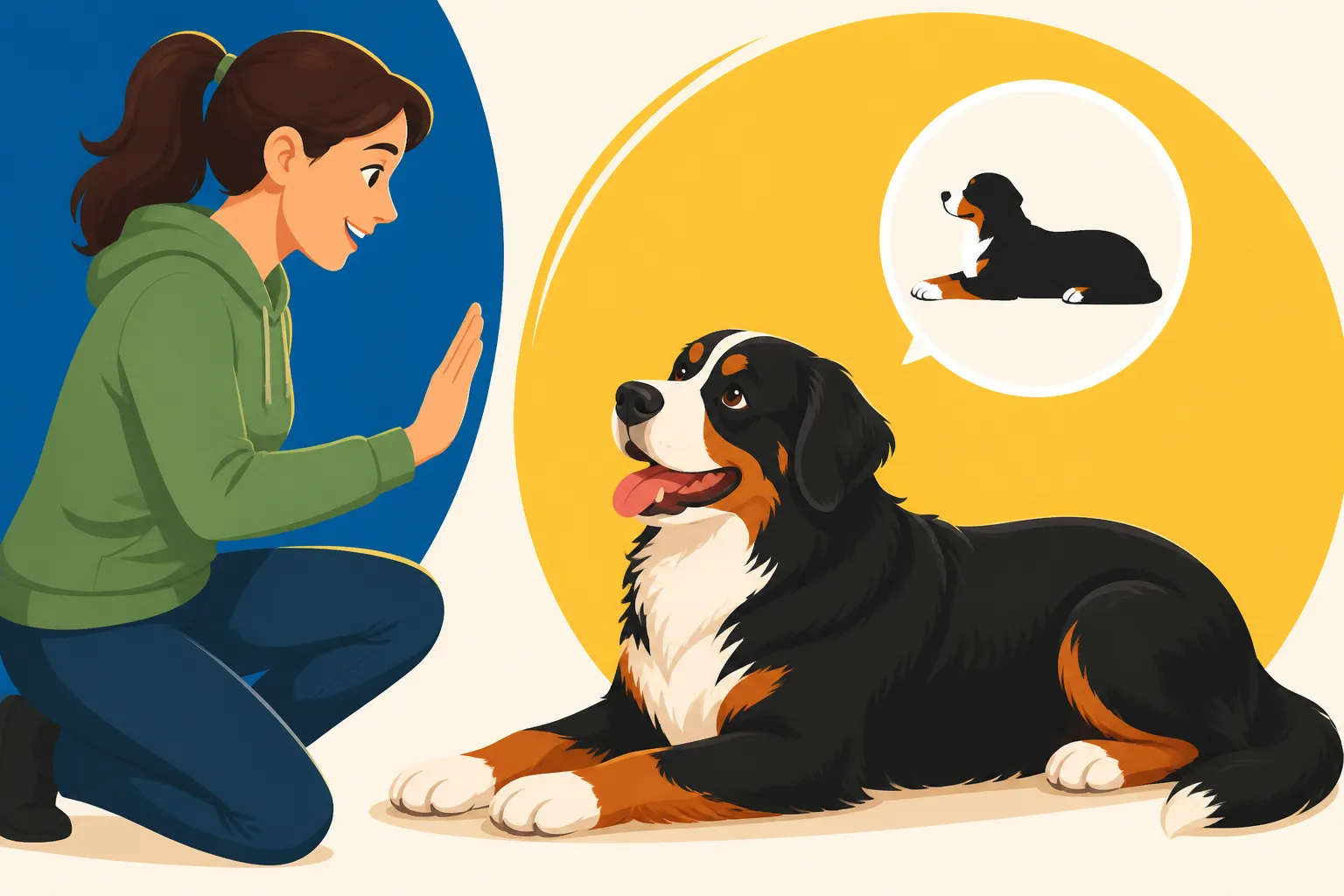
Simultaneously, you can start incorporating a hand signal. A common hand signal for 'down' is to bring your open hand down from chest height towards the floor, palm facing down. As you say "Down" and lure, make this hand gesture. Eventually, you'll start to fade out the physical lure (the treat right at their nose). Instead of holding the treat to their nose, you’ll show them the empty hand signal, say "Down," and then immediately produce the treat from your other hand to reward them when they lie down. The goal is for them to respond to the verbal cue and hand signal alone, with the treat appearing after the behavior.
Practice and Generalization
A common mistake in dog training is assuming that once a dog performs a command perfectly in your living room, they've "learned" it everywhere. This isn't usually the case. Your Bernese Mountain Dog needs to understand that "down" means "down" regardless of where they are or what's happening around them. This is called generalization.
Start practicing in different, slightly more distracting environments within your home – perhaps in the kitchen, then the backyard, then near a window where people might be walking by. Gradually increase the level of distraction. You can also start practicing the duration of the 'down.' Ask for a 'down,' reward, then ask them to stay down for a second or two before releasing them with a cheerful "Okay!" and another reward. Slowly build up the duration.
Consider using a raised bed or a mat as a "place" command, which naturally encourages a down. You can teach them to go to their "place" with a treat, and then once they're on it, ask for a 'down.' This can be a wonderful way to give your Berner a job and help them settle in various situations, whether you're relaxing at home or visiting a friend. Many durable, comfortable dog beds, easily found on Amazon, are perfect for this. Remember that for a Bernese Mountain Dog, especially one that tends to quit after too many corrections, as detailed in The Bernese Mountain Dog That Quits After One Correction, keeping sessions positive and varied is crucial to maintaining their engagement and enthusiasm for learning.
Common Challenges and Troubleshooting
Even with the best intentions and the right techniques, training a Bernese Mountain Dog isn't always a straight line. There will be moments of frustration, confusion, and perhaps even a bit of Berner stubbornness. Knowing how to troubleshoot these common hurdles will help you stay patient and consistent.
The "Floppy" Berner Who Just Sits
It’s a familiar scenario: you offer the lure for "down," your Bernese Mountain Dog lowers their head, sits beautifully, and then just… stops. Their gaze is fixed on the treat, but they seem to have hit a mental wall, unable to transition from sitting to lying down. This "floppy Berner" response is common when dogs don't quite understand the final step of the luring process.
The key here is to refine your lure. Instead of just moving the treat forward from between their paws, make sure it moves down almost to the floor, and then very slowly sweeps outwards, parallel to the ground, away from their nose. This motion encourages them to stretch their front legs out, which naturally leads to the rest of their body following into a lie-down position. Be precise with your hand motion; a subtle change can make a big difference. Also, ensure you are rewarding the full down – both elbows on the ground. If you accidentally reward them for just sitting with their head down, that's what they'll keep offering. Resist the urge to repeat "down, down, down" if they're not getting it; instead, reset, take a breath, and try the lure again with more intentional movement. Sometimes, they're not being stubborn, they just don't understand what you're asking.
When Your Berner Gets Frustrated (or You Do!)
Training, especially when hitting a snag, can be a test of patience for both human and dog. Your Bernese Mountain Dog might show signs of frustration by yawning excessively, licking their lips, sniffing the ground, looking away from you, or even walking off. These are their ways of saying, "I don't understand," or "I'm overwhelmed." When you see these signals, it’s a clear sign to take a break.
It's equally important to recognize your own frustration. If you feel your voice getting sharper, your movements becoming less patient, or you're just plain annoyed, your Berner will pick up on that energy immediately. A frustrated trainer rarely leads to a successful session with a sensitive Berner. When either of you is feeling frustrated, stop. Take a deep breath. End the session on an easy command your dog does know, like a simple "sit," reward them, and then walk away. You can always come back to it later with a fresh perspective. Remember, as discussed in Whether a Bernese Mountain Dog Is Stubborn and How Long a Bernese Mountain Dog Will Concentrate, these dogs thrive on positive interactions and can shut down if they feel pressured or corrected too harshly. A few minutes of quiet downtime can reset everyone and make the next session more productive.
Maintaining the "Down" Command Over Time
Learning "lie down" is just the first step; maintaining it and building its reliability are ongoing processes. Once your Berner understands the basic command, you'll want to work on duration (how long they stay down) and distance (how far you can be from them while they remain down).
Start by asking for a 'down,' then take one small step back. If they stay, step forward, praise, and reward. Gradually increase your distance. For duration, ask for a 'down,' count to one, then praise and reward. Slowly extend the time you ask them to hold the position. Remember to reward frequently in the beginning, especially for longer durations, to build their confidence. You might also want to combine "down" with a "stay" command, which is a separate skill but complements "down" perfectly.
Life happens, and sometimes a once-perfect command can get rusty. Be prepared to revisit the basics, use higher-value treats, or reduce distractions if your Berner starts struggling. Reinforce the behavior periodically, even if they know it perfectly. A quick "down" and a treat during commercials, while you're cooking, or before greeting a visitor reinforces the command in a natural, positive way. Long-lasting, durable chew toys or snuffle mats, often found on Amazon, can also be fantastic for keeping your Berner occupied and happily in a 'down-stay' for longer periods, associating the position with something pleasant and engaging.
Benefits Beyond Basic Obedience
Teaching your Bernese Mountain Dog to lie down isn't just about showing off a neat trick; it's a foundational command that unlocks a host of practical benefits for both you and your giant companion. A reliable "down" can significantly improve safety, promote calmness, and even deepen the bond you share.
Safety and Control in Public
Imagine you're at a busy park, a local pet-friendly cafe, or even just a friend's house. Your Bernese Mountain Dog, as majestic as they are, can be a force of nature. A reliable "down" command gives you invaluable control in these situations, enhancing both their safety and the comfort of those around you. For instance, if a small child approaches or another dog gets too close, you can immediately ask your Berner to lie down, preventing accidental knocking over or an overwhelming greeting.
This command is also crucial for trips to the veterinarian. A calm, settled Bernese Mountain Dog lying down quietly in the waiting room is much less stressful for everyone involved than one who is anxious and standing, pulling on the leash. It demonstrates excellent manners and ensures your dog is perceived as well-behaved, a true ambassador for the breed. As we discussed in Handling a Bernese Mountain Dog at the Vet, being able to settle your large dog on command can make a world of difference in a potentially high-stress environment. It also allows you to focus on the vet's instructions rather than constantly managing a restless dog.
Calmness and Impulse Control
The "lie down" command is more than just a physical action; it's a powerful tool for teaching impulse control and promoting a sense of calm in your Bernese Mountain Dog. When you ask your dog to lie down, you're essentially asking them to pause, take a breath, and override any impulses to jump, run, or demand attention. This simple act of stillness teaches them patience.
Think about common scenarios: the doorbell rings, and your Berner erupts in excitement; dinner is being prepared, and your dog is underfoot. Instead of chaos, a "down-stay" can become your go-to solution. By consistently using the command in these high-energy situations, you train your dog to choose calmness over impulse. Over time, they learn that a polite 'down' earns them attention or a treat, whereas frantic behavior does not. This translates into a more settled household and a more relaxed Bernese Mountain Dog overall, making life much more enjoyable. This also ties into Teaching a Bernese Mountain Dog to Settle, as the 'down' command is often the first step in achieving that relaxed state.
Strengthening Your Bond
Beyond the practical applications, the process of teaching and reinforcing the "lie down" command is a fantastic opportunity to strengthen the bond between you and your Bernese Mountain Dog. Positive reinforcement training isn't just about obedience; it's about communication, trust, and mutual understanding.
When you engage in fun, rewarding training sessions, your Berner learns that you are a source of good things, a reliable leader who communicates clearly and fairly. They look to you for guidance and enjoy the mental stimulation and attention. Every successful 'down' and every treat or praise exchanged builds confidence in your dog and fosters a deeper connection with you. It’s a language you both learn to speak, reinforcing that you are a team. This shared experience creates a strong foundation for all other interactions and ensures that your Bernese Mountain Dog sees training not as a chore, but as an engaging and positive part of their relationship with their favorite human.
Comparing "Lie Down" Training Techniques for Bernese Mountain Dogs
While positive reinforcement is generally recommended for Bernese Mountain Dogs due to their sensitive nature, it's helpful to understand the different approaches and why one might be preferred over another for this specific breed.
| Training Method | Description | Pros for Bernese Mountain Dogs | Cons for Bernese Mountain Dogs |
|---|---|---|---|
| Lure-Reward (Positive Reinforcement) | Using a high-value treat to guide the dog into the "down" position, immediately followed by praise and the treat once the desired position is achieved. | Builds confidence and trust; kind and gentle, ideal for sensitive Berners; encourages enthusiastic participation; low risk of fear or shutdown. | Can be slower initially as the dog learns the mechanics; requires consistent high-value rewards; may need more repetition in varied environments. |
| Capturing | Waiting for the dog to naturally offer the "down" behavior on their own, then immediately marking and rewarding it. | Excellent for building strong, intrinsically motivated behaviors; dog learns to "offer" the behavior; very gentle. | Can be unpredictable; requires excellent timing from the handler; might take a long time to "capture" a down if the dog doesn't offer it frequently; less direct for initial teaching. |
| Physical Manipulation | Gently pushing or guiding the dog's rear end or front paws to encourage them into the "down" position. | Can sometimes achieve the position quickly in a pinch. | Highly discouraged for Berners due to their size and sensitivity; can be perceived as forceful or punishing; risks creating fear or resistance; difficult to apply without causing discomfort; doesn't teach the dog to choose the action. |
| Verbal Repetition (without lure/reward) | Repeatedly saying "Down" until the dog eventually lies down, without guiding or rewarding initially. | (No significant pros for Bernese Mountain Dogs) | Extremely ineffective; dog learns to tune out the command; leads to frustration for both dog and owner; can create a "punishment" associated with the word "down" if the dog is corrected for not responding. |
As you can see, the lure-and-reward method is overwhelmingly the most suitable and effective approach for teaching a Bernese Mountain Dog to lie down. It respects their gentle nature, builds a positive association with the command, and fosters a stronger, more trusting relationship.
Disclaimer
This article is for general informational purposes only and does not constitute professional advice. Laws, prices and regulations vary by location and change over time. Consult a qualified professional for guidance on your specific situation.