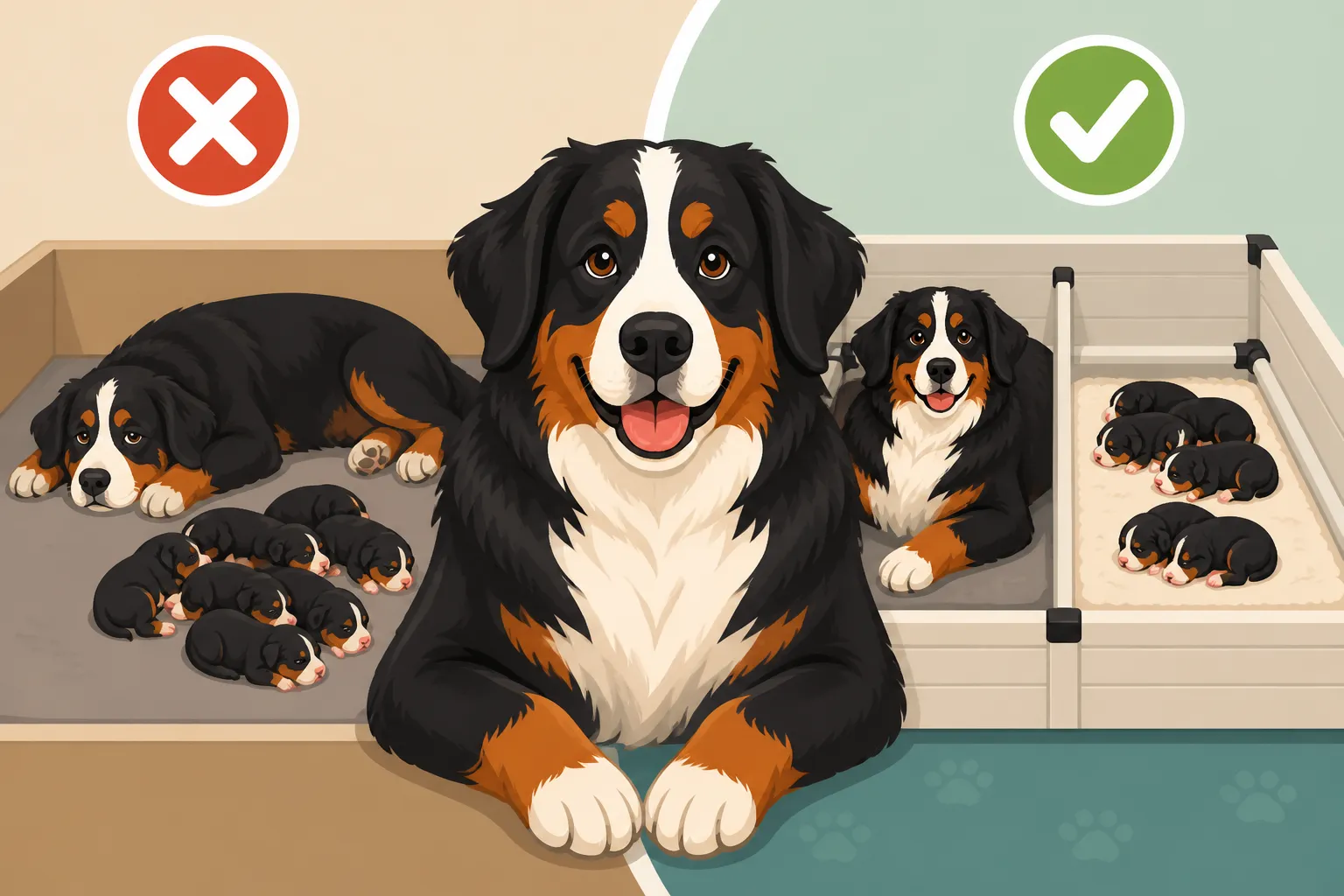
Whether a Bernese Mountain Dog Litter Needs a Section
A Bernese Mountain Dog does not automatically need a cesarean section simply because she is a large breed. The decision depends on her health, the puppies’ position and size, labor progress, and any history of delivery problems. This guide explains when a planned C-section may be discussed, what signs can make delivery an emergency, and how breeders and veterinarians prepare for either outcome.
Do Bernese Mountain Dog litters usually need a C-section
Breed size alone does not decide how puppies are born
A Bernese Mountain Dog’s size can make owners worry that natural delivery will be difficult, but the mother’s overall size does not tell you whether she can deliver safely. The size and position of each puppy, the mother’s pelvic anatomy, her contractions, and the number of puppies all matter. Some Berners deliver without surgery; others need veterinary help because labor stalls or a puppy cannot pass through the birth canal.
There is no reliable rule that every Bernese Mountain Dog litter should be delivered by C-section. A veterinarian evaluates the individual dog and pregnancy rather than making the decision based only on breed. A large puppy may be difficult to deliver even if the mother is also large, while a smaller litter can sometimes create its own complications if one puppy grows especially large.
Litter size may also affect how closely the pregnancy needs to be monitored. A very small litter can mean fewer puppies sharing the space, and an individual puppy may grow larger than expected. A large litter can be tiring for the mother and may be associated with weaker contractions later in labor. These are possibilities to discuss with the veterinarian, not guarantees that surgery will be needed. For more on litter size, see Whether a Bernese Mountain Dog Has Large Litters.
Natural delivery, planned surgery, and emergency surgery are different situations
A planned C-section is arranged before labor or before it becomes urgent. A veterinarian may discuss this option when a dog has a known delivery risk, such as a previous difficult birth or a prior C-section, or when examination and pregnancy imaging raise concerns about the puppies or birth canal. The timing should be decided by the veterinary team, which can assess the pregnancy and reduce the risk of operating too early or waiting too long.
An emergency C-section is performed when labor or the puppies’ condition suggests that waiting could put the mother or puppies at risk. For example, a puppy may be lodged in the birth canal, contractions may not be moving the litter along, or a veterinarian may find signs of fetal distress. In these situations, the priority is prompt examination and care—not trying to determine at home whether surgery is definitely necessary.
A C-section also does not mean a breeder has failed or that the mother cannot have a healthy life afterward. It is a medical intervention with risks and recovery needs, just as natural delivery has risks. The right choice is the one the veterinarian recommends for the specific mother and litter, based on what is happening at the time.
When a veterinarian may recommend a C-section
Pregnancy findings and breeding history can affect the plan
The veterinarian may use an examination and imaging to estimate litter size, assess the puppies’ development, and discuss whether the mother has factors that could make delivery more complicated. Imaging has limits: it cannot guarantee that every puppy will arrive easily or predict every problem during labor. Still, information about the litter can help the veterinary team make a practical plan, including where to go if the mother needs urgent care.
A history of difficult labor, a previous emergency C-section, or a known problem with the mother’s reproductive tract is important to share. So are details about the mating, the expected due window, and any pregnancy complications. A breeder should bring records rather than relying on memory, especially if a different clinic is handling the delivery than the one that managed the pregnancy.
Responsible breeding decisions start well before labor. If you are considering a litter, discuss the mother’s health, age, and family history with a veterinarian before breeding. It is also worth asking breeders how they evaluate health and breeding suitability; The Age a Bernese Mountain Dog Should Be Bred and Which Tests a Bernese Mountain Dog Breeder Should Show cover related questions.
Labor that stalls can become urgent
A dog may need veterinary assessment if labor is not progressing, even when she seems calm between contractions. Warning signs can include strong, repeated straining without a puppy appearing, prolonged pauses when more puppies are expected, or a puppy visible at the opening that does not advance. A veterinarian should also be contacted if the mother becomes weak, collapses, appears severely distressed, or has heavy bleeding or foul-smelling discharge.
The color and timing of discharge matter, but it can be hard to interpret at home. Dark green discharge before the first puppy arrives can be concerning, while discharge later in labor may have a different meaning. Rather than trying to diagnose the situation by color alone, call the veterinarian and describe what you see, when it began, and whether a puppy has already been born.
Timing guidelines found online can be confusing because labor differs between dogs, and the stage of labor matters. If the mother has been straining without progress, if you believe a puppy is stuck, or if you are unsure whether a pause is safe, call the veterinary team promptly. Do not pull forcefully on a puppy, give medication to stimulate contractions, or wait for a set number of hours when the mother or puppies seem unwell. Attending a Bernese Mountain Dog Through Labor offers more detail on preparing for and observing the birth.
| Situation | Why it matters | What to do |
|---|---|---|
| Strong, repeated straining without a puppy emerging | A puppy may be stuck, or labor may not be progressing | Contact the veterinarian urgently |
| A puppy is visible but does not advance | The puppy or mother may be at risk of injury or distress | Do not pull forcefully; call the veterinarian |
| The mother collapses, becomes very weak, or seems severely distressed | Her condition may need immediate treatment | Seek emergency veterinary care |
| Heavy bleeding or foul-smelling discharge | These signs may indicate a serious complication | Call the veterinarian or emergency clinic promptly |
| Labor pauses while more puppies are expected | The pause may be harmless or may signal a problem | Follow the veterinarian’s instructions and report the timing and signs |
How to prepare for a possible C-section
Make a delivery plan with the veterinary team
Before the due window, ask the veterinarian which clinic to call during normal hours and where to go overnight or on weekends. Find out how the clinic wants you to contact them, what information they need, and whether they recommend a planned delivery appointment or monitoring at home. If your regular clinic does not perform emergency surgery, identify a referral or emergency hospital in advance rather than searching while labor is underway.
A useful plan includes transport arrangements for a large dog, a way to keep the car clean, and a second person who can help with the mother and puppies. Think through practical details: Can the dog get into the vehicle without jumping? Is there a nearby emergency clinic that can accommodate a giant-breed patient? Does someone know how to meet the veterinary team at the entrance if the mother cannot walk comfortably?
Keep pregnancy records, the veterinarian’s phone numbers, and any instructions in one accessible place. A breeder should also share the plan with the people who will be present during labor. What a Bernese Mountain Dog Breeder Puts in Writing and What the BMDCA Asks of Bernese Mountain Dog Breeders are useful starting points for thinking about breeder responsibilities and clear communication.
Prepare supplies without trying to replace veterinary care
Set up a clean, quiet whelping area and have basic supplies ready, but do not assume that a home kit can manage an obstructed delivery or a puppy in distress. Keep the veterinarian’s contact details nearby, along with clean towels and a safe way to transport the mother and newborns. Ask your veterinarian what supplies they want you to have and what they prefer you leave to the clinic.
For ordinary preparation, some owners use washable bedding, disposable liners, and cleaning supplies from a pet retailer such as Chewy. These can make it easier to keep the whelping area tidy, but they are not substitutes for sterile surgical supplies or veterinary assessment. If you order essentials through Chewy, check that they arrive well before the expected due window, and avoid buying medications or medical equipment for use without veterinary direction.
It is also sensible to prepare for recovery in case surgery is needed. Ask the veterinarian what the mother may need at home, how to keep the incision clean and protected, and how to manage nursing if she is groggy or uncomfortable. Chewy may be convenient for routine household items such as washable blankets or a suitable pen, while medication, wound care, and feeding concerns should be handled according to the clinic’s instructions.
What happens after a C-section
The mother and puppies need close observation
After surgery, the mother may need time to become fully alert before caring for her puppies. The veterinary team will advise when nursing can begin and how to keep the puppies warm and supervised while she recovers. At home, watch that the mother is responsive and comfortable, that the incision remains clean, and that she is not licking or chewing at the surgical site. Contact the clinic if you notice worsening pain, swelling, discharge, a poor appetite, unusual weakness, or another change the veterinarian told you to watch for.
Newborn puppies need to stay warm and feed regularly. If the mother is not ready to nurse, cannot safely lie with them, or is not producing enough milk, ask the veterinary team what to do rather than improvising a feeding plan. A small scale can help track each puppy’s weight when the veterinarian recommends monitoring, but weight changes should be interpreted with professional guidance. Chewy can be a source for general puppy-care items, but ask the clinic which products are appropriate for newborns and which feeding supplies to use.
A C-section can require extra hands in the first hours and days. One person may need to monitor the mother while another checks that the puppies are warm and nursing safely. Keep the environment calm, limit unnecessary visitors, and follow the clinic’s advice about activity, incision checks, and follow-up appointments.
Ask about future pregnancies and records
A C-section does not automatically mean the mother can never be bred again, but it is a major part of her medical history. Before considering another litter, discuss the reason for surgery, her recovery, and the risks of another pregnancy with her veterinarian and an experienced, responsible breeder. The answer will depend on why the surgery was needed and how the mother and puppies fared.
Keep copies of the pregnancy records, imaging reports, labor notes, operative report, and follow-up instructions. These details help the veterinarian assess future risks and give breeders a clearer picture of what happened. If the birth involved a suspected inherited or structural issue, ask the veterinary team what that might mean for breeding decisions.
For anyone choosing a puppy, ask the breeder how the litter was delivered and whether the mother had complications. A C-section by itself does not tell you whether a breeder acted responsibly; context matters. A thoughtful breeder should be willing to discuss the mother’s health and the care the litter received. Visiting a Bernese Mountain Dog Litter Before Choosing can help prospective owners think through what to ask and observe.
Disclaimer
This article is for general informational purposes only and does not constitute professional advice. Laws, prices and regulations vary by location and change over time. Consult a qualified professional for guidance on your specific situation.