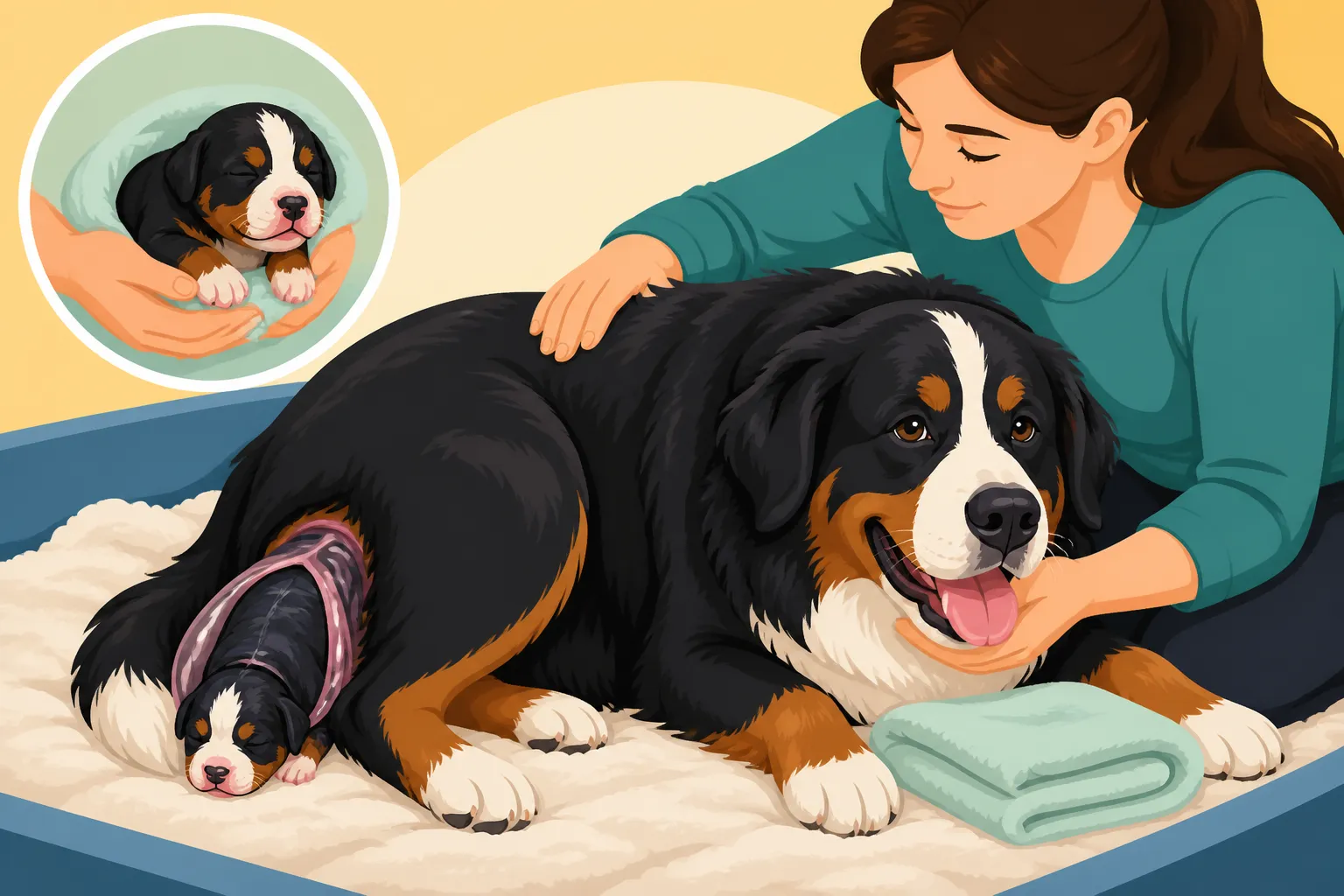
Attending a Bernese Mountain Dog Through Labor
A Bernese Mountain Dog going into labor can turn a carefully prepared whelping room into a stressful place very quickly, especially if you are unsure what is normal and what needs urgent help. This guide explains how to prepare, what to watch during labor, when to call your veterinarian, and how to care for the mother and puppies afterward.
Prepare for your Bernese Mountain Dog’s labor
Arrange veterinary support before labor starts
Do not wait for contractions to find out which clinic can help your dog. Before her due window, talk with your regular veterinarian about how to reach them after hours and where they would send you if she needed emergency care or a cesarean section. Ask what signs should prompt an immediate call, and make sure you know the route and travel time.
A Bernese Mountain Dog is a large dog, but her size does not make labor automatically straightforward. The number, position, and size of the puppies can all affect delivery. Your veterinarian can advise you about your dog’s individual pregnancy and whether imaging or a planned delivery approach makes sense. If you are still planning a breeding, start with guidance on The Age a Bernese Mountain Dog Should Be Bred and Which Tests a Bernese Mountain Dog Breeder Should Show.
It is also helpful to keep the breeder involved if they have experience supporting whelpings. Agree in advance on who will make decisions if your dog needs urgent treatment, and keep your veterinarian’s contact details, pregnancy records, and any relevant breeding information together. A written plan is much easier to follow when you are tired and worried.
Set up a quiet whelping area and gather essentials
Choose a calm, warm, draft-free space where your dog can lie comfortably and you can reach her without crowding her. Introduce the area before labor begins so it feels familiar. Keep other pets and visitors out, and make sure the mother can leave the whelping box briefly without the puppies being exposed to a fall or chilly floor.
Gather clean towels, washable bedding, a notebook or phone for recording times, a kitchen or baby scale suitable for weighing puppies, and a way to contact your veterinarian. Ask your vet whether they want you to have any additional supplies. Ordinary items can be purchased in advance from retailers such as Chewy, but a shopping list is not a substitute for veterinary advice about what your particular dog may need.
| Prepare ahead | Why it helps | Check with your veterinarian |
|---|---|---|
| Whelping area and clean bedding | Gives the mother a familiar, tidy place to deliver | How to keep the area safely warm |
| Clean towels and spare bedding | Helps with routine cleanup and changing soiled material | Whether any special supplies are appropriate |
| Scale and written log | Helps track puppy weights, birth order, and timing | How often to weigh and what changes need a call |
| Phone numbers and transport plan | Reduces delays if labor becomes difficult | Which clinic to use after hours |
| Pregnancy and breeding records | Gives the veterinary team useful context | Whether imaging or a planned delivery is recommended |
Keep supplies organized in one place instead of scattered around the house. If you use Chewy to order routine items, check them when they arrive and put them beside the whelping area well before the expected delivery. Avoid giving medications, calcium, supplements, or labor-inducing products unless your veterinarian specifically directs you to do so.
Understand the stages of labor
Early labor can look restless rather than dramatic
During the first stage, a dog may pant, pace, nest, shiver, refuse food, or repeatedly change position. Some dogs become clingy; others prefer to be left alone. These behaviors can come and go, and visible abdominal pushing may not have started yet. Stay nearby, keep the room quiet, and note when you first see a clear change.
A dog that seems uncomfortable is not necessarily in danger, but a major change in her condition deserves attention. Call your veterinarian if you are unsure whether what you see is early labor or a problem, especially if she appears weak, has severe pain, collapses, or has unusual discharge. If your veterinarian has given you a specific labor plan, follow that plan rather than relying on a general guide.
Try not to repeatedly move, examine, or handle her. Offer water and a chance to go outside on leash if she wants it, but keep outings brief and supervised. If she is unsettled, a familiar person sitting quietly nearby may be more reassuring than a group of people watching.
Active labor means observing closely and recording events
In the second stage, the mother has visible abdominal contractions and begins delivering puppies. Record the time each puppy is born and, if you can do so without disrupting her, note whether a placenta follows. A placenta may not appear immediately after every puppy, and the mother may eat some of them. If you are uncertain about what has passed, write down what you observed and tell the veterinary team.
Give the mother room to work, but watch closely enough to notice changes. In many normal deliveries she will open the puppy’s sac, clean the puppy, and encourage breathing. If she does not respond to a newborn or seems exhausted, ask your veterinarian what to do rather than waiting and hoping the situation improves. Be especially cautious about pulling on a puppy or attempting an internal examination; incorrect handling can injure the mother or puppy.
The number of puppies and the length of the delivery can vary. Knowing the expected litter size, if it has been established by your veterinarian, can help you judge whether delivery appears complete. For more context about litter expectations, see Whether a Bernese Mountain Dog Has Large Litters. Still, timing and puppy count alone cannot tell you whether everything is safe; your veterinarian’s advice should guide decisions.
Know when labor needs urgent veterinary attention
Call promptly for stalled delivery or signs of distress
Contact a veterinarian urgently if your dog has strong, repeated contractions for around 20 to 30 minutes without delivering a puppy, or if a puppy appears stuck. Also call if there is a prolonged gap between puppies and you believe more remain, particularly if the mother is still straining or seems unwell. Your own veterinarian may give different timing instructions based on her pregnancy, so use their guidance whenever available.
Other reasons to seek urgent help include collapse, marked weakness, severe or worsening pain, heavy bleeding, foul-smelling discharge, or a mother who becomes unusually dull or difficult to rouse. Green or dark discharge before the first puppy is delivered also warrants an urgent veterinary call. The appearance of discharge can depend on the stage of labor, so describe what you see and when it started rather than trying to diagnose it yourself.
If you think something is wrong, call while preparing to leave rather than spending time searching online or waiting for another contraction. Tell the clinic your dog’s breed and size, how long labor has been underway, whether she is pushing, how many puppies have been born, and what discharge or other symptoms you have noticed. A clear timeline helps the team prepare.
Have a cesarean plan without assuming one is inevitable
A cesarean section may be needed when puppies cannot be delivered safely, labor stops progressing, or the mother or puppies are in distress. A veterinarian decides whether surgery is appropriate based on an examination and the pregnancy details. Do not attempt to induce labor or use medications to speed it up at home; these can make a delivery emergency worse if there is an obstruction or another complication.
Planning ahead matters because reaching help quickly can be important. Ask your veterinarian which facility should receive your dog if surgery may be needed, whether you should call before setting off, and what records to bring. The article Whether a Bernese Mountain Dog Litter Needs a Section can help you prepare questions, but it cannot determine what your dog needs during an individual delivery.
If a cesarean has been discussed as a possibility, clarify who will transport the mother, how the newborn puppies will be kept warm during travel, and who will contact the clinic. Chewy may be convenient for stocking ordinary supplies before the due window, but do not delay a veterinary visit while waiting for an order or trying to assemble extra equipment.
Care for the mother and puppies after birth
Check that every puppy is breathing, warm, and nursing
Once a puppy is born, observe whether it is breathing normally, moving, and able to reach a teat. The mother usually handles cleaning and stimulation, but if she does not, contact your veterinarian for immediate instructions. Keep newborns close to the mother and away from drafts, while making sure she cannot accidentally lie on them. A safe, warm area matters, but avoid placing a heat source where puppies can touch it directly or become overheated.
Early nursing is important because puppies need the mother’s first milk. Watch for puppies that cannot latch, are repeatedly pushed away, feel cool, cry continuously, or seem weak. Those signs merit a call to your veterinarian. Ask your veterinary team how often to weigh the puppies and how to interpret changes. A simple written log can reveal that one puppy is falling behind even when the litter looks busy and active.
Use clean bedding and keep the space calm. Limit handling to what is needed for checks and weighing, especially while the mother is settling. If you need to buy routine items such as extra bedding or a suitable scale, Chewy may be one option, but get veterinary guidance before using supplements, milk replacers, or feeding equipment.
Monitor the mother and record changes
After delivery, the mother needs rest, water, food appropriate for nursing, and opportunities to go outside under supervision. Keep her bedding clean and watch her appetite, energy, comfort, and interest in the puppies. Some discharge can occur after birth, but heavy bleeding, a foul smell, feverish behavior, collapse, severe pain, or neglect of the puppies needs veterinary attention.
Contact your veterinarian if a puppy stops nursing, loses weight, becomes weak, or seems persistently distressed. Do not assume that a quiet puppy is necessarily fine, and do not wait for several concerning signs to appear before asking for help. Your vet can tell you whether the mother and litter need an examination and how to respond to specific symptoms.
Before breeding, it is also worth understanding the breeder’s responsibilities and the practical support expected around a litter. See What the BMDCA Asks of Bernese Mountain Dog Breeders and What a Bernese Mountain Dog Breeder Puts in Writing for related preparation. Whether this is a planned litter or an unexpected pregnancy, attentive observation and a clear veterinary plan make it easier to respond calmly when the situation changes.
Disclaimer
This article is for general informational purposes only and does not constitute professional advice. Laws, prices and regulations vary by location and change over time. Consult a qualified professional for guidance on your specific situation.