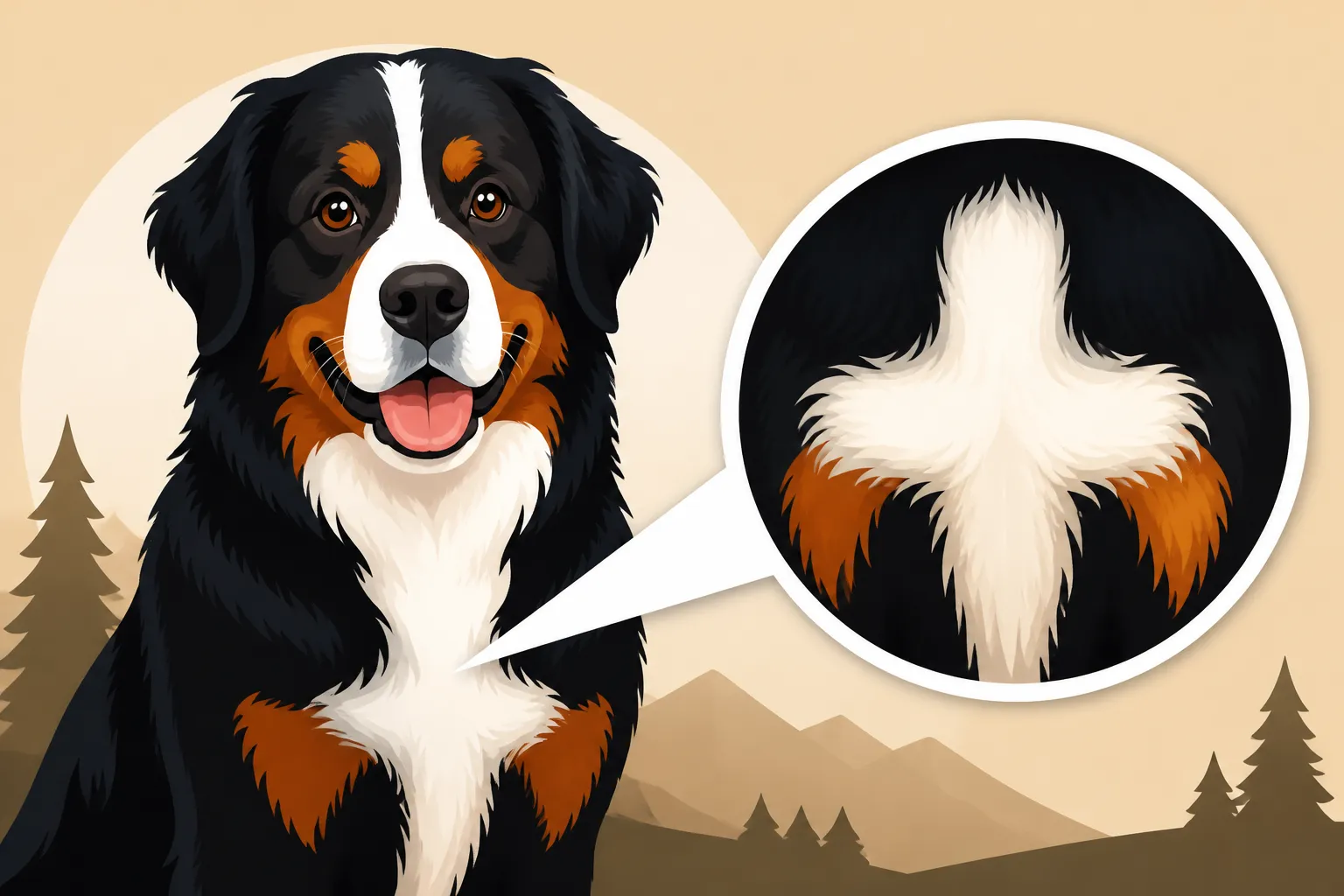
What the Swiss Cross on a Bernese Mountain Dog Is
A Bernese Mountain Dog’s “Swiss cross” is the white marking on its chest, not a separate symbol or a sign of ancestry from a particular Swiss village. Because the shape can vary from dog to dog, owners often wonder whether their Berner’s marking is normal or meets the breed standard. This guide explains what the cross means, how it relates to other markings, and what matters for health.
What the Swiss cross looks like on a Bernese Mountain Dog
A white chest marking, not a literal emblem
The Swiss cross is the name commonly given to the white marking on a Bernese Mountain Dog’s chest. On some dogs, the white area has a shape that resembles a cross. On others, it looks more like a broad patch, an irregular blaze, or a marking whose outline is difficult to describe. The name is about the general appearance, not a precise design.
It also isn’t a little Swiss flag on the dog. The Swiss flag has a white cross on a red background, while the Bernese marking is white fur against the dog’s dark coat. The resemblance is loose and visual. The marking isn’t applied, painted, or deliberately shaped by a breeder.
That variation is one reason photographs can be misleading. A dog standing squarely with its chest facing the camera may seem to have a crisp cross, while the same dog turned sideways may show a patch that looks quite different. Coat length, lighting, and the way the chest hair lies can change the impression, too.
How it fits the breed’s tricolor pattern
The Swiss cross is one piece of the Bernese Mountain Dog’s familiar tricolor appearance: a black base coat with rust-colored and white markings. White is usually seen on the chest and may also appear as a blaze on the face, on the feet, or at the tail tip. The balance and outline of those markings differ among individual dogs.
The three colors are part of the breed’s recognizable look, but they aren’t a checklist of separate symbols. A white chest mark doesn’t mean the dog has a special role or personality, and a broader or narrower mark doesn’t tell you whether the dog will be affectionate, energetic, or easy to train. Those traits can’t be read from the shape of the fur.
For a closer look at how the full pattern is described, see Bernese Mountain Dog Markings and What They Mean and Why the Bernese Mountain Dog and Its Cousins Are Tricolor. The chest marking also makes more sense when considered alongside the facial blaze and white feet, rather than by itself.
How the Swiss cross relates to other white markings
The chest, blaze, feet, and tail
The white marking on the chest is often the most noticeable white area, but it is only one feature of the overall pattern. Many Berners have a white blaze running up the center of the face, white on some or all of the feet, and a white tip on the tail. These markings can be subtle or prominent, and their exact edges aren’t identical from dog to dog.
The blaze is a separate marking from the chest cross. A dog may have a narrow facial stripe and a broad chest patch, or a wider blaze and a more modest chest marking. The descriptions of these features are easiest to understand individually: The Blaze on a Bernese Mountain Dog's Face focuses on the face, while The Four White Points a Bernese Mountain Dog Should Have describes the commonly noted white areas.
Owners sometimes worry when one white marking looks different from the others in a litter or from a dog they saw online. That comparison rarely tells the whole story. Puppies can have different outlines and amounts of white, even when they share the same parents. A photo of one especially symmetrical dog is not a reliable template for every Berner.
What counts as “enough” white
People often ask whether the Swiss cross must have a particular width, height, or symmetry. In show descriptions, the preferred markings are defined as part of an overall breed picture, but everyday dogs don’t need to resemble a perfect illustration. A chest patch can be uneven or less cross-shaped and still be the marking people are referring to.
The amount of white can vary, too. The breed standard describes an ideal appearance for judging; it isn’t a health report or a measure of a dog’s worth as a companion. A deviation in color or marking doesn’t, by itself, mean a dog is sick, poorly cared for, or less lovable.
If you’re comparing your dog’s markings with a show standard, keep the purpose of that standard in mind. It helps explain what a judge may look for in the ring, but it shouldn’t be used to diagnose health or decide whether a family dog is “good enough.” For more detail, read How Much White a Bernese Mountain Dog May Have, Whether Too Little White Faults a Bernese Mountain Dog, and The Bernese Mountain Dog Breed Standard.
| Feature | Where it appears | What to keep in mind |
|---|---|---|
| Swiss cross | Chest | A traditional name for the white chest marking; its shape varies |
| Blaze | Face | A separate white marking, often running along the center of the face |
| White feet | Paws | The amount of white can differ between feet |
| White tail tip | End of tail | A common feature described in the breed’s markings |
The Swiss kiss behind the neck
A white mark at the back of the neck is sometimes called a “Swiss kiss.” It is distinct from the chest marking, even though both are white areas in the coat. Some Bernese Mountain Dogs have one; others don’t. The nickname can make the mark sound like a required feature, but it isn’t something every Berner must have.
This is a good example of how informal breed language can be charming but confusing. Terms such as “Swiss cross” and “Swiss kiss” describe visible markings; they don’t indicate that the dog has a different type of coat, a particular lineage, or a special health status. Learn more in Whether Every Bernese Mountain Dog Has a Swiss Kiss.
Does the Swiss cross affect health or care
A marking is not a health diagnosis
A white chest marking alone is not a reason to assume that a Bernese Mountain Dog has a health problem. It’s part of the dog’s coat pattern. If the marking has always looked the same and the skin beneath it is comfortable, the shape of the patch generally isn’t a cause for concern.
What deserves attention is a change in the skin or coat rather than the outline of the white fur. Redness, swelling, sores, persistent itching, unusual hair loss, or a patch that changes suddenly should be discussed with a veterinarian. Those signs can have many possible causes and can’t be evaluated just by looking at coat color.
It’s also worth separating coat markings from breed-health questions. Responsible breeding and routine veterinary care matter for a dog’s overall wellbeing, but a white chest patch can’t tell you whether the dog has had health screening or predict what conditions it may develop. If you’re choosing a puppy, ask the breeder about health testing and family history rather than treating a particular marking as proof of quality.
Keeping the white fur clean
White chest fur can show mud, drool, and food more readily than dark fur. That can be frustrating after a rainy walk or a water-bowl visit, especially when the long coat takes time to dry. A gentle brush-through and a damp cloth may be enough for everyday dirt; if the coat needs a bath, use a dog-safe product and follow its directions.
The goal is clean, comfortable fur, not a brighter-than-natural coat. Avoid household cleaners, bleaching products, or whitening treatments unless a veterinarian has specifically advised their use. Products that are fine for people can irritate a dog’s skin, and repeated washing can leave the coat or skin dry.
If you’re assembling basic grooming supplies, Chewy is one place owners may browse for brushes, dog shampoo, and other coat-care items. Check product labels carefully and ask your veterinarian if your dog has sensitive skin or a recurring skin problem. Chewy can also be a convenient place to compare grooming tools, but no brush or shampoo can change the pattern of the markings themselves.
For a young Berner, it helps to make grooming ordinary rather than waiting until the coat is tangled or dirty. Short, calm sessions let the dog get used to being touched around the chest, legs, and feet. A soft brush, praise, and breaks can make the routine easier than trying to hold a large, wiggly dog still for one long session.
Chewy may also be useful when replacing a grooming tool that isn’t working well for your dog’s coat; choose tools suited to a long double coat and use them gently. If the white area is stained, matted, or irritated despite regular care, ask a groomer or veterinarian for advice instead of scrubbing harder. The marking itself doesn’t need special treatment.
What to remember about your dog’s chest marking
Don’t judge the dog by a perfect-looking cross
A neat, balanced cross may be striking, but real dogs don’t always match the clean shapes seen in breed illustrations or carefully posed photos. One Berner’s white chest may look like a cross; another’s may be broader, narrower, or uneven. These differences are normal parts of individual appearance.
If you’re considering a puppy, focus on the breeder’s transparency, the health information available, and whether the dog’s needs fit your household. A perfectly shaped marking can’t compensate for a lack of responsible care, and an irregular one doesn’t make a puppy less deserving of a loving home.
For current owners, the most useful question is usually not “Does this look exactly like a cross?” but “Is my dog comfortable, and is the skin and coat healthy?” If the answer is yes, there’s no need to fuss over the shape. If you notice a new skin change or discomfort, ask your veterinarian about that specific change.
A quick way to describe the marking
When talking with a breeder, groomer, or veterinarian, simple descriptions are usually clearer than relying only on breed nicknames. You might say “a broad white patch on the chest,” “a narrow blaze between the eyes,” or “white at the tips of the front feet.” Those details help another person understand what you’re seeing without assuming the marking has a precise, standardized outline.
The phrase “Swiss cross” remains a familiar and affectionate way to describe the white chest marking on a Bernese Mountain Dog. Just remember that it refers to appearance, not a literal Swiss emblem, a health guarantee, or a requirement that every dog’s coat look identical. The marking is part of the breed’s distinctive tricolor look, and its variations are part of what makes each Berner recognizable as an individual.
Disclaimer
This article is for general informational purposes only and does not constitute professional advice. Laws, prices and regulations vary by location and change over time. Consult a qualified professional for guidance on your specific situation.