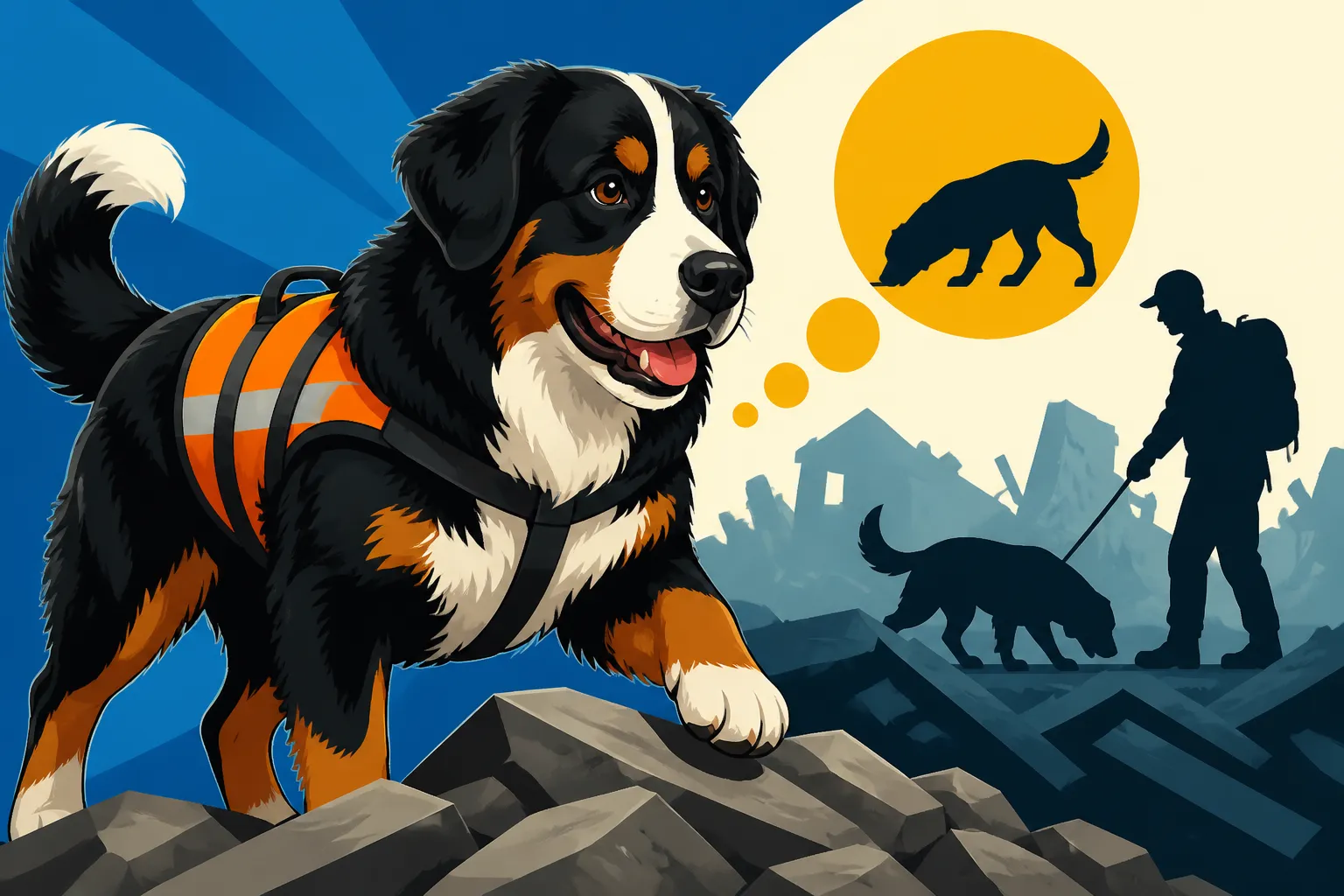
Whether a Bernese Mountain Dog Can Do Search Work
A Bernese Mountain Dog can learn scent work and may enjoy searching for people, objects, or hidden food. But a friendly, powerful dog is not automatically suited to search-and-rescue work: success depends on health, confidence, training, and the specific job. This guide explains what search work involves, how to get started safely, and how to tell whether your Berner is enjoying it.
What Search Work Means for a Bernese Mountain Dog
“Search work” covers several activities, from casual scent games at home to demanding operational search-and-rescue deployments. They share a dog’s ability to use its nose, but the training, physical demands, and standards are very different. It helps to know which one you have in mind before buying gear or signing up for a class.
Scent games, nosework, and tracking
At the simplest level, search work can mean teaching your dog to find a favorite toy, a treat, or a person hiding behind a tree. These games give a dog a clear job and let it use its nose without requiring long runs or rugged terrain. Many Berners enjoy this kind of activity because it can be adjusted to their pace and confidence.
Organized nosework builds on that idea. A dog learns to locate a particular scent in different places, such as boxes, rooms, or outdoor areas. Tracking is related but distinct: the dog follows a person’s ground trail, often by scent left along the route. Both activities can be taught recreationally, and neither automatically qualifies a dog to search for missing people in real emergencies.
A short search game can be as simple as asking your dog to wait while you hide a toy in an easy-to-find spot, then releasing the dog with a consistent cue. As your dog understands the game, make the hiding place slightly less obvious. Keep early sessions brief and end while your dog is still engaged. The goal is a happy, focused dog—not an exhausted one.
Search-and-rescue work is a bigger commitment
Search-and-rescue dogs may be trained for different tasks, including locating a person’s scent in an area, following a specific trail, or searching for people in particular environments. Each discipline asks for different skills. A dog that loves finding treats in the living room may enjoy recreational nosework but still find a busy search scenario too difficult or stressful.
Operational work also involves a trained handler, ongoing practice, and evaluation by the relevant team or organization. The dog must be able to work around unfamiliar people, changing conditions, distractions, and potentially difficult footing. The handler must learn to read the dog’s behavior and communicate clearly with the team. A dog’s enthusiasm is important, but it is only one part of readiness.
This distinction matters if you are imagining a Berner joining a real search team. Start by contacting established search-and-rescue organizations in your area and asking about their training pathway and expectations. Do not assume that completing a pet nosework class qualifies a dog for deployment. For other activities that may suit the breed, see Sports a Bernese Mountain Dog Can Do and Whether a Bernese Mountain Dog Can Herd.
Is a Berner a Good Candidate for Search Training
There is no single temperament profile that guarantees success. Bernese Mountain Dogs can be affectionate, people-oriented, and willing to work with their handler, but individual dogs vary. A good candidate is curious, able to recover after mild uncertainty, and motivated to keep searching without being pushed beyond their comfort level.
Strengths that may help
A Berner’s size and strength can be useful in some outdoor settings, and many enjoy spending time with their people. Their interest in working alongside a handler can make training rewarding. A dog does not need to be frantic or fast to do scent activities well; steady, thoughtful searching can be valuable in recreational training.
The breed’s working history can also prompt owners to explore practical activities. Berners were used for farm work, including pulling and moving goods, but historical work does not mean every modern Berner will have the same drive or stamina. A dog’s health, temperament, early experiences, and individual preferences matter more than assumptions based on breed. For background, read What a Bernese Mountain Dog Did on a Swiss Farm.
Your dog’s response to new places is worth observing. Does your Berner investigate new smells, take treats in unfamiliar settings, and return to you after a distraction? Does the dog recover after a dropped object or a sudden sound? These are useful observations to discuss with an instructor, not a pass-or-fail test you need to administer alone.
Limitations to take seriously
Berners are large dogs, and their body size can make strenuous work harder than it looks from the sidelines. Long searches over rough ground, repeated jumping, or extended exertion can be a poor fit for a dog with joint pain, reduced mobility, or another health concern. Ask your veterinarian about the activity level appropriate for your particular dog, especially if the dog is young, older, overweight, or has a history of lameness.
Heat is another practical concern. A thick coat and heavy build can make warm-weather activity risky, particularly during sustained exercise. Search training should be planned around safe conditions, with access to water, rest, shade, and a way to stop promptly if your dog seems distressed. An enthusiastic dog may continue trying even when it needs a break.
It is also completely fine if your Berner is not interested. Some dogs would rather follow an easy scent trail than work in an unfamiliar building or search around strangers. Others may be nervous, easily distracted, or physically unsuited to the more demanding forms of search work. For broader breed context, see The Kind of Home a Bernese Mountain Dog Belongs In and Whether a Bernese Mountain Dog Suits a Hiker.
| Activity | What the dog searches for | Typical starting point | Main consideration |
|---|---|---|---|
| Home scent games | Food or a favorite toy | Hide an item in an easy location | Keep it playful and brief |
| Recreational nosework | A trained scent | Beginner class or simple scent hides | Progress gradually and reward searching |
| Tracking | A person’s trail | A short, uncomplicated trail | Work with an instructor on setup and safety |
| Search-and-rescue training | People or a defined scent target | An established team or organization | Requires substantial handler training and evaluation |
How to Get Started Without Overfacing Your Dog
A gradual start gives you a clearer picture of what your dog enjoys. It also helps prevent a common beginner mistake: making the search too difficult too soon, then assuming the dog lacks ability when it is actually confused or tired.
Begin with an easy win
Choose a quiet place your dog knows and a reward that genuinely matters to them. For some dogs, that is a treat; for others, it is a favorite toy or a chance to greet a familiar person. Let the dog see the reward being hidden at first, then use a simple cue such as “find it.” When the dog reaches the target, praise and reward promptly.
Once your Berner understands the game, hide the reward where it is still easy to find but not immediately visible. Give your dog time to investigate rather than pointing, repeating the cue, or guiding them to the answer. If the dog gets stuck, make the next search easier. This keeps the activity understandable and helps build confidence.
Keep track of what you see after each search. Does your dog use its nose, stay engaged, and appear pleased when it finds the target? Or does it start wandering, pant heavily, seek you out, or lose interest? Those reactions can help you decide whether to shorten the session, simplify the search, or try a different activity. For general training principles, Training a Bernese Mountain Dog Without Breaking It and Training Sessions Short Enough for a Bernese Mountain Dog offer useful related guidance.
Find a suitable class or organization
For recreational scent work, look for an instructor who welcomes beginners and explains how sessions are structured. A good class should allow dogs to learn at a manageable distance from one another, offer breaks, and adapt the setup if a dog is hesitant. Ask whether the instructor has experience with large breeds and how they handle dogs that become worried or overexcited.
For tracking or search-and-rescue training, ask more specific questions before committing. What skills do dogs need before joining? How much time does the handler need to practice? What environments will the dog encounter? What health and safety considerations does the group address? If you are looking for operational work, ask the local team directly about its training and evaluation process rather than relying on a general pet-training class.
You do not need specialist equipment to try a basic game at home. A comfortable harness, a standard leash, water, and rewards are enough for many beginner activities. If you are assembling a basic outing kit, Chewy is one place owners may look for everyday supplies such as treat pouches or travel bowls; check that any equipment fits your dog and suits the instructor’s advice. A long line can be useful for some outdoor exercises, but it needs to be handled safely and should not be used around obstacles where it could snag.
Keeping Search Work Safe and Enjoyable
A sustainable routine is more valuable than an impressive-looking session. With a large dog, especially one prone to overheating or joint strain, it pays to think about the surface, weather, duration, and recovery as carefully as the search itself.
Adjust the work to your dog
Start with short sessions and simple searches. Add difficulty in small steps: perhaps a less obvious hiding place, a new room, or a slightly different outdoor setting. Change only one part at a time. If you make the target harder to find and move to a noisy, unfamiliar location in the same session, it can be difficult to know what overwhelmed your dog.
Build in water and rest, and avoid strenuous searching during hot parts of the day. Watch for heavy or unusual panting, slowing down, lagging behind, seeking shade, or seeming unsteady. Stop the activity if you are concerned, move your dog to a cooler place, and contact a veterinarian when symptoms are serious or do not improve. Do not try to coax a tired dog through one last search.
Make sure your dog can move comfortably on the surfaces you choose. Deep footing, steep slopes, slippery floors, and repeated jumping may increase physical demands. If your dog has a limp, stiffness, or a change in willingness to move, pause training and speak with your veterinarian rather than treating reluctance as stubbornness. The more demanding the activity, the more important it is to get advice tailored to your dog’s health.
Read your dog’s motivation, not just its performance
A dog that finds the target quickly is not necessarily having a good time, and a dog that searches slowly is not necessarily failing. Look at the whole picture: whether your dog is willing to begin, remains interested, recovers from small surprises, and enjoys the reward. If your Berner repeatedly tries to leave, avoids the search area, or seems distressed, make the activity easier or stop.
Rewarding the search itself helps prevent the game from becoming a test. Praise your dog for investigating and following the scent, even if the first attempt is not perfect. Avoid scolding or physically directing the dog to a hidden target. If you need help deciding how to build the exercise, an experienced instructor can suggest a simpler setup.
Everyday supplies can make practice more comfortable without turning it into a complicated project. A dedicated pouch can keep treats handy, while a collapsible bowl helps make water breaks easier on an outing. Chewy may be one option for finding general pet supplies, but the most important choice is gear that fits securely and does not interfere with your dog’s movement. If your dog is working in a class, follow the instructor’s requirements before buying specialized equipment.
A Bernese Mountain Dog can absolutely participate in search activities, and many owners find scent games a satisfying way to work with their dog. Whether that means finding a toy in the yard or training toward a formal search discipline depends on the individual dog, the handler, and the physical demands involved. Keep the first steps easy, ask for guidance when the work becomes more complex, and let your Berner’s health and enthusiasm shape the plan. For a wider look at the breed’s learning style, see Whether a Bernese Mountain Dog Learns Slowly.
Disclaimer
This article is for general informational purposes only and does not constitute professional advice. Laws, prices and regulations vary by location and change over time. Consult a qualified professional for guidance on your specific situation.