A Bernese Mountain Dog That Steals Food
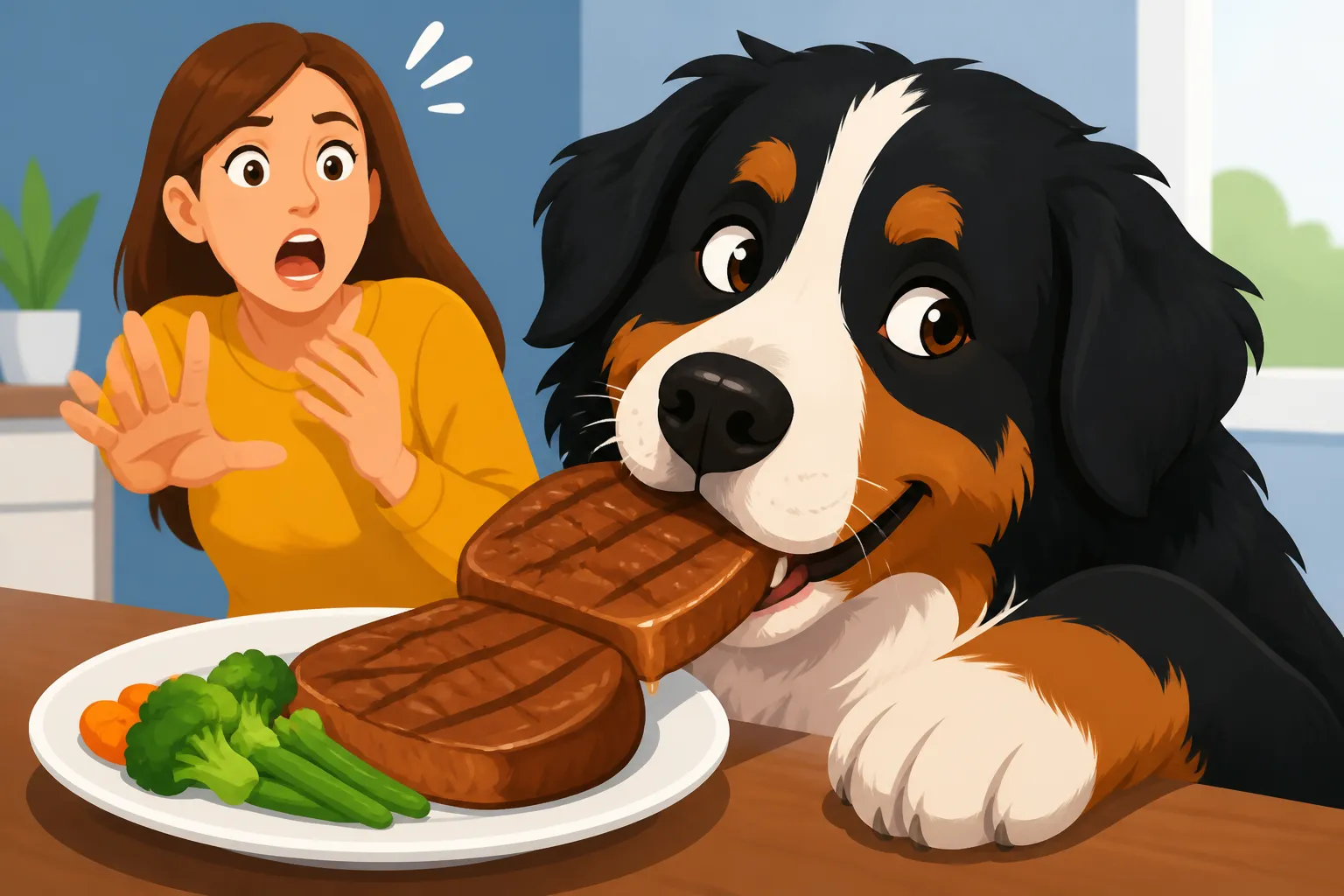
Oh, the sheer frustration of walking into the kitchen only to find that your majestic, seemingly well-behaved Bernese Mountain Dog has once again decided that your freshly baked pie or last night's dinner leftovers were simply begging to be sampled. It's a tale as old as time for many Berner owners – these gentle giants have an uncanny ability to become stealthy, opportunistic counter-surfers and food thieves, leaving you wondering how such a large dog could be so quick and quiet. This guide is here to help you understand why your beloved Berner develops this habit and, more importantly, how to put a stop to it before your culinary creations become their next snack.
Understanding Why Your Bernese Mountain Dog Becomes a Food Thief
It’s easy to feel personally offended when your Bernese Mountain Dog helps themselves to food they shouldn't have. After all, they look at you with those big, soulful eyes, full of such innocence! But for dogs, and especially a breed with the historical background of a Bernese Mountain Dog, food acquisition isn't about disrespect; it’s often deeply rooted in instinct, opportunity, and learned behavior.
Firstly, let's consider their heritage. Bernese Mountain Dogs originally served as all-around farm dogs in the Swiss Alps, where they might have been expected to scavenge for food or be fed scraps. While our modern Berners are far removed from those working days, a faint echo of that opportunistic nature can still reside within them. They are generally intelligent dogs, and if they discover that exploring the countertop or a low-lying table yields a tasty reward, they will absolutely remember that success. It’s a classic case of positive reinforcement: dog steals food, dog eats delicious food, dog learns stealing food is rewarding. This cycle can be incredibly powerful and hard to break once established.
Then there's the simple fact of their size. A smaller dog might only be able to reach items on the very edge of a coffee table, but a full-grown Bernese Mountain Dog stands tall enough to easily inspect countertops, dining tables, and even some pantry shelves. What seems like a safe height for other breeds is just eye-level for a curious Berner. They can lean, stretch, and use their paws with surprising dexterity to knock things down, all without making much fuss until the crunching begins. Their sheer presence makes many household surfaces potential targets.
Sometimes, food stealing can also stem from boredom or a lack of appropriate mental and physical stimulation. A Bernese Mountain Dog, while not hyperactive, is still a working breed that thrives on routine, activity, and engagement. If they're left alone for long periods without adequate exercise, interactive toys, or mental puzzles, they might seek out their own entertainment. The thrill of exploring the kitchen for hidden treasures, successfully snagging a forbidden treat, and enjoying the spoils can be a highly stimulating game for a bored Berner. This isn't to say they're intentionally mischievous, but rather that an idle mind can lead to creative (and inconvenient) ways to pass the time. It’s worth checking in with their overall routine; an under-stimulated Bernese might develop other undesirable habits too.
Immediate Prevention: Securing Your Home Against the Berner Bandit
When you have a Bernese Mountain Dog who has discovered the joy of counter-surfing or raiding bins, the very first step is to manage the environment. Training takes time, and during that time, every successful theft reinforces the behavior. Think of yourself as a master strategist, outsmarting your clever Berner before they even get the chance to fail.
The golden rule here is simple: if you don't want your Bernese Mountain Dog to steal it, don't leave it out. This means adopting a "nothing on the counters" policy, especially for food items. That half-eaten sandwich, the cooling tray of cookies, the fruit bowl – they're all potential targets. Get into the habit of immediately clearing the dining table and wiping down counters after cooking or eating. Store all food in cupboards, the refrigerator, or in dog-proof containers. Even seemingly innocuous items like mail or keys might get swept off if your Berner is searching for something else, so a clean surface is a safe surface.
For food waste, investing in a heavy-duty, dog-proof trash can is an absolute must. Many standard kitchen bins are easily tipped over or have lids that a smart Berner can figure out. Look for bins with a secure latching mechanism, foot pedal locks, or even ones designed to be mounted inside a cabinet. Remember, a Berner’s nose is powerful, and the scent of discarded food is an irresistible magnet. Leaving a bag of trash by the back door "just for a minute" is an open invitation for a Bernese Mountain Dog to investigate and quite possibly redecorate your home with its contents.
During mealtimes, when the delicious smells are most potent and temptations are highest, consider crating your Bernese Mountain Dog or confining them to another room with a sturdy baby gate. This removes the opportunity entirely and helps teach them that human mealtimes are not their foraging time. Make sure they have a comfortable bed, a safe chew toy, or a puzzle toy to keep them occupied and happy while you eat. If you use a crate, ensure it's appropriately sized and a positive space for them. Crates and Gates for a Bernese Mountain Dog can provide more detail on selecting the right setup.
You can also leverage some handy tools for prevention. Companies like Amazon offer a wide range of child-proof locks for cabinets and pantries, which work just as well for curious canine paws. You might also find pressure-sensitive mats that emit a harmless, startling sound when stepped on. These can be placed strategically in front of counters or bins, acting as a deterrent. However, these tools should be used with caution and not as a substitute for training, as some sensitive Berners might find them too alarming. The goal is to make the undesirable behavior unrewarding, not scary.
| Prevention Strategy | Description | Pros | Cons |
|---|---|---|---|
| Counter Clearance | Removing all food items from accessible surfaces. | Most effective immediate solution; prevents reinforcement. | Requires consistent human effort; easy to forget. |
| Dog-Proof Bins/Cabinets | Using secure bins and child locks on pantries. | Blocks access to high-value targets (trash, stored food). | Initial investment cost; Berners can be surprisingly clever. |
| Crating/Confinement | Restricting access to the kitchen during human mealtimes or absences. | Eliminates opportunity entirely; can be part of a routine. | Requires a dedicated space; might not address underlying issues. |
| Pressure Mats/Alarms | Electronic deterrents that create a sound or sensation when activated. | Can create a negative association with the forbidden area. | Some dogs are unfazed; can be overly startling for sensitive Berners. |
| Enrichment Toys | Providing puzzle toys or long-lasting chews when unsupervised. | Redirects energy and attention; reduces boredom-driven theft. | Doesn't directly prevent counter-surfing; only addresses a root cause. |
Training Your Bernese Mountain Dog for "Leave It" and "Stay"
While managing your environment is crucial for immediate relief, the long-term solution lies in solid training. Teaching your Bernese Mountain Dog commands like "leave it" and "stay" empowers them to make good choices even when temptation strikes, strengthening your bond and their self-control.
"Leave It": The Ultimate Self-Control Command
This is perhaps the most important command for a food-stealing Bernese Mountain Dog. It teaches them to ignore an item, even if it's right in front of them. Start simple, in a quiet, distraction-free environment.
- Low-Value Item: Hold a low-value treat (like a piece of kibble) in your closed fist.
- Say "Leave It": Present your fist to your Berner. The moment they sniff, lick, or paw at it, say "Leave It."
- Wait for Disengagement: Wait for them to disengage – even if it's just looking away for a second.
- Reward: As soon as they look away, praise them enthusiastically and reward them with a different, higher-value treat from your other hand or pocket. The key is to never let them get the "leave it" item.
- Progression: Gradually increase the difficulty:
- Place the low-value treat on the floor, cover it with your hand, say "Leave It," and reward when they look away.
- Place the treat on the floor, gradually remove your hand, still saying "Leave It."
- Introduce slightly higher-value treats.
- Practice in more distracting environments (e.g., in the kitchen, with other family members).
- Slowly increase the duration they have to "leave it" before being rewarded.
"Stay": The Foundation of Patience
A reliable "stay" command helps keep your Berner out of trouble when you need to step away for a moment.
- "Sit" First: Ask your Bernese Mountain Dog to "Sit."
- "Stay" and Step Away: Say "Stay" and take one small step back.
- Return and Reward: If they remain, immediately step back to them, praise, and reward.
- Increase Distance/Duration: Gradually increase the distance you step away and the length of time they need to "stay" before returning to them to reward.
- Add Distraction: Once they're solid with distance and duration, start introducing minor distractions, such as you moving around the room or another family member walking past. Eventually, you'll want to practice "stay" with tempting smells in the kitchen.
Consistency is absolutely vital with these commands. Everyone in the household needs to use the same cues and follow the same rules. Your Bernese Mountain Dog needs to know that "leave it" means the same thing no matter who says it or where they are. Using positive reinforcement, with high-value treats and enthusiastic praise, will make training a fun and rewarding experience for your Berner. Online resources, such as BAXTER & Bella's comprehensive puppy training programs, often include detailed modules on these foundational commands, providing step-by-step guidance that can be incredibly helpful for any dog owner, especially those dealing with a growing, food-motivated Bernese Mountain Dog. Remember, your Berner wants to please you, and clear, consistent training helps them understand how to do that. Teaching a Bernese Mountain Dog to Lie Down and Teaching a Bernese Mountain Dog to Stay Put are excellent companion resources for these training efforts.
When Your Berner is a Master Thief: Advanced Strategies and Realistic Expectations
So, you've tried everything – the counters are sparkling clean, the bins are triple-locked, and you've been practicing "leave it" until you're blue in the face. Yet, your Bernese Mountain Dog still finds that rogue crumb or manages to liberate a forgotten snack. What then? For persistent food thieves, it’s important to layer your approach and manage your expectations.
First, let's be realistic: some Bernese Mountain Dogs are simply going to be more food-motivated and opportunistic than others. While training can build incredible impulse control, an unattended, high-value food item on an accessible surface will always be a powerful temptation. This means environmental management isn't just a temporary fix while training; it’s an ongoing necessity for many years, especially when you're not actively supervising. You might achieve a point where your Berner could ignore a forgotten plate, but why put them in that position? It's often easier and more reliable to remove the temptation entirely than to constantly test their willpower.
Consider adding layers of prevention. If your Berner is a particular counter-surfing menace, think about what they can reach. Are they jumping, or just stretching? Sometimes, placing something that makes noise and falls easily (like a stack of empty soda cans on the very edge of the counter, out of reach of your hands but where a nudging nose would send them clattering) can provide a startling, harmless deterrent when you're not there. This isn't about punishment, but about creating an immediate, negative consequence for the act itself. This is often more effective than you trying to 'catch' them, as they learn not to steal when you're watching, but to carry on when you're not.
If you suspect underlying issues beyond simple opportunism, such as anxiety leading to destructive foraging when left alone, or true hunger due to an inadequate diet, it’s time to consult with a veterinarian or a certified professional dog trainer. Sometimes, what looks like naughty behavior can be a sign of discomfort or stress. A Bernese Mountain Dog can be quite sensitive, and anxiety about being left alone can manifest in various ways, including destructive behaviors that might involve seeking out food. A Bernese Mountain Dog That Cannot Bear Being Left provides valuable insights into separation-related behaviors.
Finally, remember that training is a journey, not a destination. Even a well-trained Bernese Mountain Dog can have an off day, or be tempted by an unusually irresistible scent. Be patient, be consistent, and never give up. Celebrate small victories – every time they "leave it" when asked, every mealtime they calmly settle in their designated spot. If you find yourself truly stuck or frustrated, don't hesitate to seek out a professional dog trainer who specializes in positive reinforcement. They can offer personalized advice and help you troubleshoot specific challenges with your Bernese Mountain Dog. A training program like those offered by BAXTER & Bella can also provide ongoing support and a structured curriculum to help you tackle even the most ingrained habits.
Disclaimer
This article is for general informational purposes only and does not constitute professional advice. Laws, prices and regulations vary by location and change over time. Consult a qualified professional for guidance on your specific situation.