When It Is Too Hot to Train a Bernese Mountain Dog
One of the biggest heartbreaks for a Bernese Mountain Dog owner is wanting to spend quality time with their beloved companion, especially when it comes to training and exercise, only to find the weather is working against them. These magnificent dogs, with their thick double coats and large bodies, are incredibly susceptible to overheating, which can quickly turn a fun training session into a life-threatening emergency. This guide is here to help you navigate the challenges of hot weather, offering practical advice and strategies to ensure your Berner stays safe, cool, and engaged, even when the mercury rises.
Understanding Heat Stress in Bernese Mountain Dogs
It’s crucial to recognize that Bernese Mountain Dogs are not built for heat. Their natural heritage is rooted in the chilly, alpine regions of Switzerland, where their dense coats served as vital insulation against snow and cold. This genetic predisposition means they struggle immensely when temperatures climb. As their guardian, understanding this fundamental aspect of their physiology is the first step in protecting them.
Why Berners Are Prone to Overheating
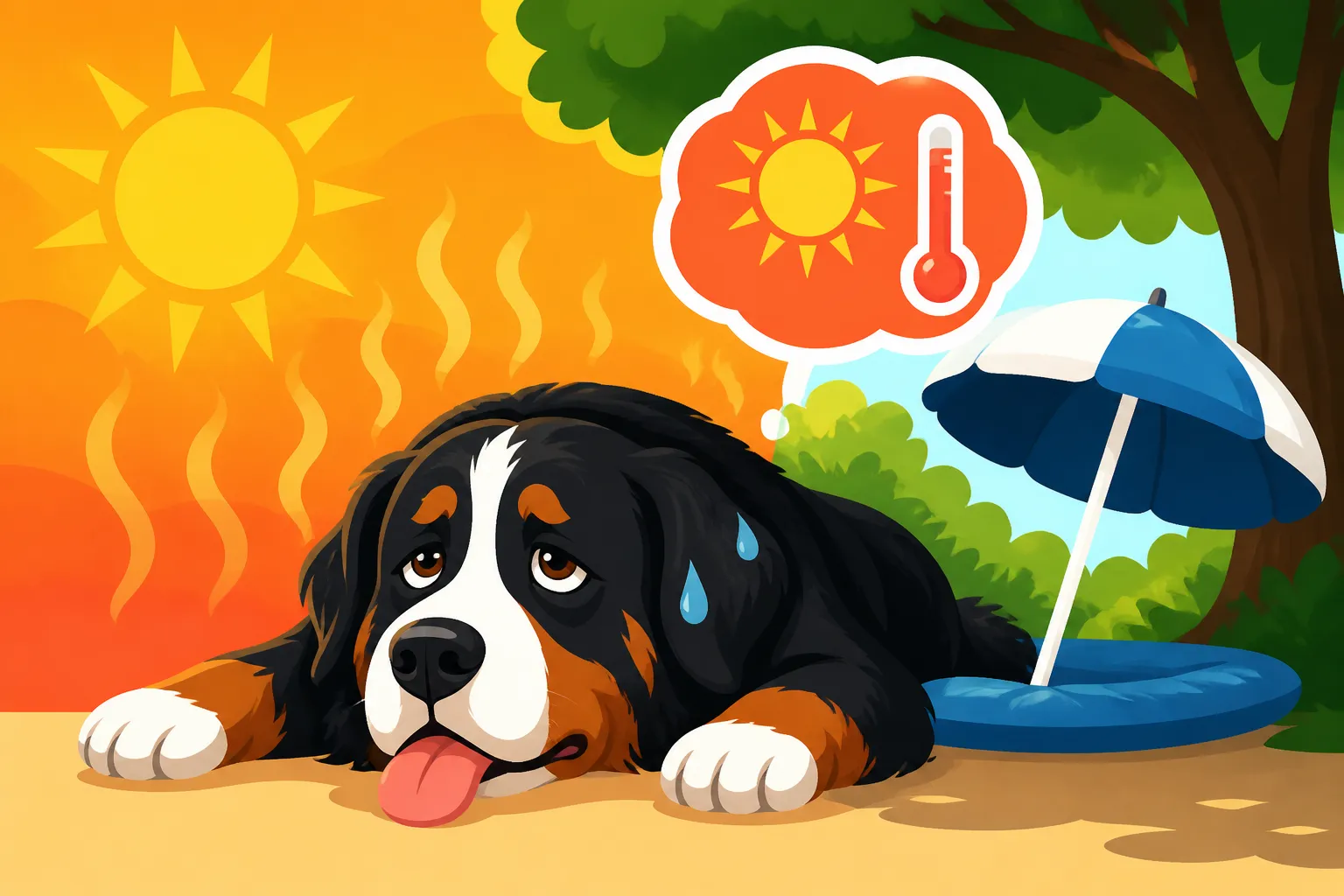
Imagine wearing a heavy wool coat in summer, and then trying to run a marathon. That's a bit like what a Bernese Mountain Dog experiences in warm weather. Their iconic, luxurious double coat, while beautiful, acts as an incredibly efficient insulator. In winter, this is a blessing, trapping warm air close to their body. In summer, however, it traps heat in, making it incredibly difficult for them to cool down. It’s a common misconception that shaving their coat helps, but often, that can do more harm than good by removing their natural insulation and exposing their skin to harmful UV rays. Beyond their coat, their sheer size also contributes to the problem. Larger bodies generate and retain more heat, and they have a smaller surface area relative to their mass for cooling compared to smaller breeds. They simply don't have the same heat-dissipating mechanisms as breeds designed for warmer climates. We've talked extensively about Heat and the Bernese Mountain Dog's Black Coat before, and it bears repeating: their dark coloring absorbs even more solar radiation, exacerbating the problem.
Furthermore, while Bernese Mountain Dogs aren't typically classified as brachycephalic (short-nosed) like Bulldogs or Pugs, some lines can have heavier jowls or a slightly shorter muzzle structure than is ideal for optimal breathing, which can somewhat restrict airflow. Their panting, which is their primary cooling mechanism, might not be as efficient as a dog with a longer, more open airway. All these factors combined create a perfect storm for heat stress, making careful management of their activity levels in warm weather absolutely non-negotiable for their health and safety.
Recognizing the Early Signs of Heat Stress
Spotting the subtle hints that your Bernese Mountain Dog is struggling with the heat can literally be a lifesaver. It’s not always as obvious as a dog collapsing; often, the initial signs are much more nuanced. The first thing you'll likely notice is excessive panting. While panting is normal for dogs to regulate body temperature, look for panting that is rapid, deep, and continuous, seeming disproportionate to their activity level or the ambient temperature. If their panting sounds labored, or they start to produce foamy saliva, it's a huge red flag.
Another key indicator is their demeanor. A Berner usually has a zest for life, but a dog experiencing heat stress might become unusually lethargic, slow to respond, or actively seek out shade, even refusing to move forward on a walk. Their gums might appear a brighter red than usual, or even pale, and their saliva can become thick and sticky. They might also appear disoriented or uncoordinated. Pay close attention to these changes. It's not just about stopping the activity; it's about immediate intervention. Don't wait until they're collapsing. We go into more detail on How a Bernese Mountain Dog Behaves Before Heat Stroke, which is vital reading for any Berner owner facing warm weather.
The Dangers of Overexertion in Heat
The transition from early heat stress to a full-blown emergency can be incredibly swift, especially with a breed as vulnerable as the Bernese Mountain Dog. Overexertion in hot weather pushes their internal temperature beyond a safe threshold, leading to heat exhaustion, and if not addressed immediately, heatstroke. Heatstroke is a severe and potentially fatal condition where the body's cooling mechanisms fail, causing a rapid rise in core body temperature. This extreme heat can cause widespread damage to internal organs, including the kidneys, liver, heart, and brain.
The consequences can be devastating, ranging from acute kidney failure and clotting disorders to neurological issues like seizures, tremors, and even permanent brain damage. Even if a dog survives heatstroke, they may suffer lasting health problems. This isn't just about discomfort; it's about life or death. An emergency vet visit for heatstroke is not only incredibly stressful but can also be financially taxing, with extensive hospitalization, IV fluids, and monitoring often required. The most heartbreaking outcome, of course, is the loss of your beloved companion. It’s a stark reminder that on a hot day, pushing your Berner for "just a few more minutes" of play or training simply isn't worth the risk. If you find yourself in a situation where your dog has collapsed, our guide on Cooling a Collapsed Bernese Mountain Dog in the Field offers crucial immediate steps.
Optimal Training Strategies for Hot Weather
Since completely abandoning training during warmer months isn't practical or fair to your Berner, the key lies in intelligent adaptation. This means rethinking when, where, and how you train to prioritize their safety above all else. With a little planning and flexibility, you can continue to engage your Bernese Mountain Dog without putting them at risk.
Timing Your Training Sessions
The time of day you choose for training is perhaps the single most critical factor in hot weather. Forget about mid-day walks or afternoon play sessions; those hours are simply too dangerous for a Bernese Mountain Dog. The absolute best times are typically very early morning, just as the sun is rising or even before, and late in the evening after the sun has set and the air has had a chance to cool down considerably. We're talking 5 or 6 AM, or after 8 or 9 PM, depending on your climate.
Always check the local weather forecast, but don't just look at the air temperature. The ground temperature is equally, if not more, important. Asphalt, concrete, and even darker-colored sidewalks can retain and radiate heat long after the sun goes down, becoming dangerously hot for your dog's sensitive paw pads. Imagine walking barefoot on a hot sidewalk – if it's too hot for your hand for more than a few seconds, it's too hot for their paws. Our article Pavement Temperature and a Bernese Mountain Dog's Pads explores this in detail. Even if the air feels cooler, radiating heat from the ground can contribute significantly to overheating. Be aware that even in the early morning, if there's been a series of hot days, paved surfaces might still be radiating heat from the previous day. So, always touch the pavement yourself. For specific guidance on ideal activity times, The Only Hours a Bernese Mountain Dog Walks in July gives practical timeframes to follow.
Choosing the Right Training Environment
Where you train your Bernese Mountain Dog during hot weather can make all the difference between a safe session and a risky one. The primary goal is to find environments that offer maximum shade and cooler surfaces. Think large, mature trees that provide dense canopy cover, covered patios, or even indoors if you have air conditioning. Natural grass can be significantly cooler than paved surfaces, but even grass can get warm in direct sun, especially if it's been exposed for hours.
Avoid direct sunlight at all costs. This means staying away from open fields, unshaded parks, and any areas with dark asphalt or concrete. If training outdoors, aim for wooded trails or parks with plenty of tree cover that block the sun's rays. Inside your home, a cool, well-ventilated room with air conditioning is ideal for mental games and gentle obedience practice. Even better, consider a specialized dog training facility that has climate control. Creating an optimal indoor environment is discussed further in Keeping a Room Cool Enough for a Bernese Mountain Dog, offering tips on making your home a cool oasis. If you find yourself in a bind with no good outdoor options, Training a Bernese Mountain Dog Indoors in Summer provides excellent strategies for continuing progress without the heat risk.
Adjusting Training Intensity and Duration
When it's hot, your training approach needs a complete overhaul. This is not the time for high-impact exercises, long walks, or demanding physical tasks. Instead, focus on shorter, more frequent sessions that prioritize mental stimulation and reinforcement of basic obedience rather than intense physical exertion. Think five to ten-minute bursts of training, followed by ample rest in a cool spot.
These shorter sessions can be incredibly effective for focus and retention, as your Berner won't have the chance to become overtired or overheated. Use this time to practice skills like "stay," "leave it," or impulse control games indoors. Scent work, puzzle toys, and trick training are fantastic ways to engage their minds without raising their body temperature significantly. This is where resources like BAXTER & Bella, an online puppy school, can be really helpful, offering structured indoor activities and mental enrichment ideas that don't rely on strenuous physical exercise. These types of programs can guide you through creative ways to keep your Berner learning and happy even when outdoor activities are limited.
Remember, consistent, gentle practice is far more valuable than sporadic, intense sessions that carry heat risk. Prioritize enjoyment and safety over achieving specific physical milestones during these periods. For more insights on how to structure your sessions effectively, take a look at Training Sessions Short Enough for a Bernese Mountain Dog.
Keeping Your Berner Cool During Training
Beyond careful planning, proactive measures to keep your Bernese Mountain Dog cool are essential. Even during short, low-intensity sessions in acceptable temperatures, having cooling aids on hand can make a significant difference in their comfort and safety. Think of it as building a multi-layered defense against the heat.
Hydration is Key
This might seem obvious, but proper hydration is absolutely non-negotiable for a Bernese Mountain Dog, especially when there's any activity involved in warmer weather. Always, and I mean always, have fresh, cool water readily available. Before, during, and after any training session, offer your Berner water. Don't wait for them to show signs of thirst; proactively encourage them to drink every few minutes.
When you're out and about, whether it's for a quick morning potty break or a shaded training session, carry a portable water bottle and a collapsible bowl. There are many excellent options available on Amazon, from water bottles with built-in dispensers to soft silicone bowls that fold flat. Avoid giving them ice-cold water if they are already hot, as this can sometimes cause stomach upset or a shock to their system; cool water is perfect. If they seem reluctant to drink, you can try adding a splash of low-sodium chicken broth to entice them. Proper hydration helps their body regulate its temperature more effectively, acting as a natural internal cooling system.
Utilizing Cooling Gear and Techniques
Thankfully, the market for pet cooling products has expanded considerably, offering several tools that can help keep your Bernese Mountain Dog comfortable. Cooling vests and bandanas work by retaining water and slowly evaporating it, drawing heat away from your dog's body. These can be particularly effective during those crucial early morning or late evening walks. You simply wet them, wring them out, and put them on your Berner. Brands available on Amazon often feature reflective materials and lightweight designs specifically for larger breeds.
Another fantastic option is a cooling mat. These mats often contain a gel that activates with pressure, providing a cool surface for your Berner to lie on, or some are designed to be filled with water and frozen. Placing one of these in their favorite resting spot can be a game-changer for their comfort indoors or in a shaded outdoor area. Don't underestimate the power of simple water! A shallow wading pool in the yard can be an absolute lifesaver. Many Berners adore splashing around in a few inches of cool water, which helps to rapidly cool their paw pads and belly—areas where they can dissipate heat more efficiently. Even a sprinkler can offer a quick cool-down. Our article, Whether a Bernese Mountain Dog Swims to Cool Off, explores water activities in more detail. Remember to rotate these methods and find what works best for your individual dog. For a comprehensive look at what's available, check out Cooling Gear for a Bernese Mountain Dog.
| Cooling Method | Pros | Cons | Best Use Case |
|---|---|---|---|
| Cooling Vests/Bandanas | Portable, active cooling, covers large area | Requires re-wetting, can get dirty | Walks, light outdoor activity, travel |
| Cooling Mats | Passive cooling, no power needed, reusable | Stationary, may not cover entire body | Resting indoors/shaded outdoors, post-exercise |
| Wading Pools/Sprinklers | Fast, full-body cooling, fun for dogs | Requires yard/space, can be messy | Playtime in the yard, emergency cool-down |
| Shade | Natural, free, always available | Limited availability, doesn't cool air | Any outdoor activity, essential for resting |
| AC/Fans | Consistent cooling, humidity control | Requires electricity, indoors only | Indoor training, heat relief at home |
Knowing When to Call It Quits
This is arguably the most important piece of advice: always, always, always err on the side of caution. Your Bernese Mountain Dog cannot tell you in words that they are overheating, and their stoic nature might even lead them to push past their limits to please you. It is your responsibility to be their advocate. If you see any of the early signs of heat stress – even just a slight increase in panting, a slower pace, or a desire to lie down – stop the activity immediately.
Do not try to push through, hoping they will be fine. That "just five more minutes" can be the difference between a mild discomfort and a severe medical emergency. Get them into a cool, shaded area, offer water, and begin active cooling methods. This might mean shortening a walk, canceling a planned training session, or simply moving your indoor training to a later, cooler time. Respect their limitations, especially when you know their breed is particularly vulnerable. There will always be another day to train. Their health and well-being must always come first. Understanding The Temperature a Bernese Mountain Dog Stops Coping will give you a clearer picture of their inherent limits and when it’s simply too hot to ask anything of them. Never feel guilty about putting your dog's safety first; it's the sign of a truly dedicated Berner parent.
Disclaimer
This article is for general informational purposes only and does not constitute professional advice. Laws, prices and regulations vary by location and change over time. Consult a qualified professional for guidance on your specific situation.