Tracking With a Bernese Mountain Dog
It’s easy to look at our big, fluffy Bernese Mountain Dogs and think of them primarily as gentle giants, perfect for cuddling on the couch or a leisurely stroll around the block. But beneath that stunning coat lies a dog with a rich working history and an incredible sense of smell, often underutilized in our modern lives. Many Berner owners find themselves wondering if there's a more engaging activity that taps into their dog's natural instincts, something beyond just fetch, and often overlook scent work or tracking. This guide is here to tell you that not only can a Bernese Mountain Dog excel at tracking, but it can also be one of the most rewarding activities you share, offering mental stimulation, physical exercise, and a fantastic way to deepen your bond.
Unlocking the Bernese Mountain Dog's Hidden Scenting Potential
When we think of tracking dogs, images of sleek, focused bloodhounds or German Shepherds often come to mind. It's easy to dismiss our Berners as being too laid-back or too "slow" for such an intricate sport. But let me tell you, that would be a mistake! Bernese Mountain Dogs possess a remarkable sense of smell and a natural inclination to follow scents, a trait deeply rooted in their history.
The Instincts Born in the Swiss Alps
Imagine their ancestors in the Dürrbach Valley, not just pulling carts of milk or cheese to market, but also searching for lost livestock or even people. Their ability to navigate varied terrain, often in challenging weather, relied heavily on their noses. They weren't just sight hounds; they were dogs that understood the world through scent. This ancestral wiring means that while your Berner might seem content to nap, a hidden desire to work that nose is just waiting to be awakened.
Think about how your Berner sniffs every blade of grass on a walk, or how they can find that tiny dropped treat even when you've lost sight of it. That's not just casual sniffing; that's their brain actively processing a world of odors we can barely comprehend. Tracking harnesses this innate ability, giving them a purpose that is both mentally exhausting and incredibly satisfying. It’s a wonderful way to honor their heritage and let them do what they were, in part, bred to do. You might find that the very qualities that make them wonderful companions—their steady nature, their desire to please, and their stamina—also make them surprisingly adept trackers.
Patience, Power, and a Nose for the Trail
One of the beautiful things about a Bernese Mountain Dog's temperament is their calm, thoughtful approach to tasks. While some high-drive breeds might launch into a track with explosive energy, a Berner often approaches it with a more methodical, deliberate pace. This can be a huge advantage in tracking, where patience and precision are often more valuable than speed. They have the physical endurance to follow a scent trail for a good distance, and their natural desire to work alongside their human companions makes them eager students.
I've seen Berners meticulously follow faint trails that other dogs struggled with, simply because they have the focus and the drive to stick with it. It’s not about being the fastest, but about being the most accurate and persistent. Their strong desire to stay connected to you, their handler, also translates well into tracking, where teamwork is paramount. You become a crucial part of their process, interpreting their signals and guiding them, even as they lead the way with their nose. This shared experience creates an incredibly strong bond, unlike almost any other activity. For those moments when you feel your Berner is being stubborn, tracking can be a wonderful exercise in mutual understanding and trust.
The First Steps to Tracking Success with Your Berner
Embarking on the tracking journey with your Bernese Mountain Dog doesn't require a special field or a lifetime of experience. It simply requires a little patience, some basic equipment, and a willingness to learn alongside your dog. The core principle is positive reinforcement, making every step of the process fun and rewarding.
Making Scent Games a Part of Daily Life
Before you even think about official tracking, start with simple scent games in your own home or yard. This warms up their nose and brain. Hide a favorite high-value treat under a cup, or toss a handful of kibble into the grass and encourage them to "find it." The key is to make it a game, something enjoyable. You can even hide yourself in a familiar spot in the yard and have your Berner "find" you. Praise them enthusiastically when they succeed! This builds their confidence and teaches them that using their nose leads to good things.
Another great way to start is with a "scent article" game. Take a small, absorbent item like a leather glove or a piece of cloth, rub your hands all over it to get your scent on it, and then hide it in an easy spot while your Berner watches. Release them with a "find it!" command. As they get better, make the hides harder, out of sight, and then gradually introduce a very short, straight line where you drag the item before hiding it. This is the foundation of them understanding a "track." Remember that What a Bernese Mountain Dog Will Actually Work For is often food or high-value toys, so use these motivators wisely.
Essential Gear for the Budding Tracker
You don't need a huge investment to start. The most critical pieces of equipment are a comfortable harness and a long line.
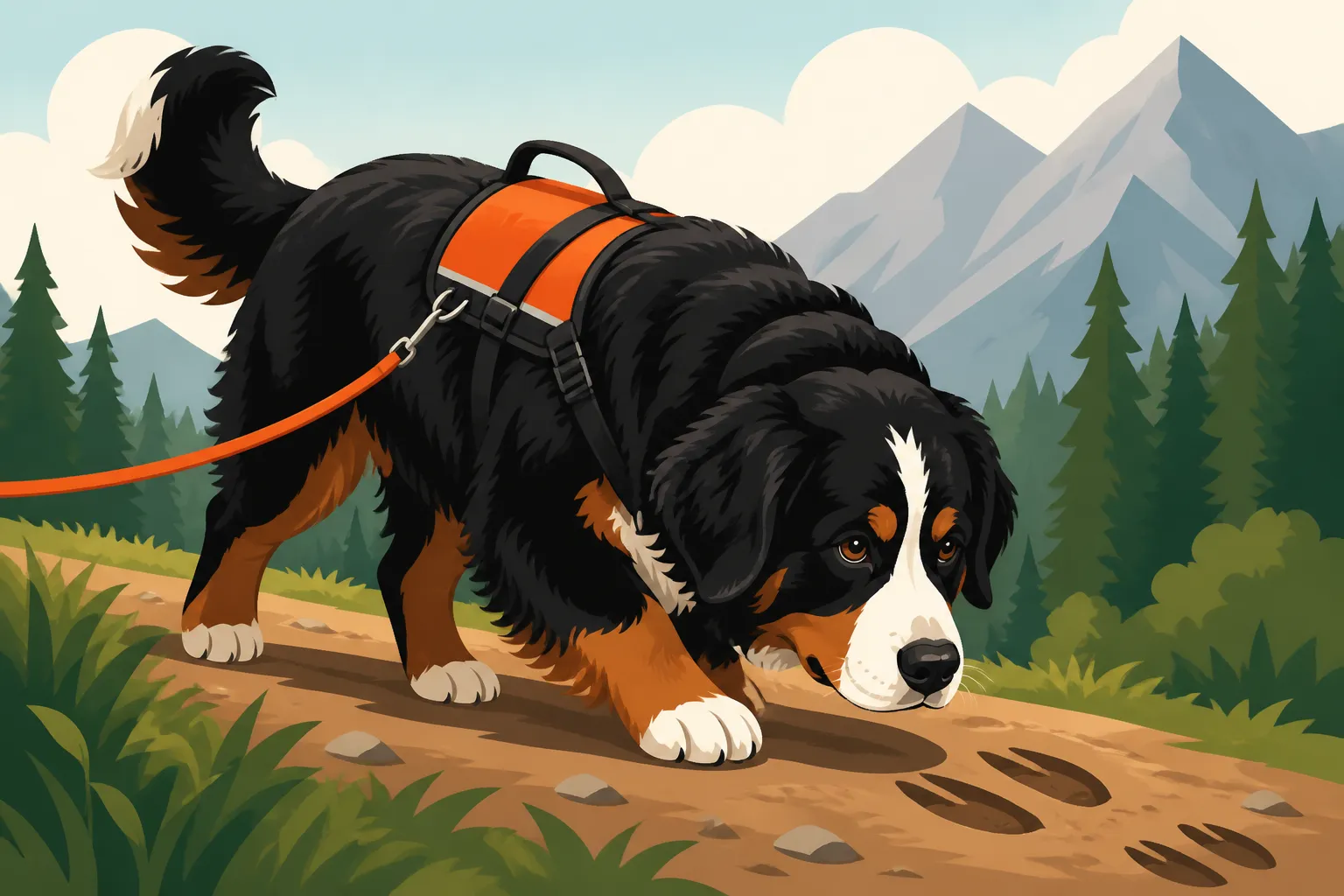
- Tracking Harness: This is different from a regular walking harness. A tracking harness is designed to sit farther back on your dog's torso, usually behind their front legs, allowing for unrestricted shoulder movement. This is crucial as your Berner will be pulling slightly into the harness as they follow the scent. Look for one that's well-padded and distributes pressure evenly. Brands like Ruffwear or similar durable options available on Amazon are often popular choices, offering comfort and freedom of movement.
- Long Line: This is a leash that is typically 15 to 30 feet long, sometimes even longer. It allows your Berner to range out and follow a scent without you directly hovering over them, while still keeping them safely connected to you. Nylon or biothane lines are great because they don't absorb water as much as cotton, which can get heavy and muddy. Again, a quick search on Amazon will show you many suitable options.
When introducing the long line, let your Berner drag it around the yard for a bit, supervised, so they get used to the feel. Then, attach it to their tracking harness and practice walking with it. The idea is for them to learn to trust the line and the harness as their "work clothes," signals that it's time to focus on scent.
Laying Your First Simple Tracks
Once your Berner is comfortable with the harness and long line, you can start laying simple tracks.
- Choose your location: A quiet, grassy area with minimal distractions is ideal for beginners. A local park early in the morning, or a secluded part of your yard, can work perfectly.
- The Scent Layer: You will be the "scent layer" initially. Wear shoes you've worn for a bit to leave a clear foot scent.
- The Start: Place a "start article" (a small, clean piece of cloth or a glove with your scent on it) on the ground. Step on it firmly a few times. This is where your Berner will begin their track.
- The Path: Take about 10-15 steps in a straight line away from the start article. Walk naturally, dragging your foot slightly or scuffing a little to disturb the ground and release more scent. At the end of these steps, place a highly visible "reward article" (like a small container of yummy treats, or their favorite toy) and step on it. This is the "end" of the track.
- Aging the Track: Wait a few minutes (5-10 minutes is a good starting point for a very fresh track). This allows your scent to "settle" and makes the task a tiny bit more challenging, but still manageable for a beginner.
- Starting Your Berner: Bring your Berner to the start article. Put the tracking harness and long line on them. Point to the start article and use a consistent command like "Track!" or "Find it!" Let them sniff the start article thoroughly.
- Following the Trail: As they put their nose down, let them lead. Hold the long line loosely, letting it slide through your hand. Do not pull or direct them. Your job is to follow them, moving with them, letting their nose guide the way.
- The Reward: When they reach the reward article, celebrate wildly! Let them have the treats or play with the toy. Make it a huge party. This reinforces the positive association with tracking.
Keep initial tracks very short, straight, and in easy environments. Success is key in these early stages. You want your Berner to build confidence and understand what's expected. Remember, Training Sessions Short Enough for a Bernese Mountain Dog are crucial; don't push them too hard or too long, especially at first. A few successful minutes are far better than a long, frustrating session.
Deepening Your Tracking Skills and Handling Distractions
Once your Bernese Mountain Dog has mastered short, straight tracks in easy environments, it's time to gradually increase the challenge. This phase requires consistency, observation, and understanding that progress isn't always linear.
Adding Complexity to the Trail
As your Berner gains confidence, you can slowly introduce new elements:
- Longer Tracks: Gradually extend the length of your tracks. Instead of 10-15 steps, try 20, then 30, and so on. Always ensure success before increasing distance significantly.
- Turns: This is a big step! After a straight section, make a 90-degree turn. Initially, make the turn obvious by scuffing your feet more, or even leaving a small treat right at the corner. Your Berner will learn that the scent doesn't always go straight. Don't be surprised if they overshoot a turn at first; gently guide them back to the last known scent.
- Aging Tracks: Increase the "age" of the track. Instead of waiting 5-10 minutes, try 20, 30, or even an hour. This simulates real-world conditions where a scent isn't always fresh.
- Varying Terrain: Move from perfectly mown grass to slightly rougher ground, short sparse grass, or even areas with a few scattered leaves. Avoid hard surfaces like pavement initially, as these hold scent differently and are much harder for beginners.
- Different Scent Layers: Have a friend or family member lay some tracks for your Berner. This teaches your dog to track a specific human scent, not just your scent, which is a key component of advanced tracking.
Remember, the goal is always to set your Berner up for success. If they struggle, go back to an easier step. Patience is your most valuable tool. If your Berner seems to be losing interest or getting frustrated, it might be a sign that the track is too challenging, or they're just not having fun. Take a break, and try again later with an easier setup.
The Role of the Handler: Trust and Observation
As the handler, your job is to observe, support, and trust your Bernese Mountain Dog. You're not there to solve the puzzle for them; you're there to encourage them to solve it themselves.
- Reading Your Dog: Learn to "read" your Berner's body language. What does it look like when they're on scent? Their head might be lower, tail still, nose working vigorously. What about when they've lost the scent? Their head might come up, they might look to you, or start sniffing randomly. These are crucial cues.
- Loose Line, Loose Dog: Keep the long line slack. A tight line can pull your dog off scent, or make them feel like you're directing them when you shouldn't be. Let them make mistakes and figure it out. The long line is there for safety and to guide them back to the general area if they wander too far, not to actively steer them.
- Encouragement, Not Commands: Use encouraging words and praise when they're working well. "Good dog!" or "Yes, that's it!" can be powerful motivators. Resist the urge to give too many commands or micromanage their every move. Your Bernese Mountain Dog is tracking, not performing obedience drills.
- Patience and Persistence: There will be days when your Berner seems to forget everything they've learned. The wind might be tricky, or there might be an irresistible squirrel scent. Don't get discouraged. Tracking is a journey, and every session is a learning opportunity for both of you. Whether a Bernese Mountain Dog Is Stubborn can sometimes feel true, but often it's a matter of motivation or confusion.
For those looking for structured guidance, platforms like BAXTER & Bella offer online puppy and dog training programs that often include modules on nose work or foundational scent games. While not specific to advanced tracking, their positive reinforcement methodology can build an excellent base for any scent-related activity, helping you understand how to communicate effectively with your Berner.
Common Challenges and Rewards in Your Tracking Journey
Tracking, like any dog sport, comes with its own set of unique challenges. But for every hurdle, there’s an even greater reward waiting for you and your Bernese Mountain Dog. Understanding what to expect can help you navigate the journey more smoothly.
Navigating Environmental Distractions
One of the biggest challenges, especially as you move beyond your quiet backyard, is managing environmental distractions.
- Wind: Wind can disperse scent, making it harder to follow a clear path. Tracking into the wind or with a crosswind adds a layer of complexity. Start tracking on calm days and gradually introduce light breezes.
- Other Scents: Deer, rabbits, other dogs – the world is full of interesting smells! Your Berner might be tempted to follow a different, more exciting "crossover" scent. This is where consistent training and high-value rewards for sticking to the human track become vital. Remember that strong foundation you built with focus and drive.
- Different Surfaces: Scent behaves differently on grass, dirt, concrete, and asphalt. Grass holds scent well, while pavement can "bake" it or wash it away quickly. Introduce new surfaces slowly and anticipate that your Berner might struggle initially. Pavement Temperature and a Bernese Mountain Dog's Pads is also a crucial consideration, especially on hotter days.
- Weather: Rain can wash away scent, while extreme heat can make tracking uncomfortable or even dangerous for your Berner. Always prioritize your dog's safety and comfort. Choose cooler times of day for tracking in warmer climates, or enjoy the cooler months. The Temperature a Bernese Mountain Dog Stops Coping is important to keep in mind.
It’s completely normal for a Bernese Mountain Dog, or any dog, to get distracted. When they do, gently guide them back to the last known point where they were on the track. Don't punish them for being a dog; simply redirect and make the correct choice more rewarding.
The Immense Rewards of Tracking
Despite the challenges, the rewards of tracking with your Bernese Mountain Dog are truly immense.
- Mental Stimulation: Tracking is a puzzle for your dog's brain. It requires immense focus, problem-solving, and concentration. A twenty-minute tracking session can be more mentally tiring than an hour-long walk, leading to a calm, satisfied Berner. This can be especially beneficial for a Berner who might be prone to anxiety or boredom.
- Physical Exercise: While it's not a high-impact sport, tracking involves steady movement over various terrains. It builds stamina, strengthens muscles, and provides a healthy outlet for their energy without putting excessive strain on their joints, which is always a concern for a hundred pound Bernese Mountain Dog.
- Bonding and Communication: When you track with your Berner, you learn to trust their instincts implicitly. You learn to read their subtle signals, and they learn to rely on you for support and encouragement. This shared experience creates an incredibly deep and unique bond, strengthening your relationship in ways other activities might not.
- Confidence Building: Each successful track, no matter how small, builds your Berner's confidence. They learn that they are capable, intelligent, and valued for their natural abilities. This boosted confidence can spill over into other areas of their life, making them a more secure and well-adjusted companion.
- Access to Nature: Tracking takes you and your Berner outdoors, often to beautiful and quiet natural areas you might not otherwise explore. It's a wonderful way to enjoy nature together, breathing fresh air and experiencing the world through your dog's incredible sense of smell.
Tracking is not about competing or achieving titles for everyone, though those avenues certainly exist if you wish to pursue them. For many Berner owners, it's simply about giving their dog a fulfilling, instinctual outlet and enjoying the quiet partnership that develops on the trail. It's a journey of discovery, both for your dog's amazing abilities and for the depth of your connection.
| Tracking Skill Level | Key Objectives | Typical Track Characteristics | Required Gear |
|---|---|---|---|
| Beginner | Build confidence, understand scent concept, associate harness with work | Short (10-30 steps), straight, fresh (5-10 min age), easy terrain (short grass), clear reward at end | Tracking harness, 15-20 ft long line, high-value treats/toy |
| Intermediate | Introduce turns, varied surfaces, longer distances, older tracks | Medium (50-100 steps), 1-2 turns, 20-60 min age, light distractions (mild wind, other dog smells), varying terrain (light brush) | Tracking harness, 20-30 ft long line, scent articles, flagging tape |
| Advanced | Complex turns, aged tracks, varied environments, specific scent discrimination | Long (100+ steps), multiple turns, 1-3+ hour age, significant distractions (wildlife, people), diverse terrain (wooded areas, light gravel) | Specialized tracking harness, 30+ ft long line, multiple scent articles, boots for handler |
For some, watching their Berner track for the first time is an eye-opening experience. It's seeing them truly engaged, truly working, with a focus that transforms them from a lounging companion into a dedicated athlete of the nose. It's a testament to The Swiss Valley the Bernese Mountain Dog Comes From and the history that shaped this magnificent breed. If you're looking for a rewarding activity that celebrates your Bernese Mountain Dog's natural gifts, tracking might just be your next great adventure.
Disclaimer
This article is for general informational purposes only and does not constitute professional advice. Laws, prices and regulations vary by location and change over time. Consult a qualified professional for guidance on your specific situation.