The Faults That Cost a Bernese Mountain Dog a Placement
It's an incredible feeling to watch your beautiful Bernese Mountain Dog move with grace and power, whether it's across a field or just the living room. For those who dream of stepping into the show ring, however, that pride can quickly be tinged with anxiety over whether their beloved Berner truly measures up to the exacting standards. Understanding the specific faults that can cost a Bernese Mountain Dog a placement isn't just about winning; it's about appreciating the breed's history and purpose, and this guide aims to demystify those often-confusing criteria.
Understanding the Bernese Mountain Dog Breed Standard
Before we dive into what can go "wrong" in the eyes of a show judge, it's crucial to understand the foundational document that dictates everything: the breed standard. This isn't just a guideline; it's the blueprint, the ideal description of the Bernese Mountain Dog, penned by the breed's parent club. Every single aspect of the dog, from the tip of its nose to the set of its tail, is described in detail, outlining the perfect specimen. Judges study this document intensely, and their role is to assess how closely each dog approximates this ideal. For an owner, it’s a detailed lesson in what makes the Bernese Mountain Dog truly unique.
Why the Standard Matters
The breed standard exists to preserve the integrity and characteristics of the Bernese Mountain Dog. It describes not just aesthetics, but also functional traits that tie back to the breed's original purpose in the Swiss Alps – a strong, agile, good-natured farm dog capable of pulling carts and herding livestock. Without this standard, breeders could stray, and the distinct traits that define a Berner could be lost or diluted over generations. For those entering the conformation ring, the standard is the ultimate rulebook. Every dog is evaluated against this ideal, not against other dogs in the ring. This means a judge isn't looking for the "best" dog among those present, but rather the dog that most perfectly embodies the written standard.
Understanding the standard helps you appreciate your dog beyond just their looks. It helps you see the purpose behind their sturdy frame, their kind expression, and even the way their coat insulates them. It tells the story of the breed's heritage, ensuring that future generations of Bernese Mountain Dogs retain the qualities that make them so special. When you are looking for a puppy, a reputable breeder will be able to talk at length about how their dogs align with The Bernese Mountain Dog Breed Standard and what they are striving for.
Interpreting the Nuances
One of the biggest challenges for new exhibitors is learning to interpret the nuances within the breed standard. It’s not always black and white. For example, the standard might call for a "kind expression" or "self-confident and good-natured" temperament. What does that truly mean in the ring? A dog that is overly shy, cowering, or even aggressive is clearly a fault, but what about a dog that is simply a bit reserved? Experienced breeders and judges have spent years honing their eye for these subtleties. They can discern a dog that is merely calm from one that lacks confidence or an appropriate level of curiosity.
Similarly, descriptive terms for physical traits, like "sturdy bone" or "well-laid-back shoulders," require a keen eye to truly understand. It’s not enough to know the words; you need to see them in action, in properly conformed dogs, and understand the implications of minor deviations. This is why attending dog shows, observing judges, and talking to seasoned exhibitors are invaluable experiences. You'll start to recognize what judges are looking for and how specific traits are interpreted. It’s a learning curve, but a fascinating one that deepens your connection to the breed.
Common Structural Faults
The Bernese Mountain Dog is known for its strong, balanced build, designed for endurance and power. Because of this, many common faults in the show ring relate to the dog's structure. These are the physical deviations from the ideal blueprint that can diminish a dog's chances of placement. Judges are looking for a dog that could still perform its historical duties, meaning its structure must be sound and efficient.
Head, Muzzle, and Bite
The head of a Bernese Mountain Dog is a vital part of its characteristic expression and contributes significantly to its breed type. Faults here can range from subtle to quite noticeable. The standard calls for a strong, well-proportioned head with a moderately defined stop and a strong, straight muzzle. Judges will scrutinize everything from the shape of the skull to the size and set of the ears. Ears that are too large, too small, or incorrectly set (e.g., high or low) can detract from the overall headpiece. The Bernese Mountain Dog Eye Shape and Color is also critical; light-colored eyes, or eyes that are round rather than almond-shaped, are considered faults as they change the dog’s expression.
Then there's the bite. A Bernese Mountain Dog should have a strong, scissor bite, where the upper teeth just overlap the lower teeth. Any deviation, such as an undershot (lower jaw protrudes) or overshot (upper jaw protrudes) bite, is a significant fault. Even a level bite, where the teeth meet edge-to-edge, is a fault, although less severe than undershot or overshot. These bite issues can affect a dog's ability to grasp and carry, harking back to their working heritage.
Legs, Feet, and Pasterns
A Berner’s legs and feet are its foundation, enabling it to move effortlessly over varied terrain. Faults in this area can severely impact movement and overall balance. Judges look for straight, strong front legs, with well-laid-back shoulders and elbows held close to the body. Splayed feet, known as "east-west" feet, where the toes point outwards, are a common fault. This often goes hand-in-hand with weak pasterns (the wrist area), which can make the dog appear down on its feet, rather than standing proudly on strong, tight paws. Conversely, feet that turn inward are also a fault.
Rear legs should be powerful and well-muscled, with moderate angulation. Hocks that are either too straight or too over-angulated (sickle hocks) are considered faults. Cow hocks, where the hocks turn inward, are also an issue, impacting the dog's drive and stability. Poor structure in the legs and feet can predispose a dog to joint issues later in life, and while judges aren't predicting health, they are assessing the visible structure that should ideally support a lifetime of activity. Many owners choose to use supplements from places like Chewy to support their Berner's joints, regardless of their conformation. This attention to The Sturdy Frame a Bernese Mountain Dog Standard Describes is crucial for the breed's longevity.
Topline and Tail Set
The topline refers to the dog's back from the shoulders to the tail, and it should be firm, level, and strong. A roached back (arched over the loin) or a swayback (a dip behind the shoulders) are both structural faults that compromise the dog's ability to carry itself efficiently and powerfully. The topline plays a critical role in the dog's overall silhouette and balance when moving. A truly correct topline gives a sense of strength and fluidity.
The tail set is also important. The Bernese Mountain Dog Topline the Standard Wants leads smoothly into the tail. The standard calls for a tail that is carried low in repose, ideally level with the back or slightly below, and may be carried higher when alert but never curled over the back or touching it. A tail that is too short, too long, or constantly carried high, even when relaxed, is considered a fault. A kinked tail, a sharp bend or abnormality in the tail, is a disqualifying fault, as it indicates a skeletal defect.
Coat and Color Imperfections
The Bernese Mountain Dog's stunning tricolor coat is one of its most defining features. Judges pay close attention to the specific patterns, colors, and quality of this coat, and deviations from the standard can certainly cost a dog a placement.
Incorrect Markings
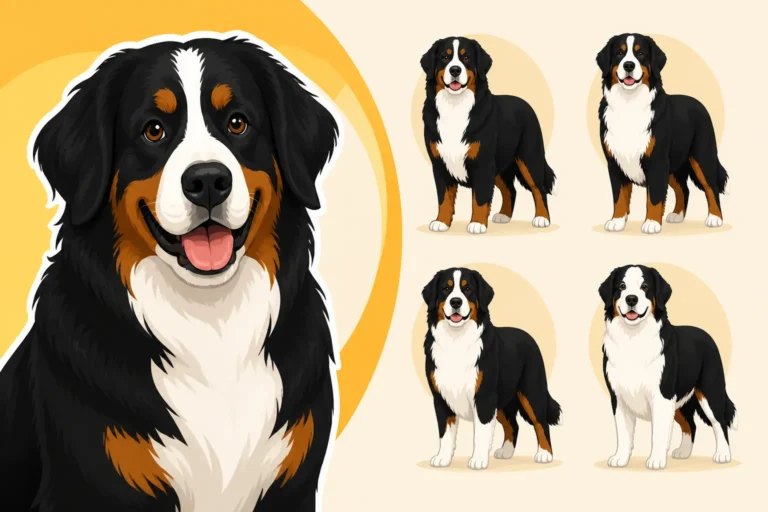
The Bernese Mountain Dog is known for its distinctive tricolor markings: jet black base, rich rust (tan) markings, and clean white markings. The placement and extent of these markings are very specific. Bernese Mountain Dog Markings and What They Mean is a whole art form in itself. For example, the rust markings should appear over each eye, on the cheeks, on all four legs, and on the chest. Absence of these markings or poorly defined ones can be a fault.
The white markings are also crucial. A white blaze on the head, a white chest (often referred to as the "Swiss cross" if shaped correctly), and white on the feet and tail tip are expected. However, too much white is a fault. Large white patches on the body, a white collar that goes all the way around the neck, or white that extends too far up the legs can all detract from a dog’s placement. Judges are looking for balance and the classic tricolor pattern, as deviations suggest a departure from the desired breed type.
Coat Texture and Quality
Beyond color, the quality of the Bernese Mountain Dog's coat is equally important. The standard describes a soft, silky, moderately long, and slightly wavy or straight coat, with a bright natural sheen. It should never be coarse, dull, or overly profuse to the point of hindering movement. The undercoat, which is dense and provides insulation, is typically not visible unless parted. Judges will physically touch the coat to assess its texture.
A coat that is woolly, open, or extremely curly is a fault. A sparse coat, lacking the density expected of a working dog from a cold climate, would also be penalized. The overall presentation of the coat also matters; while extreme grooming is not desired, a well-cared-for coat reflects the dog's health and the owner's dedication. The Bernese Mountain Dog Coat Texture a Judge Feels can tell them a lot about the dog's genetic lineage and care.
White Beyond the Standard
As mentioned, white markings are part of the Berner's charm, but there's a delicate balance. While the white chest, blaze, and feet are essential, white that extends too far up the legs, or forms a "collar" around the neck, is generally considered a fault. Even a small patch of white anywhere else on the body (such as on the back or flanks) is typically a fault. These are sometimes referred to as "ectopic" white markings.
The standard defines very clearly where white should and should not be. The ideal white blaze is symmetrical and doesn't extend too far down the muzzle. The "Swiss kiss" (a small white marking on the back of the neck) is sometimes present but not specifically required or faulted. However, large areas of white on the face, outside the blaze, are faults. The overall goal is a clean, classic tricolor pattern without excessive or misplaced white.
Temperament and Movement Issues
A Bernese Mountain Dog isn't just a pretty face; its temperament and how it moves are as integral to the breed standard as its physical appearance. A dog with a perfect body but a flawed personality or an unsound gait will not place well in the ring.
Shyness or Aggression
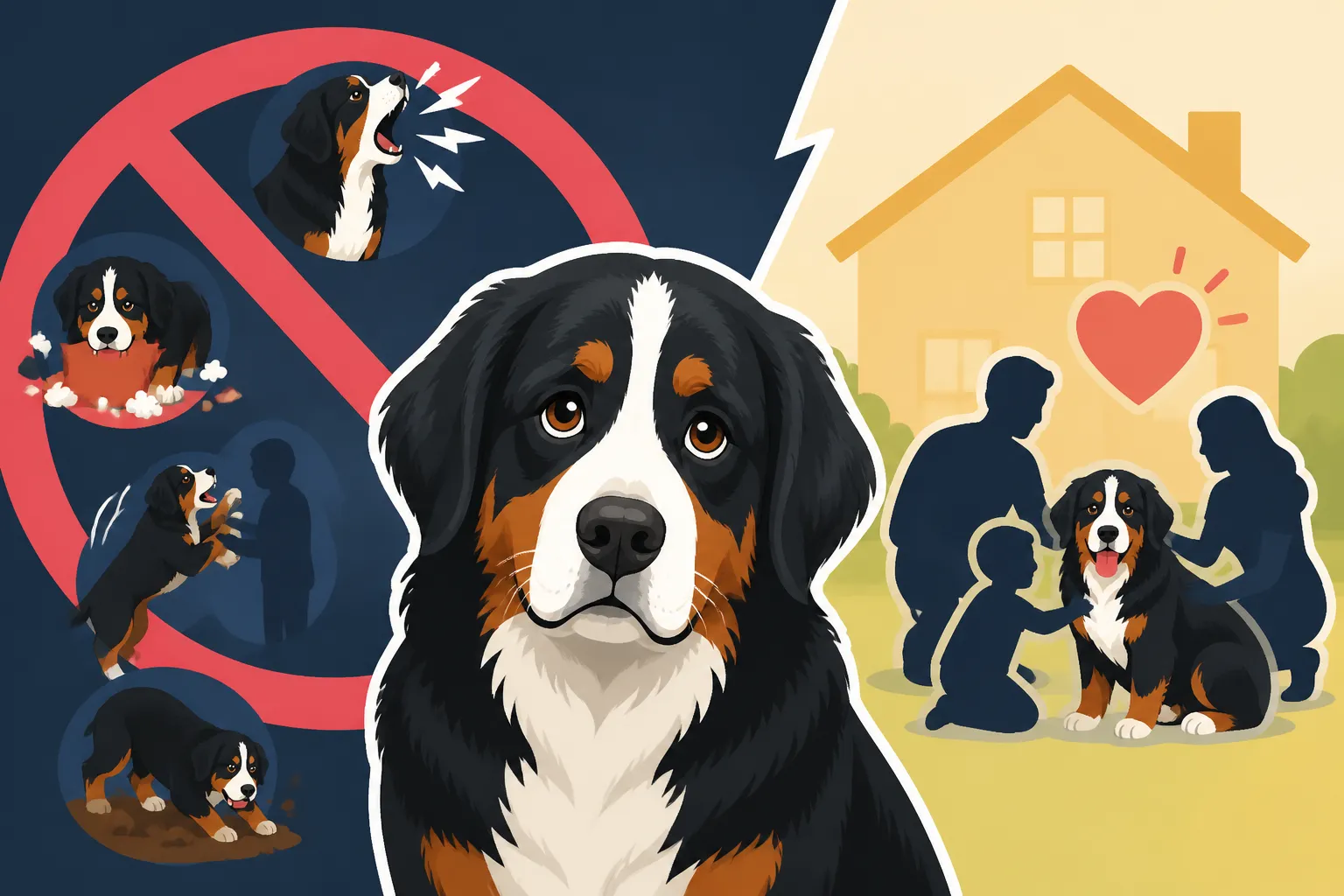
The breed standard explicitly calls for a Bernese Mountain Dog to be "self-confident, good-natured, docile, and devoted to its family; self-assured and calm toward strangers." This means extreme shyness or any display of aggression are serious faults. A dog that cowers, shrinks away from the judge, or exhibits fear biting behavior simply cannot represent the breed well. Such behaviors indicate a lack of the desired stable and confident temperament.
Conversely, a dog that is overtly aggressive towards the judge, other dogs, or people, is also heavily penalized, and can even be excused from the ring. What Sharp or Shy Means for a Bernese Mountain Dog extends beyond simple nervousness; it speaks to the core character of the animal. A truly confident Berner will allow a judge to examine them, even if they're not thrilled about it, without fear or aggression. While it's natural for some dogs to be a bit more reserved, particularly with strangers, judges distinguish between a calm reserve and true shyness. For owners looking to get their Berner comfortable with new experiences, treats from Chewy can be a great way to build positive associations.
Poor Gait and Coordination
A Bernese Mountain Dog should move with a "sound, effortless, far-reaching gait" that indicates strength and agility. This means judges are looking for a powerful, balanced stride, with good reach in the front and strong drive from the rear. The dog should move efficiently, without any wasted motion, and maintain a level topline. Poor gait and coordination are significant faults because they undermine the very purpose of the dog's structure – to move and work effectively.
Common gait faults include crabbing (where the dog moves with its body at an angle), hackney gait (high-stepping front action), or stilted movement (a stiff, choppy stride). Dogs that are too narrow or too wide in their gait, or whose legs cross over each other, will also be penalized. Any lameness, no matter how slight, is a serious fault. Judges observe the dog moving from the side, front, and rear to get a full picture of its movement. The Effortless Stride a Bernese Mountain Dog Should Have is not just about aesthetics; it's a testament to good health and conformation.
Disqualifying Faults
While faults can lower a dog's placement, disqualifying faults are absolute deal-breakers. A dog with a disqualifying fault cannot be awarded any points or placements, regardless of how excellent it might be in every other aspect. These are typically traits that severely deviate from the breed type, indicate a serious genetic issue, or compromise the safety of people or other dogs.
Severe Structural Abnormalities
Certain structural abnormalities are so significant that they are immediately disqualifying. This can include severe bite faults like a dramatically undershot or overshot jaw that prevents the mouth from closing properly. Extreme lameness or any obvious signs of physical deformity that would prevent the dog from performing its basic functions are also disqualifying. For instance, if a judge observes The Bernese Mountain Dog Whose Back Legs Give Out due to severe neurological issues, that would be a disqualification in the ring, even if it's not strictly a conformation fault.
Other severe skeletal issues, such as a kinked tail or dogs born with an incorrect number of toes (though rare), could also lead to disqualification. Judges are trained to spot these critical deviations, as they can indicate fundamental problems within the breeding line that need to be addressed to protect the breed's health and integrity.
| Trait Category | Common Faults (Lower Placement) | Disqualifying Faults (No Placement) |
|---|---|---|
| Head | Light eyes, small/large ears, weak muzzle | Severely overshot/undershot bite, deformities |
| Body/Structure | Roached/sway back, poor angulation, weak pasterns | Kinked tail, severe lameness, obvious deformities |
| Coat/Color | Poorly defined markings, too much white (collar/body patches), incorrect texture | Any color other than tricolor, solid white, solid black |
| Temperament | Marked shyness, over-excitability | Overt aggression, extreme fear biting |
| Movement | Crabbing, hackney gait, stilted motion, slight lameness | Severe lameness, inability to move freely |
Non-Standard Colors or Markings
The Bernese Mountain Dog is, by definition, a tricolor dog. Any color other than the standard black, rust, and white is a disqualifying fault. This means solid black Berners, all-white Berners, or Berners with tan and white only, for instance, cannot be shown. Even minor deviations that fundamentally alter the tricolor pattern, such as extensive white patches on the back or an entirely white head, would lead to disqualification.
Similarly, specific color patterns not described in the standard, or the absence of crucial markings (like the lack of rust markings entirely), would result in disqualification. The breed's identity is intrinsically linked to its tricolor pattern, and maintaining this distinct look is paramount for breeders and judges alike. It’s part of what makes a Berner instantly recognizable.
Unacceptable Temperament
As previously discussed, temperament is not just a preference; it’s a non-negotiable aspect of the Bernese Mountain Dog. Any dog that exhibits overt aggression towards humans (including the judge) or other dogs, or displays extreme fear and attempts to flee or bite, will be immediately disqualified. This isn't just about winning or losing; it's about the safety of everyone in the ring and the reputation of the breed.
Judges have a responsibility to ensure that dogs being awarded are not only physically sound but also mentally stable. A truly stable Bernese Mountain Dog is a joy to be around, and the standard reflects that. While a dog might be a bit nervous on its first outing, sustained fear or aggression makes it unsuitable for the show ring, and often, for its purpose as a companion dog. Whether an Aloof Bernese Mountain Dog Can Still Win depends on whether that aloofness crosses the line into genuine fear or uncooperativeness during examination.
Preparing for the Ring: Minimizing Faults
While you can't change your dog's inherent genetics, careful preparation can help present your Bernese Mountain Dog in the best possible light and avoid self-inflicted "faults" due to poor conditioning or training. This is where the partnership between owner and dog truly shines.
Working with a Breeder Mentor
One of the best resources for anyone interested in showing a Bernese Mountain Dog is an experienced breeder mentor. This is usually the person you acquired your puppy from, assuming they are reputable and involved in showing. They understand What a Bernese Mountain Dog Breeder Puts in Writing regarding health and conformation, but also possess a wealth of practical knowledge about presenting a dog. A good mentor can help you evaluate your puppy's potential, interpret the breed standard, and guide you through the process of training and conditioning. They can point out areas where your dog excels and areas where it might fall short of the ideal, offering honest, constructive criticism.
They can also advise on proper handling techniques, ring etiquette, and even help you understand the nuances of what different judges look for. This mentorship is invaluable for navigating the sometimes-intimidating world of dog shows, helping you learn from those who have years of experience. They can also connect you with local breed clubs or handling classes, providing a supportive community for your journey.
Training and Conditioning
Physical conditioning and ring training are absolutely paramount for success. A Bernese Mountain Dog needs to be in excellent physical shape – not overweight, but well-muscled and fit. Regular, appropriate exercise will build stamina and muscle tone, which directly impacts how the dog carries itself and moves in the ring. A dog that is out of condition will appear sluggish, lack proper muscle definition, and may not move with the desired power and elegance.
Ring training involves teaching your Berner to stack properly (stand in a show pose), gait at the correct speed on lead, and accept examination from a stranger (the judge). This requires patience, consistency, and positive reinforcement. Many owners attend handling classes where they can practice in a ring-like environment. Learning to handle your dog smoothly and confidently can make a huge difference in how the judge perceives your dog. Even small details, like a shiny coat (achieved with good diet and grooming products from Chewy) and clean teeth, contribute to the overall presentation. Grooming a Bernese Mountain Dog for the Show Ring is a crucial element of preparation, ensuring their coat highlights their best features without being overdone.
Disclaimer
This article is for general informational purposes only and does not constitute professional advice. Laws, prices and regulations vary by location and change over time. Consult a qualified professional for guidance on your specific situation.