The Four White Points a Bernese Mountain Dog Should Have
A Bernese Mountain Dog’s white markings can look very different from one dog to another, which makes it easy to wonder whether a blaze, chest patch, or white paw is “right.” This guide explains the four commonly discussed white markings, what breed standards actually describe, and why markings alone cannot tell you whether a dog is healthy or well bred.
What people mean by the four white points
The blaze on the face
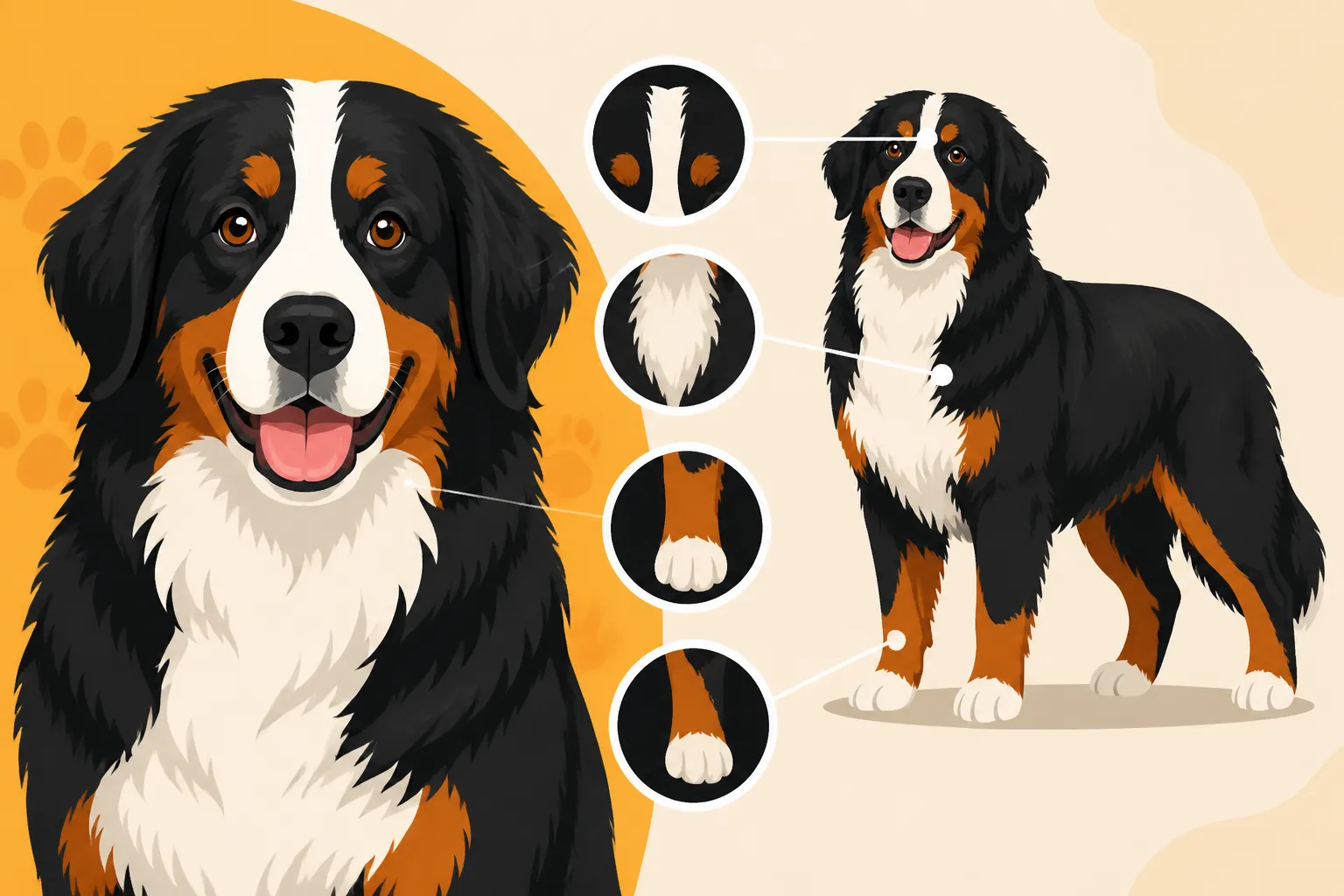
The first marking people usually notice is the white blaze: a stripe running up the center of the face, between the eyes and toward the forehead. On a classically marked Berner, it creates a crisp contrast against the black coat and helps give the breed its familiar, expressive look.
A blaze can be broad or narrow, short or extended. It may stop between the eyes, reach higher over the forehead, or vary slightly from one side to the other. Breeders and show judges may look for a marking that appears balanced, but real dogs do not come with perfectly measured paint lines. A narrow blaze does not mean a dog is unhealthy, and a wide blaze does not make a dog healthier or more affectionate.
The blaze is also not the only white marking on the face. The muzzle typically has white, and that white connects visually with the blaze in many dogs. Breed descriptions discuss the white facial pattern as a whole, not just one isolated stripe. For more detail on how facial and body markings are described, see Bernese Mountain Dog Markings and What They Mean.
The white marking on the chest
The second commonly discussed point is the white chest marking. It often spreads across the front of the chest and may extend down the sternum, creating a shape people describe as a cross or an inverted cross. The exact outline varies: one dog’s chest marking may be broad and prominent, while another’s is narrower or less sharply defined.
This patch is sometimes called the Swiss cross because it resembles the white cross on the Swiss flag. That name is a helpful visual comparison, not a promise that every dog’s chest marking will match a particular symbol. Some markings have uneven edges, small black interruptions, or a shape that looks more like a stripe or bib than a neat cross.
When you are looking at a puppy, remember that the coat grows and the dog’s body changes as it matures. The underlying markings do not typically transform into a different pattern, but a small puppy’s proportions can make a patch look larger or smaller than it will on an adult. The chest marking is one part of the breed’s overall tricolor pattern, not a stand-alone test of breed quality.
The white feet and the tail tip
The phrase “four white points” is often used informally for four areas of white: the facial blaze, the chest marking, the feet, and the tip of the tail. It can be confusing because “four points” might sound as if it means exactly four separate paws. In everyday breed discussions, people are usually talking about these four general regions rather than a strict count of white patches.
White on the feet can range from a few toes to more extensive white that covers much of the foot. The amount may not be identical on every paw. Breed descriptions commonly favor white feet, but the markings are not always symmetrical, and not every pet Bernese Mountain Dog will have the same “sock” height.
A white tail tip is another familiar feature. It can be very noticeable when the dog is moving, or so small that you only see it when the tail is raised. In some breed standards, white on the tail tip is described as desirable rather than essential. That distinction matters: a desirable marking is not automatically a requirement every dog must meet.
| Commonly discussed white area | What it usually looks like | What to keep in mind |
|---|---|---|
| Facial blaze | A white stripe between the eyes and up the forehead | Width, length, and symmetry vary |
| Chest marking | A white patch across the chest, often cross-like | The outline does not need to look perfectly geometric |
| Feet | White on some or all of the paws | Paw markings can differ from foot to foot |
| Tail tip | White at the end of the tail | It may be small, prominent, or absent |
How breed standards describe Bernese markings
The pattern is more than four separate spots
The Bernese Mountain Dog is a tricolor breed, with black as the primary coat color and rust and white markings. The white areas people call the “four points” are part of a larger pattern that includes color on the face, chest, legs, and tail. In other words, the breed is not defined by four isolated white marks alone.
Breed standards describe the overall appearance and placement of markings, but the wording and emphasis can differ among kennel organizations. Some descriptions put particular weight on a white blaze, white muzzle, chest marking, feet, or tail tip. If you are evaluating a dog for showing, check the standard used by the organization where the dog will be shown rather than relying on a casual phrase such as “four white points.”
It helps to separate three ideas that are often blended together: a marking that is typical of the breed, a marking a standard prefers, and a marking that affects a show evaluation. Those are not necessarily the same thing. A feature can be attractive or preferred without being a health requirement. For a closer look at the formal description of the breed, read The Bernese Mountain Dog Breed Standard.
Ideal markings are not a health checklist
A striking white blaze or neatly marked feet can make a Berner look especially familiar, but coat markings do not tell you whether the dog has healthy hips, sound elbows, good heart health, or a long-lived family line. A puppy with a beautiful pattern still needs the same thoughtful care and health background as any other puppy.
That distinction matters when choosing a breeder. Photos can show a puppy’s appearance, but they cannot replace questions about the parents’ health testing, relatives’ longevity, temperament, and the breeder’s approach to raising the litter. Ask to see records and understand what tests were completed. Which Tests a Bernese Mountain Dog Breeder Should Show offers a useful starting point for those conversations.
Markings also should not be treated as a guarantee of temperament. The breed is often known for a steady, people-oriented nature, but individual behavior depends on more than coat pattern. Socialization, health, genetics, and the dog’s experiences all matter. If you are deciding whether the breed fits your home, Whether a Bernese Mountain Dog Is Right for You can help you think beyond appearance.
Why white markings vary from dog to dog
Small differences are normal
Even puppies from the same litter can have noticeably different markings. One may have a broad, straight blaze and a large chest patch; another may have a narrow blaze, uneven white toes, and only a small white tail tip. That variation is part of what makes looking at a litter so interesting—and why trying to match a puppy to one idealized photo can lead to unnecessary worry.
The white pattern can also look different depending on coat length, posture, lighting, and how the dog is standing. A puppy sitting on a dark floor may show its chest markings clearly, while the same dog standing in grass might appear to have less white. Feathering around the legs can partly conceal where the white markings end.
A dog’s markings can be described as more or less typical of the breed, but visual differences do not automatically signal a problem. The white markings should be considered alongside the dog’s structure, movement, health, and temperament. For example, a white foot does not reveal whether a dog has comfortable joints; that calls for appropriate veterinary assessment and relevant health information.
Puppy photos are not the whole story
When comparing puppy photos, look at the dog’s whole body rather than zooming in on a single patch of white. Check whether the pictures are clear, taken in good light, and show the puppy from more than one angle. A photo can make a blaze seem crooked because the puppy has turned its head, or make the chest patch look uneven because the dog is sitting at an angle.
It is also reasonable to ask a breeder how they describe the litter’s markings and whether they are discussing pet homes or show prospects. A responsible breeder should be able to explain that appearance is only one part of evaluating a puppy. If you are interested in the breed, Visiting a Bernese Mountain Dog Litter Before Choosing can help you prepare for a more useful visit than simply picking the puppy with the most dramatic markings.
Be cautious if someone presents a specific white pattern as proof that a puppy is rare, superior, or guaranteed to have a particular temperament. Markings can be part of a dog’s appeal, but claims that turn appearance into a promise deserve careful questions. A puppy should be chosen for the fit between the dog and your household, not only for a particularly wide blaze or bright white socks.
Caring for a Berner’s white coat areas
Keep the coat clean without overdoing it
White fur can show mud, food, and outdoor dirt more clearly than black fur, especially around the paws and chest. That does not mean the dog needs constant bathing. Regular brushing, wiping muddy feet after a walk, and checking the feathering for debris are usually more practical than trying to keep every white hair spotless.
Use grooming products intended for dogs, and follow label directions. If you are comparing brushes or coat-care items, Chewy may be one place to browse options, but match the tool to the coat and your dog’s comfort rather than buying based on a product claim alone. A gentle routine introduced early can make paw handling and brushing easier as your puppy grows into a large adult.
For muddy paws, start with a damp cloth or a dog-safe wipe, then dry the feet well, especially between the toes. Do not scrub hard to remove ordinary staining; rough handling can irritate skin and make grooming unpleasant. If the coat has persistent discoloration, skin irritation, odor, or a change in the hair, ask your veterinarian rather than trying stronger cleaning products.
Look after the whole double coat
The white patches are part of a long double coat, so grooming should focus on the coat as a whole. Brush down to the undercoat without scraping the skin, and pay particular attention to places where tangles form, such as behind the ears, under the collar, and around the legs. A quick surface brush can make the top look tidy while leaving compacted hair underneath.
A grooming kit does not need to be complicated. A suitable brush and comb, nail-care tools, and a towel by the door can make ordinary upkeep easier. If you are shopping for basic supplies, Chewy is another retailer to compare, but check that a brush is appropriate for a long double coat and that any wipes are formulated for dogs. For coat-specific advice, see Grooming a Bernese Mountain Dog's Long Tricolor Coat.
It is usually best not to shave a Bernese Mountain Dog simply to make white markings look cleaner or to reduce shedding. The coat has a protective role, and shaving can change how it grows back. Routine trimming for cleanliness—such as tidying excess hair around the feet—is different from removing the coat. If you are uncertain what a groomer plans to do, explain that you want the natural coat maintained and ask which areas they intend to trim.
Treat staining as a grooming issue, not a breed defect
A dog that runs through wet grass or plays in muddy soil will not keep bright white feet for long. That is normal life with a dog, not a sign that the markings are wrong. A washable mat near the entrance, a towel within reach, and a calm “wait” cue at the door can save you from chasing muddy paw prints through the house.
Some owners keep a small grooming station near the entryway with a towel, a brush, and dog-safe cleaning supplies. Chewy can be useful for comparing ordinary pet-care products, but no cleaner should be used near the eyes or on irritated skin unless its label specifically allows it. If a stain does not lift with gentle cleaning, leave the coat alone and ask a groomer or veterinarian for guidance.
Most importantly, do not let the search for perfect white markings distract from the everyday realities of the breed. Berners shed, get dirty, and need regular coat care. Their markings are part of their distinctive appearance, but a happy, comfortable dog matters far more than spotless paws or a perfectly symmetrical blaze. For a broader look at the breed’s background and appearance, see Why Only the Bernese Mountain Dog Has a Long Coat and The Swiss Cross on a Bernese Mountain Dog's Chest.
Disclaimer
This article is for general informational purposes only and does not constitute professional advice. Laws, prices and regulations vary by location and change over time. Consult a qualified professional for guidance on your specific situation.