How Long a Bernese Mountain Dog’s Ancestors Lived
A Bernese Mountain Dog’s ancestors were Swiss farm dogs, but there is no dependable historical record showing how many years they usually lived. Their working lives are easier to reconstruct than their lifespans. This guide explains what is known about those early dogs, why a precise age is out of reach, and what their history can—and cannot—tell us about the Bernese Mountain Dog today.
Who the Bernese Mountain Dog’s ancestors were
Farm dogs from the Bernese region
The Bernese Mountain Dog developed from working dogs kept on farms in the Swiss canton of Bern. These were not yet a standardized breed with carefully recorded pedigrees. They were practical farm dogs, shaped by the needs of local families and by the environment in which they lived.
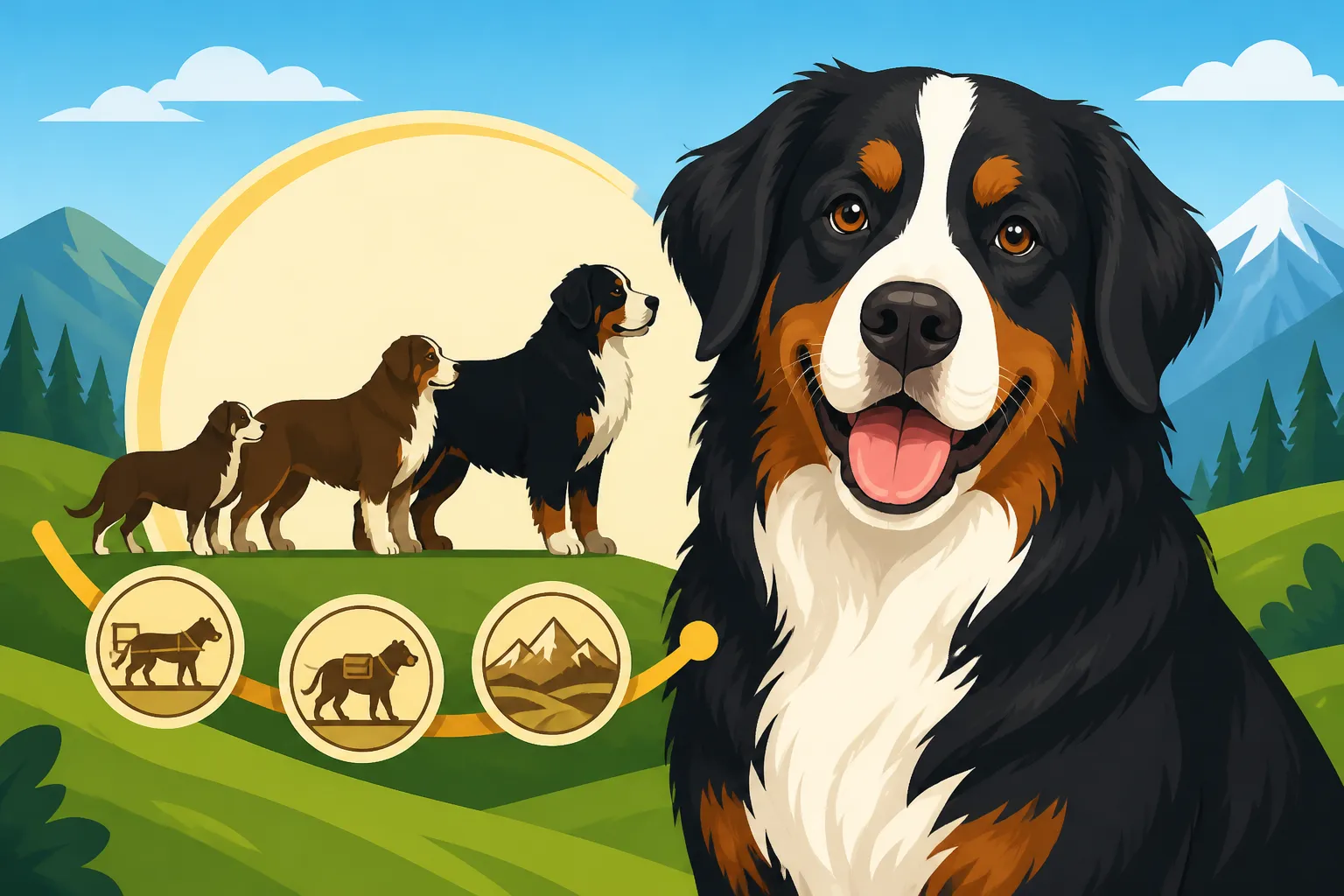
Their work could include moving cattle, pulling carts, and keeping watch around a farm. That broad working role helps explain why the modern Bernese Mountain Dog is often associated with strength and versatility. For more about those historical jobs, see What Swiss Farmers Used Bernese Mountain Dogs For.
The name “Sennenhund” reflects this farming heritage. It refers to the dogs associated with Alpine herdsmen and farm life, rather than identifying one precise ancestral dog or a documented family line. The history of the name is explored in What Sennenhund Means in a Bernese Mountain Dog's Name.
Why early dogs were not a modern breed population
The dogs that contributed to the Bernese Mountain Dog were regional farm dogs, not members of a carefully managed modern breeding program. A farm dog might be valued for being useful, steady, and suited to its household. There was no widespread system requiring owners to record that dog’s birthday, cause of death, or age at death.
That makes it misleading to talk about “the ancestors” as though they were one uniform group. Dogs in different villages and households could have different backgrounds, workloads, diets, and living conditions. Even if a family remembered how old a particular dog was, that story would not tell us the average lifespan of all the dogs in the region.
The breed’s local history is closely tied to the Dürrbach area and the dogs that came to be known as Dürrbachlers. The Dürrbach Valley and the Dogs Named After It gives more context for the place associated with the breed’s development.
From local farm dogs to a named breed
The modern Bernese Mountain Dog took shape after enthusiasts began identifying and organizing these local dogs as a distinct breed. That transition matters when asking about lifespan: the breed’s documented history is much newer than the history of farm dogs that may have contributed to it.
Early breed advocates helped bring the dogs into public view, but their work did not create detailed longevity records for every earlier generation. The story of those efforts is covered in The Innkeeper Who Saved the Bernese Mountain Dog and Franz Schertenleib and the Bernese Mountain Dogs He Found.
As the dogs became more consistently identified and bred, their names and type became clearer. The label Dürrbachler is part of that story, rather than proof that every dog called by that name belonged to a fully documented lineage. For more, see Why the Breed Was Once Called the Dürrbachler.
How long did the ancestors live
There is no reliable average lifespan
The honest answer is that we do not know how long the Bernese Mountain Dog’s ancestors lived on average. Historical accounts describe what these dogs did and where they lived, but they do not provide a representative dataset of birth dates and ages at death.
A story about one long-lived farm dog would not establish a typical lifespan. Nor would a record of a dog dying young tell us whether the cause was illness, injury, difficult working conditions, or something else. Without a large, consistent set of records, calculating an average would create a false impression of certainty.
| Question | What the historical record can support | What it cannot establish |
|---|---|---|
| What kind of dogs came before the modern breed? | Regional Swiss farm dogs with practical working roles | One single, uniform ancestral population |
| What work did they do? | Tasks such as droving, cart work, and farm watch | How workload affected lifespan across the population |
| How old did they usually get? | No dependable population-wide lifespan figure | A reliable average age at death |
| Were they healthier than modern Bernese Mountain Dogs? | Historical conditions and records differed greatly | A fair health comparison between then and now |
Why old records leave so many gaps
Before modern veterinary care and formal record keeping, many dogs’ lives were not documented in a way that would help researchers calculate lifespan. A farm family might remember a dog’s working years or its place in the household without knowing its exact birth date. If the dog died, the event might never have been written down.
There is another problem: surviving accounts tend to preserve unusual or useful details. A notable working dog, a memorable animal, or a dog connected to a particular farm might be mentioned, while ordinary dogs leave no trace. That kind of selective record can make the surviving stories feel more complete than they really are.
Even the point at which a dog was considered “old” could vary. Owners may have judged age by reduced stamina, changes in work, or appearance, rather than by a known number of years. Those observations matter as history, but they cannot be converted into a precise lifespan estimate.
Why a modern comparison is difficult
It is tempting to assume that farm dogs lived longer because they were active, or that they died younger because they faced harsher conditions. Neither conclusion follows from the available evidence. Activity alone does not determine lifespan, and a lack of veterinary records does not mean dogs were free of disease.
Modern Bernese Mountain Dogs receive different food, preventive care, diagnostic testing, and treatment than working dogs on historical farms. They also live in different households and are bred within a modern population. Comparing these dogs directly with poorly documented regional farm dogs would mix very different circumstances.
For a present-day discussion of breed lifespan, see The Average Age a Bernese Mountain Dog Reaches and Why a Bernese Mountain Dog Lives Only Seven or Eight Years. Those topics address modern dogs rather than offering a measurable lifespan for their historical ancestors.
What their working lives tell us—and what they do not
Work gives clues about daily life, not age at death
Historical working roles suggest that many of these dogs were expected to be useful members of a farm household. They might spend time outdoors, accompany people around the property, or help move goods. Their work offers a glimpse into how people relied on them, but it does not show how long they lived.
A dog’s working life could also end before its actual life ended. A dog might become less suited to hauling or moving livestock with age, yet remain part of the household. Conversely, a dog could stop working because of injury or a change in farm needs. “Worked until old age” is not a precise age measurement.
This distinction is useful when reading breed histories. Accounts of a dog pulling a cart or driving cattle describe purpose and ability; they do not tell us whether that dog lived a particular number of years. The Milk Carts Bernese Mountain Dogs Pulled explores one familiar part of that working history.
Historical conditions were not all the same
There was no single farm life that every ancestor experienced. A dog’s food, shelter, workload, access to care, and relationship with its family could differ from one household to another. Geography and climate also shaped daily life. A dog in one setting might have had different demands from a dog elsewhere in the region.
It is easy to romanticize the past and picture a hardy farm dog living a long, vigorous life outdoors. It is just as easy to assume that working dogs must have been worn down early. Both pictures may describe some individual experiences, but neither is enough to establish the typical lifespan of the population.
The cautious conclusion is simple: these dogs were valued for practical work, but their lives were not recorded in a way that lets us calculate how long they generally lived.
What a pedigree can tell a modern owner
A modern Bernese Mountain Dog pedigree may help trace known relatives and family history, especially when records include health outcomes and ages. It still cannot fill in the missing details about unnamed farm dogs from generations before formal breeding records existed.
If you are researching a particular line, distinguish documented information from family stories. Ask what records exist, how many relatives they cover, and whether the reported ages refer to verified records or recollection. A pedigree is most helpful when it is treated as evidence about the dogs actually recorded—not as a complete window into centuries of ancestry.
For guidance on making sense of recorded family longevity, see Reading Longevity Into a Bernese Mountain Dog Pedigree. Broader questions about changes in present-day records are discussed in Whether Longevity Is Improving in Bernese Mountain Dogs.
What this history means for caring for a Bernese Mountain Dog today
Focus on the dog in front of you
A dog’s historical ancestry cannot predict exactly how long an individual Bernese Mountain Dog will live. For a present-day owner, practical care means paying attention to that dog’s condition, behavior, mobility, appetite, and comfort, and discussing changes with a veterinarian.
For example, a dog that is slower to rise or less interested in its usual walk may be aging, uncomfortable, or dealing with another health issue. It is better to notice and discuss those changes than to dismiss them as an inevitable part of the breed’s history. An old farm dog’s presumed toughness is not a reason to overlook a modern dog’s discomfort.
Keep routines manageable and consistent
As a Bernese Mountain Dog ages, routine care may need small adjustments. A comfortable resting place, regular grooming, and meals suited to the dog’s needs can make daily life easier. If your veterinarian recommends a particular food or supplement, keep track of what you are using and how your dog responds rather than making several changes at once.
Some households use retailers such as Chewy to order familiar food or everyday care supplies. If you use Chewy, keep the product name and feeding instructions with your dog’s care notes, and check with your veterinarian before adding supplements. A retailer can help with access to supplies, but it cannot determine what is appropriate for an individual dog.
For mobility or grooming needs, the best choice depends on the dog’s size, health, and comfort. Owners may use Chewy or another source to look for practical items, but equipment should fit properly and should not replace veterinary advice when a dog is painful or struggling to move. Keeping a short written record of changes can also help you explain what you have observed at an appointment.
Keep the past in perspective
The ancestors of the Bernese Mountain Dog tell a compelling story of farm life, useful work, and the development of a distinctive Swiss breed. But their history does not provide a dependable lifespan figure. The surviving record is too incomplete to support claims that they usually lived longer or shorter lives than Bernese Mountain Dogs do today.
That gap does not make their story less meaningful. It simply means the most accurate answer is a careful one: the early dogs’ typical lifespan is unknown. Modern owners can learn from the breed’s history while relying on present-day health records, veterinary guidance, and close attention to the individual dog in their care.
Disclaimer
This article is for general informational purposes only and does not constitute professional advice. Laws, prices and regulations vary by location and change over time. Consult a qualified professional for guidance on your specific situation.