Whether Bernese Mountain Dogs Really Pulled Milk to Market
A Bernese Mountain Dog pulling a milk cart is not just a charming modern picture: dogs of this type did help Swiss farming families move dairy goods and other loads. But the story is easy to overstate. This guide explains what the dogs likely hauled, how cart work fit into farm life, and why it was one useful job among several—not a task every Berner performed.
Why Bernese Mountain Dogs Were Used for Farm Work
The breed grew up around working farms
The Bernese Mountain Dog comes from the Swiss canton of Bern, where farm life could involve livestock, dairy production, and moving goods between a farm and nearby communities. The breed was developed as a practical farm dog, not for one narrowly defined task. Its strength, sturdy frame, weather-resistant coat, and close relationship with people made it suited to varied work.
The dog’s historical name, Berner Sennenhund, reflects that working background. “Sennenhund” is associated with dogs kept by alpine herders and farmers. The breed’s farm duties could include staying near the property, accompanying people, and helping move livestock or supplies. For more about the setting behind the breed, see The Swiss Valley the Bernese Mountain Dog Comes From and What Sennenhund Means in a Bernese Mountain Dog's Name.
It is worth keeping the geography in perspective. Rural Swiss communities were not all alike, and a family’s needs depended on its farm, terrain, and access to roads or markets. A dog that helped with a cart on one property might have spent more time with cattle or people on another. There was no single daily routine followed by every Bernese Mountain Dog.
Cart pulling was one part of a broader job
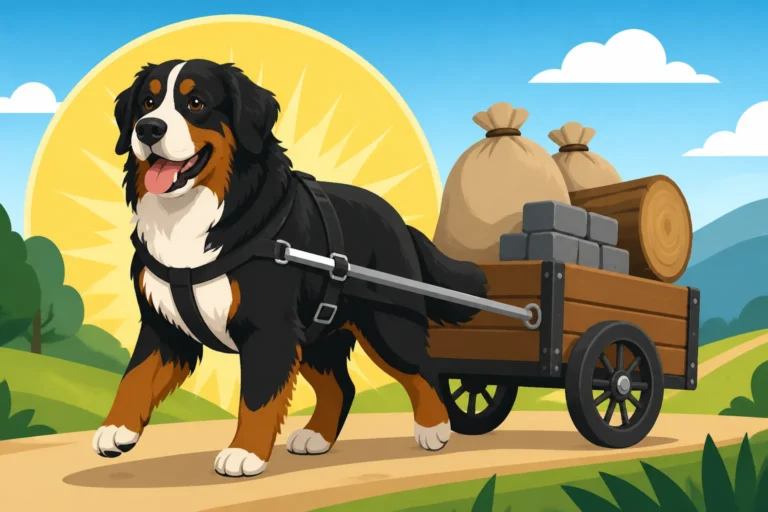
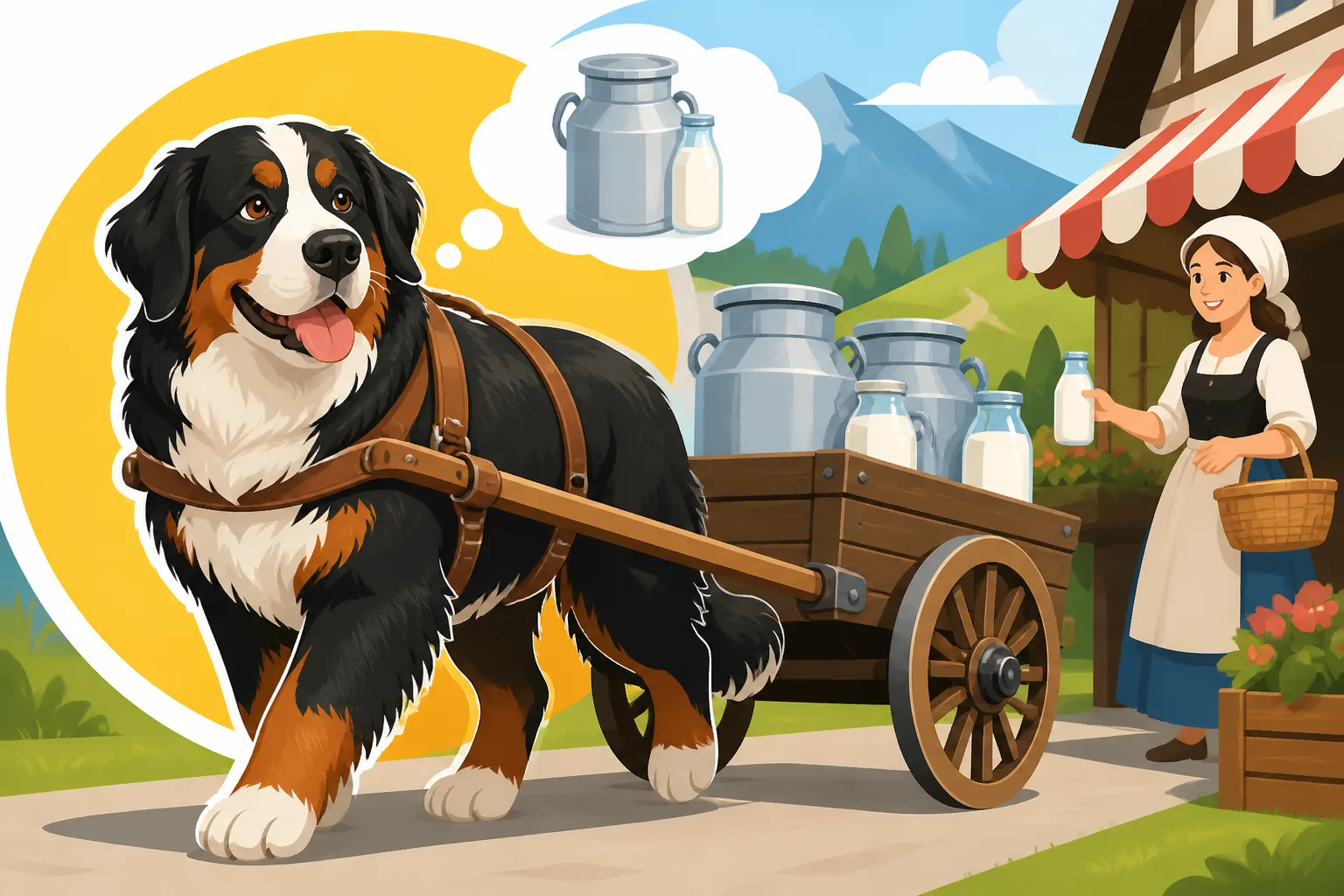
Accounts and historical depictions associate Bernese Mountain Dogs with pulling carts loaded with goods, including milk containers and other farm products. That makes sense in a working landscape where a capable dog could help move a manageable load over a short route. The dog did not need to be a specialist freight animal to be useful; it needed to be strong, steady, trained, and handled by someone who knew the route and the load.
Cart work sat alongside other farm tasks. A Bernese Mountain Dog might accompany a farmer, help keep livestock moving, or stay around the homestead. The breed’s history is better understood as practical versatility than as a single-purpose “milk-cart dog.” You can explore those related roles in What a Bernese Mountain Dog Did on a Swiss Farm and Cattle Droving and the Bernese Mountain Dog's Old Job.
That distinction matters because a familiar picture can harden into a claim that every dog routinely hauled milk to market. The evidence supports cart pulling as a real historical use, but it does not mean all Berners did it, or that it was their primary occupation everywhere. Individual dogs and farms differed, just as working dogs’ roles do today.
What the Milk-Cart Story Means in Practice
Dogs could help move dairy products and supplies
The milk-cart image generally refers to a dog harnessed to a small cart carrying goods from a farm or along a local route. Milk cans are the most recognizable cargo in popular retellings, but a cart could also carry other farm items. The dog’s strength was useful when a person needed help moving a load and the route suited a dog-drawn cart.
A cart did not make the dog an independent delivery service. A person would have been responsible for loading it, guiding the dog, managing the route, and keeping the animal safe. The dog’s contribution was physical assistance under human direction. That is a more realistic picture than imagining a Berner regularly making a complicated trip alone through busy streets.
The phrase “to market” can also suggest long journeys, but it should not be taken to mean that dogs commonly hauled heavy loads over great distances. A short, practical trip between a farm and a nearby destination is a more cautious interpretation. The exact route, load, and frequency would have depended on local conditions and the household.
A cart and harness needed to suit the dog
For draft work, the harness has to distribute pressure appropriately, and the cart needs to be stable and proportionate to the dog. A poorly fitted setup can rub, restrict movement, or place strain on the body. The dog also needs gradual training so that the cart’s movement, noise, and resistance are not frightening or uncomfortable.
Historical work and modern recreational carting are not identical. Today, owners may teach a dog to pull a lightweight cart as a supervised activity, but that does not mean an old photograph or breed-history story is a ready-made training plan. A dog’s age, health, fitness, temperament, and equipment all matter. The Milk Carts Bernese Mountain Dogs Pulled looks more closely at the carts and their role, while Teaching a Bernese Mountain Dog to Pull a Cart covers the modern training question.
| Part of the story | What is reasonable to say | What not to assume |
|---|---|---|
| The dog’s role | Some Bernese Mountain Dogs helped pull carts as farm dogs | Every Berner had cart work as a daily job |
| The cargo | Dairy goods, including milk containers, are linked to the tradition | Every cart carried only milk |
| The handler | A person would guide and manage the dog and load | The dog routinely made deliveries alone |
| The distance | Carting could be useful on a suitable local route | Dogs commonly hauled heavy loads over long distances |
| Modern carting | It can be a trained activity for an appropriate, healthy dog | Historical use proves that every modern dog should pull |
How the Story Became So Closely Linked to the Breed
A memorable image can simplify a complex history
A large, strong dog in harness beside a farm cart is an easy image to remember. It captures something true about the Bernese Mountain Dog’s working heritage, but it can crowd out the less photogenic parts of farm life: walking with people, staying near the home, and helping with livestock. The cart story is a useful entry point, not a complete biography of the breed.
Breed histories often use a vivid example to make a working role understandable. In this case, milk cans help people picture what a sturdy farm dog might have moved. But a memorable image does not tell us how often the task happened, how far the dog travelled, or how heavy a particular load was. Those details should not be filled in with confident-sounding guesses.
That is why it helps to think in terms of “a documented type of work” rather than “the job every dog did.” The historical role belongs within the larger account of the breed’s farm life, alongside companionship, livestock work, and guarding or watching the homestead. The emphasis on multiple roles is also reflected in What a Bernese Mountain Dog Did on a Swiss Farm.
Working ability did not mean unlimited hauling
The breed’s powerful appearance can tempt people to assume that a Bernese Mountain Dog could pull any load placed behind it. That is not a safe conclusion. A dog’s body, conditioning, footing, equipment, and the weight and balance of the cart all affect what is reasonable. Even a strong dog can be hurt by excessive strain or by working when tired, sore, or overheated.
The same caution applies to modern owners who want to recreate a historical activity. Before starting cart work, discuss the dog’s health and physical readiness with a veterinarian, particularly if the dog is young, older, overweight, or has a history of joint problems. Draft exercise should be introduced gradually and stopped if the dog shows reluctance, an altered gait, unusual fatigue, or signs of discomfort. Whether Pulling a Cart Hurts a Bernese Mountain Dog's Joints and Building a Bernese Mountain Dog's Fitness for Draft Work address those concerns in more detail.
A responsible handler also treats the dog as a partner, not as equipment. Training should be positive and paced around the dog’s comfort. A Berner that does not enjoy carting does not need to be persuaded simply because the breed once had working roles. Breed history can inspire activities, but a particular dog’s wellbeing comes first.
What the Tradition Means for Berners Today
Historical work is not a requirement for a modern pet
Most Bernese Mountain Dogs today live as family companions. Their working ancestry may show up in an interest in learning, spending time with people, or participating in structured activities, but it does not guarantee that an individual dog will enjoy pulling a cart. Some may find it engaging; others may prefer a walk, scent game, or relaxed time alongside their family.
Owners who are curious about carting can begin by learning about equipment, safe training, and suitable workloads rather than buying a cart and attaching it immediately. A qualified trainer familiar with draft work can help assess fit and teach foundational skills. A veterinarian can advise whether the dog is physically ready, especially when joint health is a concern.
There is also no need to turn every modern activity into a reenactment of farm life. The historical point is that Bernese Mountain Dogs were valued for their practical usefulness and close partnership with people. Today, that partnership can take many forms, including calm training, hiking at an appropriate pace, or simply being a steady presence at home.
Caring for a working or outdoorsy Berner
A dog spending time outside may come home with mud in its leg feathering, tangles behind the ears, or debris caught between its toes. Check the coat and paws after outings, and keep grooming gentle so that the dog learns to accept handling. For routine grooming supplies, a retailer such as Chewy may be one place to compare basic brushes and coat-care items; choose tools suited to a long double coat rather than relying on a product label alone.
If an owner is preparing for a modern carting activity, the focus should be on safe equipment and the dog’s comfort, not on recreating a heavy historical load. A retailer such as Chewy may also be a starting point for comparing general dog-care supplies, but harness fit and cart suitability are best assessed with knowledgeable guidance. A product being available does not establish that it is the right fit for a particular dog.
After outdoor work, inspect for rubbing, soreness, or changes in movement. Keep the dog’s coat clean and dry when needed, and make sure the activity fits the weather and the dog’s condition. Chewy can be one option for looking at everyday grooming basics, while questions about training, equipment fit, or health belong with an experienced trainer or veterinary professional.
The most accurate answer to the milk-market question
Yes, Bernese Mountain Dogs really were associated with pulling carts, and milk containers are part of that tradition. The key is not to turn a genuine historical role into an exaggerated universal claim. Cart pulling was one form of useful farm work, and the needs of individual farms and dogs varied.
A Bernese Mountain Dog was not simply a milk-delivery machine. It was a working farm companion whose usefulness could include pulling a cart, helping with livestock, and staying close to people. That broader picture is more informative—and more respectful of the breed’s history—than reducing its past to a single charming scene.
Disclaimer
This article is for general informational purposes only and does not constitute professional advice. Laws, prices and regulations vary by location and change over time. Consult a qualified professional for guidance on your specific situation.