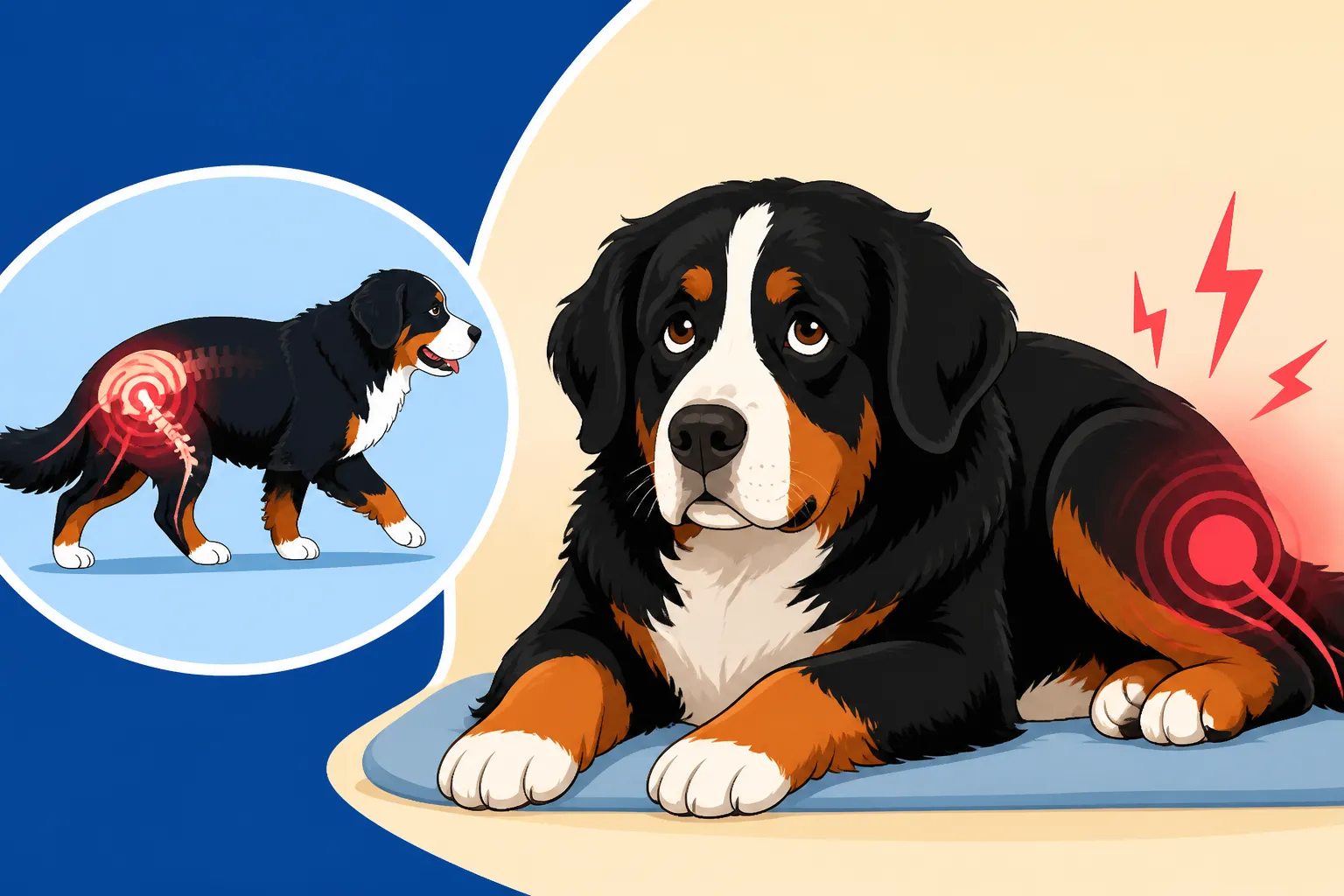
Whether a Bernese Mountain Dog With Myelopathy Is in Pain
It's an agonizing question for any Bernese Mountain Dog owner: when your beloved companion starts to falter, stumble, and eventually lose control of their back legs due to degenerative myelopathy, you can't help but wonder if they're in constant pain. This guide is here to shed light on this complex condition, help you understand the true nature of the discomfort your Berner might experience, and empower you with knowledge to manage their quality of life.
Understanding Degenerative Myelopathy in Bernese Mountain Dogs
Degenerative Myelopathy (DM) is a cruel and progressive neurological disease that steals your dog's mobility, and it’s a condition far too many Berner families encounter. It primarily affects the spinal cord, slowly and relentlessly. For a deep dive into the initial signs, you might find our article on Early Degenerative Myelopathy in a Bernese Mountain Dog helpful.
What Degenerative Myelopathy Actually Is
At its core, Degenerative Myelopathy is a genetic disease of the spinal cord in older dogs, somewhat akin to Amyotrophic Lateral Sclerosis (ALS) in humans. It involves the degeneration of the white matter in the spinal cord, which are the nerve fibers that transmit signals between the brain and the rest of the body. Specifically, DM targets the pathways responsible for movement and proprioception – your dog's awareness of their body's position in space. Think of it like the insulation around electrical wires fraying and disappearing; the signals can't travel effectively anymore.
Crucially, DM is a motor neuron disease. This means it primarily affects the nerves that control voluntary movement, leading to weakness and paralysis. What it does not directly affect are the sensory neurons responsible for transmitting pain signals. This is a fundamental point that often brings a huge sense of relief to worried owners: the disease itself, in its direct neurological action, is not typically a source of direct, sharp pain for your Bernese Mountain Dog.
The progressive loss of nerve function gradually interrupts the communication between the brain and the hind limbs. This leads to the characteristic weakness and incoordination. Your Berner's brain might be sending the command to lift a paw, but the signal gets scrambled or doesn't arrive clearly at the muscles, resulting in stumbling or dragging. It's a frustrating breakdown of communication, not an agonizing electrical storm of pain within the spinal cord.
While the primary disease itself isn't painful, the ensuing complications from reduced mobility can certainly cause discomfort. It's a critical distinction to make when you're watching your once-sturdy Bernese Mountain Dog struggle. Understanding this difference allows us to focus our efforts on managing the secondary issues that do cause distress, rather than chasing a pain that isn't directly stemming from the neurological deterioration itself.
Common Symptoms and Progression
The journey with DM often begins subtly, making it easy to dismiss early signs as just "getting old" or a minor sprain. Typically, you'll first notice a lack of coordination in your Berner's hind limbs. This might manifest as a slight wobble when they walk, an occasional scuffing of their back paws, or a tendency for their legs to cross over each other. They might struggle to stand up from a lying position, or seem hesitant to climb stairs that were once easy. These initial symptoms usually start in one hind leg and then progress to affect both.
As the disease advances, the weakness in the hindquarters becomes more pronounced. Your Bernese Mountain Dog will likely start dragging their feet more consistently, leading to worn-down nails on their back paws. Their gait will become increasingly wobbly and uncoordinated, often described as "drunk" or "ataxic." Eventually, this leads to complete paralysis of the hind limbs, where they can no longer support themselves or walk independently. Our guide on How Fast Degenerative Myelopathy Progresses in a Berner details this unfortunate timeline.
Throughout this progression, it's vital to remember that the dog's mental faculties usually remain sharp. Your Bernese Mountain Dog will typically stay alert, engaged, and happy to interact, even as their body fails them. This can be one of the most heartbreaking aspects of DM, as their vibrant personality is trapped in a body that can no longer move as they wish. They still want to play, still want to be near you, and still show affection, even from a prone position.
The entire process, from the first subtle signs to full paralysis, can take anywhere from six months to three years, though for many Berners, it falls within the 1-2 year range. It’s a slow, relentless decline in motor function, but usually without the piercing cries of pain you might associate with other severe conditions. Recognizing these stages helps you anticipate needs and adapt your care to maintain their comfort and dignity.
Differentiating True DM Pain from Secondary Discomfort
This is where many owners understandably get confused and distressed. It's natural to assume that such a profound loss of mobility must be excruciating, but with DM, the picture is more nuanced.
The Lack of Direct Pain from DM Itself
Let’s be absolutely clear: Degenerative Myelopathy itself is not a painful disease. The neurological damage occurs in the white matter of the spinal cord, which is responsible for transmitting motor commands and proprioceptive information – signals about body position. It does not directly impact the nerves that carry pain sensations. So, your Bernese Mountain Dog isn't feeling a sharp, burning, or aching pain originating from their deteriorating spinal cord due to DM. This distinction is paramount for managing expectations and deciding on treatment paths.
Think of it this way: imagine your internet connection is extremely slow or frequently disconnects. You can still send emails, but they take forever, or don't go through at all. The computer itself isn't in pain; it's just unable to perform its function efficiently. Similarly, DM disrupts the signals for movement, but it doesn't create pain signals. Dogs with DM often maintain their appetite, their interest in toys, and their desire for human interaction, which are all strong indicators that they are not suffering from chronic, debilitating pain directly from the disease.
Many owners will observe their Bernese Mountain Dog struggling to stand or walk and interpret those struggles as signs of pain. While the effort can be frustrating and tiring for the dog, the neurological inability to execute the movement doesn't inherently hurt. They might grunt or whine from exertion, or from the sheer frustration of their body not cooperating, rather than from actual pain in their spine. Validating this experience is crucial; it’s a difficult thing to watch, and understanding the source of their vocalizations can bring a measure of peace.
It's a strange concept for humans to grasp, as we often equate paralysis or severe physical impairment with profound suffering. However, the specific pathology of DM means that while their ability to move is compromised, their ability to feel the primary discomfort of that compromise is not. This doesn't mean we ignore their overall well-being, but it refocuses our attention on the real sources of potential distress.
Secondary Aches and Pains from Mobility Loss
While the DM itself doesn't cause pain, the immense effort required to move, or the inability to move at all, inevitably leads to secondary issues that can be uncomfortable or even painful. These are the aspects we, as owners, need to be vigilant about and actively manage. For instance, consider the impact on The Bernese Mountain Dog Whose Back Legs Give Out.
One of the most common issues is muscle strain. When your Berner's hind legs become weak, they will naturally compensate by overusing their front legs, shoulders, and core muscles to try and maintain balance and propulsion. This unnatural gait and constant effort can lead to soreness, stiffness, and even muscle spasms in these overtaxed areas. Imagine walking with a limp for months or years; other parts of your body would certainly start to ache.
Another significant source of discomfort comes from pressure sores or skin irritation. As your Bernese Mountain Dog spends more time lying down or dragging their limbs, certain areas of their body – particularly hips, elbows, and hocks – can develop sores. These can be quite painful and, if not managed, can become infected. Regular repositioning, soft bedding like orthopedic beds, and diligent skin care are essential to prevent these. This is where comprehensive pet insurance like Healthy Paws can truly make a difference, covering the costs of vet visits, special bedding, and any necessary treatments for these secondary complications.
Joint discomfort is also a major concern. Many large breeds, including Berners, are prone to conditions like arthritis or hip and elbow dysplasia. DM often manifests in older dogs who may already have some degree of these orthopedic issues. The altered gait and uneven weight distribution due to DM can exacerbate existing joint pain or even lead to new problems. Furthermore, immobility can cause joints to stiffen, making any movement, however slight, more difficult and uncomfortable. Your veterinarian might recommend treatments typically used for physiotherapy for an arthritic Bernese Mountain Dog.
Finally, reduced mobility can lead to other systemic issues. Dogs struggling with DM might have difficulty maintaining hygiene, leading to skin infections, or they might struggle with bladder and bowel control, which can predispose them to urinary tract infections or constipation. These are not direct pains from DM but are incredibly uncomfortable and can significantly impact their quality of life. Proactive management of these areas is just as important as managing their mobility.
Recognizing and Managing Discomfort in a Bernese Mountain Dog with DM
Knowing that true DM doesn't cause pain is one thing, but figuring out if your Berner is uncomfortable due to secondary issues is another. It requires keen observation and proactive care.
Signs Your Berner Might Be Uncomfortable
Even if your Bernese Mountain Dog isn't experiencing direct pain from Degenerative Myelopathy, the secondary issues can certainly cause discomfort. It's crucial for us, as their caretakers, to learn to read their subtle cues. One of the most common signs of discomfort is restlessness. A dog in pain or discomfort often struggles to get comfortable, constantly shifting positions, sighing, or failing to settle down for a restful sleep. They might pace aimlessly, even if it's difficult for them, simply trying to find relief.
You might also notice changes in their vocalizations. While DM itself doesn't cause sharp pain, a dog struggling with muscle soreness or joint stiffness might groan, whimper, or grunt more frequently when attempting to move, stand up, or lie down. These aren't typically cries of acute agony, but rather expressions of effort, frustration, or a dull ache. Some dogs might also lick excessively at specific areas, such as their joints or paws, indicating localized irritation or discomfort.
Beyond physical signs, observe changes in their behavior and mood. A normally outgoing Bernese Mountain Dog might become more withdrawn or less interested in usual activities if they're uncomfortable. They might lose their appetite, become irritable when touched, or even show signs of anxiety. While these aren't exclusive to pain, when combined with mobility issues, they strongly suggest that something is amiss with their comfort levels. Regular veterinary check-ups, as outlined in Screening an Older Bernese Mountain Dog, are essential to catch these early.
It's also important to differentiate between the purely neurological struggle and physical discomfort. A Bernese Mountain Dog trying to stand and failing repeatedly might be vocalizing out of sheer frustration and exertion, not pain. However, if they finally get up and then take only a few steps before collapsing, and look visibly distressed, it could point to muscle fatigue or joint pain making movement genuinely arduous. Learning to distinguish these subtle differences takes time, patience, and a close relationship with your Berner.
Strategies for Pain and Discomfort Management
Once you've identified potential sources of secondary discomfort, there are numerous strategies you can employ to improve your Bernese Mountain Dog's quality of life. The goal is to minimize physical strain and maximize their ability to move as comfortably as possible. Physical therapy and rehabilitation are incredibly beneficial. This can include gentle massages to relieve muscle tension, passive range of motion exercises to keep joints flexible, and even hydrotherapy, where your Berner can move more freely in water with reduced impact on their joints. These therapies are often covered by pet insurance, which is where a provider like Healthy Paws can be incredibly helpful in managing the ongoing costs of specialized care.
Environmental modifications at home are equally vital. Invest in high-quality orthopedic bedding to prevent pressure sores and provide ample cushioning for their joints. Ramps can help your Berner navigate stairs or get into and out of vehicles or onto furniture more easily, reducing strain. Non-slip runners or rugs throughout your home can provide much-needed traction on slick floors, preventing dangerous slips and falls. Our guide on Orthopedic Beds Sized for a Bernese Mountain Dog offers more specific advice.
Mobility aids can dramatically improve your Berner's ability to get around. Lifting harnesses, which support their hindquarters, can assist you in helping them stand and walk short distances. As the disease progresses, a dog wheelchair or cart can restore a remarkable degree of independence and joy, allowing them to continue enjoying walks and exploring their surroundings. Exploring A Cart for a Bernese Mountain Dog Losing Its Legs can provide insights into these aids.
Finally, veterinary intervention, often supported by pet insurance plans like those from Healthy Paws, is key for managing specific secondary pains. Non-steroidal anti-inflammatory drugs (NSAIDs) can effectively reduce inflammation and pain from arthritis or muscle soreness. For neuropathic pain that might arise from nerve compression or damage (distinct from DM's primary pathology), medications like gabapentin might be prescribed. Your veterinarian will work with you to create a comprehensive pain management plan, regularly assessing your Berner's comfort levels and adjusting treatments as needed. The focus is always on alleviating any secondary discomfort, allowing your Bernese Mountain Dog to live out their life with as much joy and comfort as possible.
Here's a quick comparison of DM symptoms versus signs of secondary discomfort:
| Feature | Primary Degenerative Myelopathy (Neurological Dysfunction) | Secondary Discomfort (Physical Aches/Pains) |
|---|---|---|
| Origin | Degeneration of spinal cord white matter | Muscle strain, joint pain, pressure sores, UTIs, constipation, nerve compression |
| Pain Level | NOT directly painful | Can range from mild to significant |
| Onset | Gradual weakness, incoordination in hind limbs | Often develops alongside mobility loss; can be acute if injury occurs |
| Key Signs | Scuffing paws, stumbling, hind limb crossing, paralysis | Restlessness, groaning/whining on movement, difficulty settling, licking, panting, appetite changes |
| Mental State | Typically remains alert and engaged | Can become withdrawn, irritable, or show anxiety |
| Treatment Focus | Supportive care, mobility aids | Pain medication, physical therapy, environmental modifications, hygiene care |
Quality of Life and End-of-Life Decisions
This is arguably the hardest part of the journey with a Bernese Mountain Dog diagnosed with DM. It’s a road paved with love, difficult choices, and deep emotional bonds.
Assessing Your Berner's Overall Well-being
Even as mobility declines, a Bernese Mountain Dog with DM can still enjoy a high quality of life for a significant period. The key is that DM doesn't usually cause direct, debilitating pain. This means that if their secondary discomforts are well-managed, their personality, mental engagement, and zest for life can remain intact. It’s heartbreaking to see their body fail, but their spirit often continues to shine brightly. Pay close attention to whether your Berner still greets you with enthusiasm, enjoys their meals, engages in gentle play (even if just with toys while lying down), and seeks out your company. These are strong indicators of continued well-being.
Your Berner’s enjoyment of interaction, even if limited, is a huge factor. Do they still love being petted, having their ears scratched, or cuddling close? Do they still respond to their name with a wag of their tail or a bright-eyed gaze? These moments, however small, demonstrate that their emotional and psychological needs are still being met, and they are still experiencing joy and comfort in their world. Our article on Living With a Bernese Mountain Dog Losing Its Back Legs delves into the emotional aspects of this journey.
It's about focusing on their entire experience, not just their physical limitations. A dog that is paralyzed but happy, alert, and comfortable with their routine can still have a wonderful life. We, as humans, often project our fears onto our animals, but it’s vital to remember that dogs live in the present. If their present moment is filled with love, comfort, and positive interactions, they are often content, even amidst their physical challenges. Maintaining this perspective helps you make decisions based on their actual experience, rather than what you imagine yours would be.
Regularly evaluate their ability to perform basic bodily functions, even with assistance. Are they able to eat and drink? Can you manage their toileting effectively to keep them clean and prevent infections? How well do they sleep? A comfortable, well-fed, and clean Bernese Mountain Dog who is still mentally engaged is a dog whose quality of life is still worth preserving, even with significant mobility loss.
When Pain Becomes a Factor in Euthanasia
The decision to say goodbye is one of the most agonizing moments a pet owner will ever face, and with DM, it’s particularly complex because the primary disease isn’t painful. So, when does pain become a factor? It typically arises not from DM itself, but from the unmanageable accumulation of secondary issues. For example, if despite all efforts, your Bernese Mountain Dog develops severe, chronic pressure sores that won't heal and cause significant pain, or if their joint pain becomes so excruciating that no medication provides relief, then pain certainly becomes a primary consideration.
Another critical factor is the loss of dignity and the inability to maintain hygiene. Even if pain is minimal, if your Berner is constantly wet, soiled, or struggling with severe discomfort from incontinence or immobility, their quality of life rapidly diminishes. When the good days become extremely rare, and even with maximum effort and supportive care, you can no longer provide comfort or manage their basic needs without causing them distress, it's time to consider that difficult conversation with your veterinarian. Our guide on Deciding When to Let a Paralyzed Bernese Mountain Dog Go offers a compassionate perspective on this challenging choice.
Ultimately, the decision often comes down to weighing the sum of their struggles against their capacity for joy and comfort. Is your Bernese Mountain Dog still able to enjoy their favorite things, even if in a modified way? Is the effort of living, even with your devoted assistance, outweighing any moments of happiness? When secondary pains become refractory to treatment, when they are constantly agitated or withdrawn, or when basic functions like eating, drinking, and voiding become sources of significant distress, then the overall suffering, even if not directly from DM, can indicate that it's time.
Having a robust pet insurance policy, such as Healthy Paws, can also ease the financial burden of palliative care and, tragically, end-of-life expenses, allowing you to focus purely on your Berner's comfort without added stress. This is a journey that no owner takes lightly, and seeking guidance from your veterinarian, who can objectively assess their physical condition and pain levels, is invaluable. They can help you identify when the cumulative burden of their physical challenges outweighs their ability to find comfort and joy.
Disclaimer
The information provided in this guide is for general informational purposes only and does not constitute veterinary advice. Always consult with a qualified veterinarian for any health concerns or before making any decisions about your Bernese Mountain Dog's medical care.