Cruciate Surgery on a Hundred Pound Bernese Mountain Dog
Seeing your beloved Bernese Mountain Dog suddenly struggling to put weight on a leg, or developing a chronic, heartbreaking limp, is one of the most agonizing experiences a dog owner can face. Often, these signs point to a torn cranial cruciate ligament (CCL), a common but severe injury that can bring even the most active Berner to a standstill. This comprehensive guide is here to walk you through everything you need to know about cruciate surgery for a large breed like a Bernese Mountain Dog, from understanding the injury to navigating recovery and beyond.
Understanding the Cruciate Ligament Injury in Bernese Mountain Dogs
When your Bernese Mountain Dog tears their cranial cruciate ligament, it's essentially the canine equivalent of an ACL tear in humans. This ligament is absolutely vital for stabilizing the knee joint. Given the impressive size and often boisterous nature of Berners, a CCL tear can be particularly debilitating, affecting their mobility and quality of life profoundly.
Why Berners are Prone to Cruciate Tears
Bernese Mountain Dogs, with their sturdy build and substantial weight, unfortunately, carry a higher predisposition to certain orthopedic issues, and cruciate ligament tears are definitely on that list. It's not usually a sudden, dramatic injury from one wrong step, but rather a degenerative process that weakens the ligament over time, often exacerbated by their size and genetic factors. Imagine the constant strain on those knee joints every time a hundred-pound Berner jumps off the couch, runs through the yard, or even just shifts their weight. This chronic stress, coupled with possible underlying conformation issues or inflammation, can lead to a partial tear that progresses to a full rupture. We know that conditions like Joint Disease in a Hundred Pound Bernese Mountain Dog are prevalent, and CCL tears are a significant part of that picture.
Genetics play an undeniable role as well. While not as straightforward as some other inherited conditions, a predisposition for weaker ligaments or certain knee conformations can be passed down. This is why a good breeder will always be transparent about the orthopedic health history of their lines, though predicting a CCL tear can still be tricky. Obesity also dramatically increases the risk. Every extra pound your Berner carries adds exponential stress to their joints, making a tear far more likely. It’s a harsh reality that keeping a lean, healthy weight is one of the best preventative measures, a topic we touch on in Whether a Lean Bernese Mountain Dog Lives Longer.
Recognizing the Signs of a Cruciate Tear
Recognizing the signs early can make a big difference in the prognosis and treatment options. If your Bernese Mountain Dog has a sudden, complete tear, you'll likely see acute, non-weight-bearing lameness – they simply won't put any weight on the affected leg. It’s a truly heartbreaking sight, often accompanied by yelping or signs of pain. The dog might hold the leg up, reluctant to even touch it to the ground. This immediate, severe lameness usually warrants an emergency vet visit.
However, many Berners experience a partial tear or a slow degeneration of the ligament first. In these cases, the symptoms can be more subtle and intermittent. You might notice a milder limp that comes and goes, especially after exercise. Your dog might be reluctant to jump into the car or climb stairs, or they might struggle to get up from a lying position. You might also observe what's sometimes called a "toe-touching" gait, where they just lightly touch their toes to the ground rather than bearing full weight. Some dogs will sit with the affected leg extended out to the side, rather than tucked neatly under them, a posture often referred to as a "sideways sit." Any change in gait or activity level that persists for more than a day or two, especially if it seems to worsen after activity, should prompt a visit to your veterinarian. Early intervention can sometimes slow progression or allow for more effective planning.
Diagnosis and Initial Steps
Once you get your Berner to the vet, the diagnostic process usually begins with a thorough physical examination. Your vet will carefully palpate the knee joint, looking for signs of instability, swelling, or pain. The tell-tale sign of a CCL tear is often the "cranial drawer sign" or "tibial thrust," which involves specific manipulations of the leg to check for abnormal forward movement of the tibia relative to the femur. Performing these tests on a large, strong dog like a Bernese Mountain Dog can be challenging, and sometimes light sedation is needed to get an accurate assessment, especially if they are tense or in pain.
X-rays are also a standard part of the diagnostic process. While X-rays don't directly show the ligament (it's soft tissue), they can reveal secondary signs of a torn CCL, such as joint effusion (fluid buildup), early signs of Arthritis in a Bernese Mountain Dog by Six, or bone changes that indicate chronic instability. They also help rule out other potential causes of lameness, such as bone tumors or fractures. In some complex cases, particularly if a partial tear is suspected or if other issues are present, your vet might recommend advanced imaging like an MRI, or even a referral to an orthopedic specialist for further evaluation. Once a CCL tear is confirmed, your vet will discuss the various treatment options, with surgery being the most recommended path for a dog of your Berner's size.
Navigating Cruciate Surgery Options for a Large Breed
Deciding on cruciate surgery for a Bernese Mountain Dog is a significant decision. The goal isn't just to fix the immediate problem but to ensure long-term stability and comfort for such a large, active dog. Given their size, conservative management (rest, medication) is rarely a successful long-term solution for full tears, as the joint simply cannot stabilize itself under their weight.
Common Surgical Techniques for Berners
For large and giant breeds like the Bernese Mountain Dog, the most recommended surgical techniques aim to change the biomechanics of the knee joint to eliminate the need for the cranial cruciate ligament altogether. These are typically more successful than traditional lateral suture techniques, which try to replace the ligament.
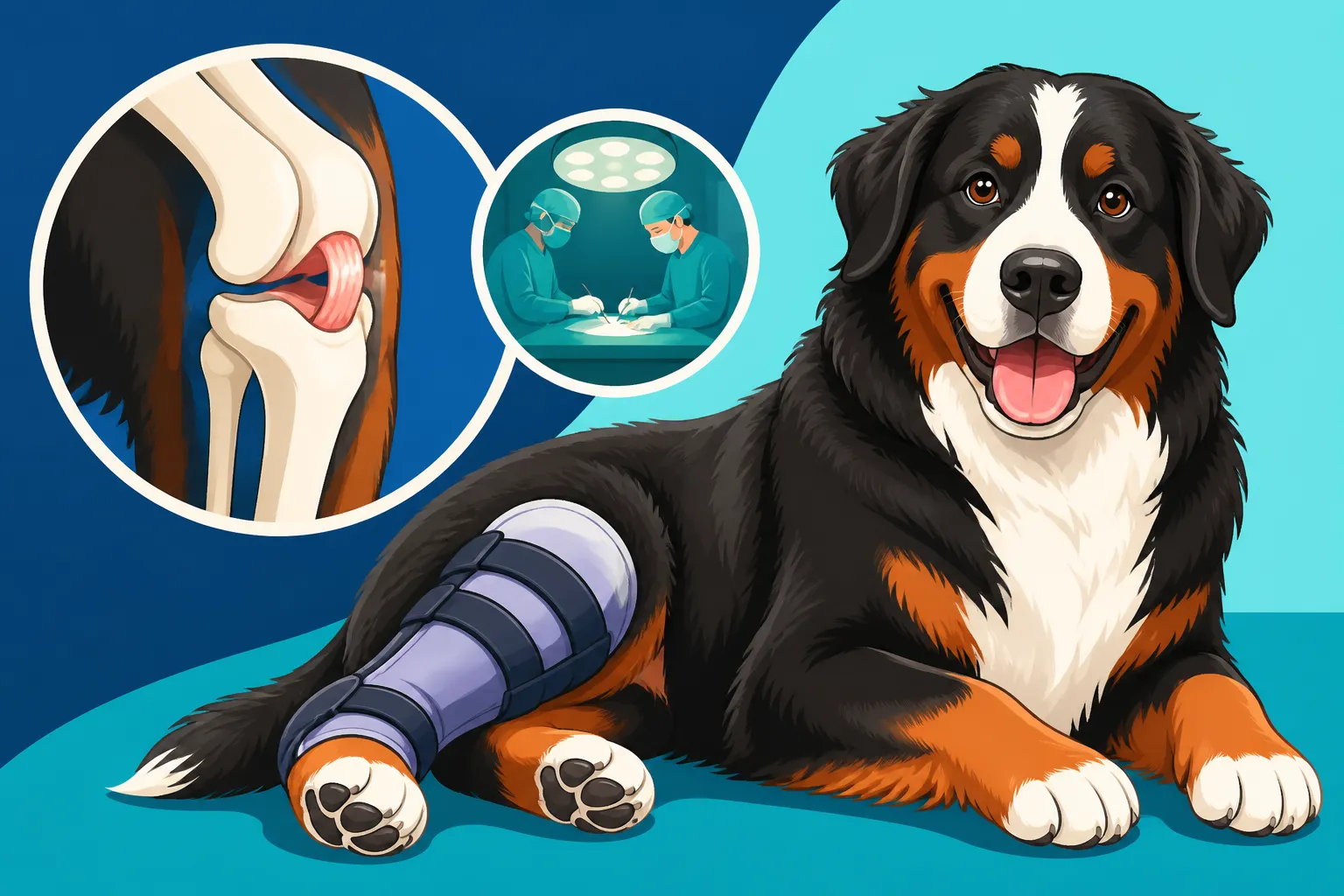
- Tibial Plateau Leveling Osteotomy (TPLO): This is one of the most common and highly effective procedures for large dogs. It involves making a curved cut in the top of the tibia (shin bone), rotating the segment, and fixing it in place with a bone plate and screws. The goal is to flatten the tibial plateau angle, which prevents the femur from sliding backward down the sloped tibia during weight-bearing, thus neutralizing the forces that cause instability. TPLO generally offers a very stable joint post-operatively and allows for a quicker return to full function compared to some other methods.
- Tibial Tuberosity Advancement (TTA): Similar to TPLO, TTA also aims to alter the knee's biomechanics. In this procedure, the front part of the tibia (the tibial tuberosity) is cut, advanced forward, and stabilized with a cage and plate. This changes the angle of the patellar ligament, effectively creating a stable joint without relying on the cranial cruciate ligament. TTA can be a good option for certain cases, and recovery is often similar to TPLO.
- Lateral Suture (Extracapsular Repair): While less commonly recommended as the primary repair for very large, active dogs, it's worth understanding. This older technique involves placing a strong suture material outside the joint to mimic the function of the torn ligament, providing external stability. For smaller, less active dogs, or sometimes as a secondary procedure, it can be effective. However, for a heavy Bernese Mountain Dog, the artificial ligament often stretches or breaks over time due to the immense forces placed upon it, potentially leading to re-instability.
The choice of technique often depends on the individual dog's anatomy, the surgeon's preference and expertise, and sometimes the owner's financial considerations. Your vet or orthopedic specialist will discuss which option they believe is best suited for your Berner's specific situation.
Preparing Your Berner for Surgery
Preparation for such a major surgery starts well before the actual operating day. Weight management is paramount. If your Berner is overweight, even by a few pounds, losing that weight can significantly improve surgical outcomes and reduce stress on the healing joint. This might involve a prescription diet and carefully controlled exercise, as outlined in guides like Taking Weight Off a Bernese Mountain Dog. Your vet will likely recommend pre-operative bloodwork to ensure your dog is a good candidate for anesthesia and to check for any underlying health issues that could complicate surgery or recovery. This can include a full blood panel and sometimes a cardiac workup.
At home, you'll need to prepare for your Berner's recovery. This means creating a safe, confined space where they can comfortably rest without temptation to jump or run. Orthopedic beds, non-slip rugs on slick floors, and baby gates to block stairs are essential. You might also want to consider a lifting harness, which can be invaluable for helping a large, injured dog move around, get outside for potty breaks, or get into a vehicle. Discussing pain management strategies with your vet beforehand is also wise, so you know what to expect in terms of medication and potential side effects.
The Role of a Board-Certified Surgeon
While many general practice veterinarians perform cruciate surgeries, for a large breed like a Bernese Mountain Dog, involving a board-certified veterinary orthopedic surgeon is often highly recommended. These specialists have advanced training and experience specifically in complex orthopedic procedures, including hundreds of TPLOs and TTAs. They often have access to specialized equipment and facilities that may not be available in a general practice.
Their expertise can lead to more precise surgical execution, reduced risk of complications, and potentially better long-term outcomes for your Berner. They can also offer more nuanced advice on post-operative care and rehabilitation, tailoring a plan specifically to your dog's needs. While a referral to a specialist might mean additional costs, the investment can be well worth it for the peace of mind and the improved chances of a successful recovery for your beloved companion.
The Recovery Journey: Post-Surgery Care and Rehabilitation
The surgery itself is only half the battle; the recovery period for cruciate repair in a Bernese Mountain Dog is extensive and requires immense dedication from owners. It’s a marathon, not a sprint, and consistency is key to a successful outcome.
Immediate Post-Operative Care
After surgery, your Bernese Mountain Dog will typically spend a day or two at the veterinary hospital. During this time, the veterinary team will monitor them closely for pain, swelling, and any immediate complications. They will manage pain with a combination of injectable medications and likely start oral pain relief and anti-inflammatories that you’ll continue at home. You'll receive detailed instructions on incision care, which usually involves keeping it clean and dry, and watching for signs of infection such as redness, swelling, discharge, or a foul odor. An Elizabethan collar (e-collar or "cone of shame") will be a temporary but necessary accessory to prevent your Berner from licking or chewing at the incision site, which can introduce bacteria and delay healing.
Strict activity restriction is paramount in the initial weeks. This means no running, jumping, playing, or off-leash activity. Your Berner should be confined to a small, safe area, typically a crate or a small room, and only allowed out on a short leash for supervised potty breaks. Lifting assistance, such as a sling or harness, will be crucial to help them get up and down stairs or in and out of a car, especially when their The Bernese Mountain Dog Whose Back Legs Give Out from instability. Remember, even if they seem to feel better quickly, the bone and soft tissues need time to heal properly.
Long-Term Rehabilitation and Physical Therapy
Once the initial healing phase is over, typically around 2-4 weeks post-surgery, a structured rehabilitation program becomes vital. This is where you really build back your Berner's strength, range of motion, and confidence in their leg. Many owners find working with a certified canine rehabilitation therapist incredibly beneficial. They can design a personalized program that includes:
- Controlled Exercises: Starting with very gentle range-of-motion exercises, progressing to weight-bearing activities, and then building muscle strength. This might involve slow leash walks, standing exercises, and specific movements to engage the healing leg.
- Hydrotherapy: Underwater treadmill sessions are particularly excellent for Bernese Mountain Dogs. The buoyancy of the water reduces stress on the joints while allowing for effective muscle strengthening. This is why Hydrotherapy for an Arthritic Bernese Mountain Dog is so often recommended. The controlled environment also reduces the risk of slips or falls during exercise.
- Therapeutic Modalities: These can include laser therapy, therapeutic ultrasound, or electrical stimulation to help reduce pain, inflammation, and promote tissue healing.
Consistency with the rehabilitation exercises, whether at home or in a clinic, is directly correlated with the success of the surgery. Skipping sessions or rushing the process can lead to complications and a less optimal recovery. The entire rehab process can easily last 3-6 months, sometimes longer, depending on the individual dog and the specific surgical technique.
Potential Complications and What to Watch For
While cruciate surgery has a high success rate, complications can occur. It's important for owners to be vigilant.
- Infection: Post-surgical infections, though uncommon, can be serious. Watch for increased redness, swelling, heat, discharge, or your dog becoming lethargic or feverish.
- Implant Failure: In TPLO/TTA surgeries, the plates and screws used to stabilize the bone can sometimes loosen or break, requiring further surgical intervention. This is rare but a possibility.
- Meniscal Tears: The meniscus is a C-shaped cartilage in the knee. Often, when the CCL tears, the meniscus is also damaged, or it can tear later. If a meniscal tear is present, it's usually addressed during the initial surgery. However, new meniscal tears can occur later, causing renewed lameness and pain, sometimes necessitating a second surgery.
- Re-injury or Injury to the Other Leg: Bernese Mountain Dogs, like many large breeds, are predisposed to tearing the CCL in their other knee, sometimes within a year or two of the first injury. This is why addressing underlying factors like weight and maintaining a strong, balanced musculature is so important. A good pet insurance plan, like those offered by Healthy Paws, can be incredibly helpful for covering such eventualities.
- Progressive Arthritis: Even with successful surgery, some degree of Arthritis in a Bernese Mountain Dog by Six is common in the long term, due to the initial trauma and changes within the joint. This will require ongoing management, which might include joint supplements, pain medication, and continued controlled exercise to maintain comfort and mobility. Many owners find themselves looking into Starting a Bernese Mountain Dog on Joint Medication Young to help manage this.
Financial Considerations and Long-Term Outlook
Undertaking cruciate surgery for a Bernese Mountain Dog is a significant emotional and financial commitment. Understanding the costs involved and planning for the long-term care are crucial for every owner.
The Cost of Cruciate Surgery and Follow-Up Care
The cost of cruciate surgery can be substantial, reflecting the complexity of the procedure, the specialized equipment required, and the expertise of the veterinary team. For a large breed like a Bernese Mountain Dog, you can expect the initial surgery itself (TPLO or TTA) to range anywhere from $3,500 to $7,000 per knee or even more, depending on your geographic location, the specific surgical center (general practice vs. specialist), and any pre-existing complications.
This cost typically includes:
- Pre-operative consultations and diagnostics (X-rays, bloodwork)
- Anesthesia and monitoring
- The surgical procedure itself, including implants (plates, screws, etc.)
- Hospitalization for 1-2 days post-surgery
- Initial pain medications and anti-inflammatories to take home
However, the surgery cost is just the beginning. You'll also need to budget for:
- Post-operative X-rays: Usually taken at 6-8 weeks to confirm bone healing.
- Rehabilitation therapy: Multiple sessions of physical therapy, hydrotherapy, and home exercise program guidance can add anywhere from $50 to $150 per session, and a full course might involve 10-20 sessions or more.
- Long-term medications/supplements: As discussed, ongoing management for arthritis may involve daily joint supplements, NSAIDs, or other pain relief, adding a regular monthly expense.
- Potential complications: As mentioned, addressing infections or re-injuries will incur additional veterinary bills.
Considering the financial burden, it becomes clear that preventing injuries and managing your Berner's health holistically can mitigate some of these expenses, which contributes to The Running Costs of a Hundred Pound Bernese Mountain Dog over their lifetime.
Pet Insurance and Cruciate Ligament Injuries
This is where pet insurance can be a true lifesaver for Bernese Mountain Dog owners. Given that orthopedic issues are common in the breed and the high costs associated with their treatment, having a comprehensive pet insurance policy can turn a devastating financial blow into a manageable one. Companies like Healthy Paws are well-regarded for their comprehensive coverage, which typically includes accidents, illnesses, surgeries, and rehabilitation.
However, it's crucial to understand how pet insurance works, especially regarding cruciate ligament injuries:
- Waiting Periods: Almost all pet insurance policies have waiting periods before coverage for certain conditions, including cruciate ligament injuries, kicks in. These can range from a few weeks to several months. It's imperative to get insurance before any signs of lameness or injury appear.
- Bilateral Exclusion Clauses: Some policies might have clauses that exclude coverage for the second leg if the first was injured before the policy or during the waiting period. Always read the fine print! Healthy Paws is known for not having these bilateral exclusions, which is a huge benefit for breeds prone to such injuries.
- Pre-existing Conditions: No pet insurance policy will cover pre-existing conditions. If your Berner shows any signs of lameness or is diagnosed with a partial tear before you enroll in a policy or during the waiting period, that leg (and potentially the other, depending on the policy) will not be covered for cruciate repair.
Investing in pet insurance when your Bernese Mountain Dog is a young, healthy puppy can provide immense peace of mind. It’s a vital part of managing What a Bernese Mountain Dog Costs Over Its Whole Life.
Life After Surgery: What to Expect for Your Bernese Mountain Dog
With successful surgery and diligent rehabilitation, the vast majority of Bernese Mountain Dogs go on to live active, comfortable lives. They may not be able to return to extreme athletic activities, but they should be able to enjoy walks, play in the yard, and participate in family life without significant pain or lameness.
However, it's important to have realistic expectations. The operated leg will likely never be exactly "normal" again, and long-term management of arthritis, as discussed earlier, will likely be a part of their routine. This might involve supplements, periodic medication, and maintaining a healthy weight. Regular veterinary check-ups are essential to monitor the joint and address any new issues promptly. For dogs with chronic pain or mobility issues, even after surgery, Palliative Care for a Bernese Mountain Dog can become a consideration later in life, focusing on comfort and quality of life.
The journey through cruciate surgery and recovery is a challenging one, but for a hundred-pound Bernese Mountain Dog, it offers the best chance at regaining mobility and maintaining a good quality of life. Your dedication, patience, and commitment to their rehabilitation will be the most crucial factors in their successful return to enjoying life to the fullest.
| Surgical Technique | Description | Pros | Cons | Typical Cost (USD) |
|---|---|---|---|---|
| TPLO | Reshapes the tibia to neutralize forces that cause instability. | Very stable joint, excellent for large breeds, high success rate, often faster return to function. | Invasive, requires specialized equipment and surgeon, higher cost, potential for implant complications (rare), risk of meniscal injury. | $4,000 – $7,000+ |
| TTA | Advances the tibial tuberosity to change patellar ligament angle. | Good for large breeds, often less invasive than TPLO, good success rate. | Similar to TPLO regarding specialization and cost, potential for implant complications, less common for extremely steep tibial plateau angles. | $3,500 – $6,500+ |
| Lateral Suture | Uses a strong suture outside the joint to provide external stability. | Less invasive, lower cost, can be performed by general practitioners. | Less stable for very large or active dogs, higher risk of suture breakage or stretching, often slower and less complete return to function compared to TPLO/TTA, higher re-tear rate. | $2,000 – $4,000 |
Disclaimer
This guide provides general information about cruciate surgery for Bernese Mountain Dogs and is not a substitute for professional veterinary advice. Always consult with a qualified veterinarian or board-certified orthopedic specialist regarding your dog's specific health condition, diagnosis, and treatment plan.