The Five Minute Rule and a Bernese Mountain Dog Puppy
You brought home a fluffy tricolor bear cub, and within a week someone at the dog park told you about the “five minute rule”: five minutes of walking per month of age, twice a day. Then your breeder said something slightly different, and a forum said it was a myth. This guide explains where the rule came from, what it actually protects, and how to use it sensibly with a Bernese Mountain Dog puppy.
What the Five Minute Rule Actually Says
The rule is simple on paper. For every month of your puppy’s age, allow roughly five minutes of structured, on-leash exercise, up to twice a day. A three-month-old Berner gets about fifteen minutes per outing. A six-month-old gets about thirty. A ten-month-old gets around fifty. The idea is to grow the walk with the dog instead of treating a puppy like a small adult that just needs to “burn off energy.”
It sounds tidy, and that is part of its appeal. When you are standing at the door with a wriggling twenty-five pound puppy who has just eaten a sock, a number you can count is comforting. But the rule is a rule of thumb, not a veterinary formula, and it only works if you understand what it is trying to do.
Where the Rule Came From
The five minute guideline spread through UK breeder and kennel club circles, where it became a common piece of advice handed over with puppy packs. It was never the result of a single large controlled study proving that five minutes is safe and seven minutes is dangerous. Instead, it grew out of a broad, well-supported concern: large and giant breed puppies have growth plates that stay open for a long time, and repetitive, forced, high-impact exercise during that window is linked with joint problems later.
Some research in Scandinavia looked at large breed puppies and found that certain early activities, such as regular stair use in the first months, were associated with higher rates of hip dysplasia, while gentle off-leash exercise on soft, uneven ground seemed to be associated with lower rates. That nuance matters. The five minute rule is a simplified way of saying “go easy on repetitive, forced exercise,” not “keep your puppy on the sofa.”
Why It Matters More for a Berner
Bernese Mountain Dogs are not just big. They are heavy-boned, deep-chested dogs that can go from around ten pounds at eight weeks to seventy, eighty or more than a hundred pounds as adults. Most of that growth happens in the first year, and the skeleton keeps maturing well into the second. Growth plates near the hips, knees and elbows may not fully close until somewhere between twelve and eighteen months, sometimes later in big males.
The breed also carries a well-known load of orthopedic trouble, from elbow dysplasia to hip dysplasia to cruciate tears. If you have read about Joint Disease in a Hundred Pound Bernese Mountain Dog, you already know that much of it is inherited. Exercise does not cause dysplasia on its own, but sloppy exercise habits in puppyhood can make an inherited weakness show up sooner or worse. That is why so many Berner breeders push the five minute rule hard, even if they know it is approximate.
There is also a mental side. A Berner matures slowly in body and mind, which is the theme of Why a Bernese Mountain Dog Stays a Puppy Until Three. A ten-month-old may look like an adult and still have a puppy’s judgment about leaping off a deck or wrestling a Labrador twice its age.
Using the Rule Day to Day Without Overthinking It
The most common frustration owners describe is guilt in both directions. You worry that a long walk will wreck the hips, and then you worry that a short walk is leaving a bored, mouthy puppy who chews your baseboards. Here is how to apply the guideline so it actually helps.
A Month by Month Guide
The table below gives a practical starting point. Treat the times as a ceiling for structured, on-leash walking, not a requirement, and adjust for your individual puppy.
| Puppy Age | Structured Walk per Outing | Good Activities | Things to Avoid |
|---|---|---|---|
| 2 to 3 months | 10 to 15 minutes | Yard sniffing, short leash practice, gentle socialization outings | Long neighborhood loops, stairs, jumping off furniture |
| 4 months | About 20 minutes | Slow walks on grass, carrying to new places, short training games | Running alongside a bike, rough play with adult dogs |
| 5 to 6 months | 25 to 30 minutes | Sniff walks, easy trails, puppy class | Repeated ball chasing, steep descents |
| 7 to 9 months | 35 to 45 minutes | Longer sniff walks, swimming in calm water, beginner obedience | Jogging on pavement, agility jumps |
| 10 to 12 months | 50 to 60 minutes | Varied terrain walks, longer outings with rest breaks | Forced endurance work, long hikes on hard ground |
| 12 to 18 months | Build gradually beyond an hour | Slowly add distance and hills, check with your vet | Pulling carts or heavy loads before clearance |
Notice that the “good activities” column does a lot of the work. The rule is about controlling the boring, repetitive, forced kind of exercise. A puppy who pads around the yard investigating leaves for twenty minutes, then flops down on her own, is not breaking anything.
Free Play Versus Forced Exercise
The single most useful distinction is between self-directed play and exercise you impose. When your puppy plays off leash on grass, she sets her own pace. She stops when tired, lies down, sniffs, rolls, and starts again. That pattern of short bursts and frequent rests is how young bodies naturally move.
A leash walk is different. The puppy has to keep up with you, on your route, at your speed, often on concrete. A puppy will keep walking long after she should stop, because she wants to stay with you. That is exactly where the five minute ceiling earns its keep.
Here is a realistic scenario. Maya lives in a Denver suburb with a five-month-old Berner named Otto. She used to take him on a forty-minute loop around the neighborhood every evening because he seemed wired. By the end of each walk he was lagging, sitting down on corners, and once refused to move. She cut the loop to twenty-five minutes, added fifteen minutes of free sniffing in the backyard and a few minutes of training games in the kitchen, and Otto stopped flopping on the sidewalk. He was not getting less activity overall. He was getting the right kind.
For more on avoiding repetitive strain, see Hard Surfaces and a Growing Bernese Mountain Dog and the practical answers in Whether Stairs Damage a Bernese Mountain Dog Puppy.
Filling the Rest of the Day
If structured walks are short, you need other outlets so your puppy does not become a furry demolition crew. These all tire a Berner puppy’s brain without pounding the joints:
- Short training sessions of a few minutes at a time, several times a day, working on sit, down, wait and name recognition.
- Sniff games, such as scattering part of a meal across the lawn or hiding kibble in a rolled towel.
- Food puzzles and lick mats, which slow eating and occupy a puppy during your work calls.
- Socialization trips where the puppy mostly sits and watches, such as a bench outside a hardware store or a quiet corner of a farmers market.
- Calm handling practice, touching paws, ears and mouth, which pays off later at grooming and vet visits.
- Gentle swimming in shallow, calm water once vaccines and your vet allow it, always with a close eye on fatigue.
Many owners pick up lick mats, snuffle mats and puzzle feeders from Chewy or Amazon, and both stock a wide range of sizes suitable for a big-mouthed puppy. Choose sturdy, appropriately sized versions, and supervise any toy a teething Berner might shred. Keeping sessions brief also matches the breed’s attention span, which is covered well in Training Sessions Short Enough for a Bernese Mountain Dog.
Reading Your Puppy Instead of the Clock
The five minute rule is a starting point. Your actual puppy is the final word. Some Berners are mellow couch potatoes at four months, others are bouncing off the walls. Learning to read fatigue and discomfort is more valuable than any formula.
Signs You Are Doing Too Much
Watch for these during and after outings:
- Lagging behind, sitting down mid-walk or lying flat and refusing to continue.
- A change in gait, such as bunny hopping with the back legs, a stiff or short stride, or favoring one leg.
- Stiffness when getting up after a nap, especially the morning after a busy day.
- Reluctance to go up or down steps that were easy last week.
- Unusual irritability, mouthiness or restlessness that looks like an overtired toddler.
- Excessive panting on a mild day, which in a black-coated breed can quickly become dangerous.
Growing Berners sometimes develop a limp that seems to move from leg to leg, a pattern discussed in The Shifting Limp of a Growing Bernese Mountain Dog. Any limp that lasts more than a day or two, or any lameness with pain, swelling or fever, deserves a vet visit rather than a guess. Heat adds another layer, and summer walks need to move to early morning and late evening. If you are unsure about warning signs, read up on Heat Stroke in a Bernese Mountain Dog before the hot months arrive.
Signs You Are Doing Too Little
The opposite problem is real too. A puppy kept from almost all activity can become frustrated, anxious and destructive, and muscles that never get worked do not support joints well. Signs that your puppy needs more appropriate outlets include:
- Constant chewing of furniture, door frames or walls even when chew toys are available.
- Frantic zoomies indoors every evening that end in mouthing people.
- Difficulty settling in a crate or bed, even after meals.
- Pulling hard on leash from sheer pent-up energy.
The answer is rarely a longer forced walk. It is more variety, more sniffing and more brain work. The balance is explored further in How Little a Bernese Mountain Dog Puppy Should Do.
Play With Other Dogs
Puppy play with a well-matched friend is excellent exercise, but size and style matter. A gentle adult dog that self-handicaps is great. A rowdy adolescent Lab that body-slams your puppy into a fence is not. Keep sessions short, interrupt before your puppy gets overwhelmed, and pick soft footing. The specifics are covered in Whether a Bernese Mountain Dog Puppy Can Play With Big Dogs.
Common Mistakes Well-Meaning Owners Make
Most overexertion in Berner puppies does not come from careless owners. It comes from loving, enthusiastic people who simply did not know where the hidden load was. A few patterns show up again and again:
- Weekend catch-up. The puppy gets short walks all week, then a two-hour family hike on Saturday because everyone is finally home. The weekly total might look reasonable, but a single long outing on tired legs is exactly what the rule tries to prevent.
- Endless fetch. A ball launcher on a hard lawn produces dozens of sprints, sudden stops and twisting turns in a few minutes. Swap it for rolling a toy along the grass a handful of times.
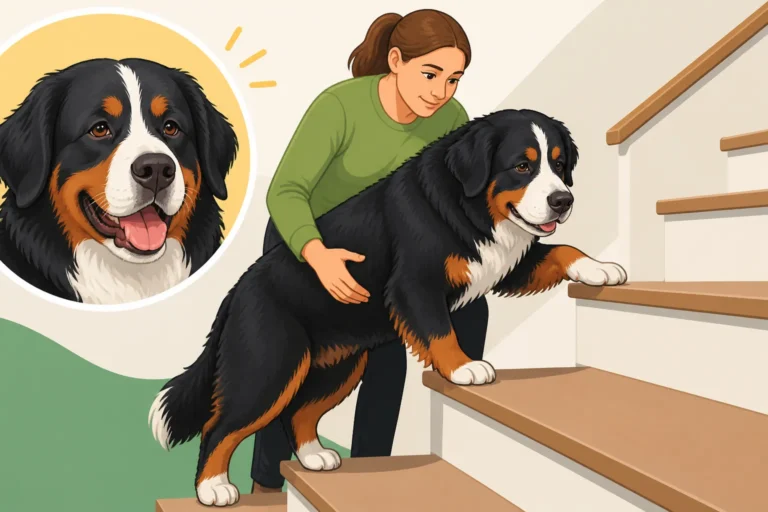
- Furniture launches. Jumping off the bed, the sofa or the back of an SUV lands the full weight of a heavy puppy on still-developing front legs. Lift your puppy or use a ramp.
- Counting only the walk. A trip to a busy pet store, a playdate and a training class all add up. On a day packed with outings, trim the leash walk.
- Ignoring the morning after. If your puppy is stiff or flat the day after a big outing, treat that as information and scale back.
None of these mistakes guarantees harm, and a single busy day will not ruin a healthy puppy. The goal is to stop them from becoming habits during the months when bones are still shaping.
How Growth, Weight and Food Fit Into the Picture
Exercise is only one part of protecting a Berner’s joints. The other big lever is how fast your puppy grows, and that is mostly about food. A lean puppy carries less load on every stride, which makes any walk safer.
Why Lean Matters More Than Big
Heavy, fast-growing puppies put more stress on developing joints. Large breed research has repeatedly found that keeping puppies lean during growth tends to be associated with fewer orthopedic problems later. You should be able to feel your puppy’s ribs easily under a thin layer of fat, and see a waist when looking from above. If you need a reference, How Fast a Bernese Mountain Dog Puppy Should Grow walks through typical growth curves and why a slower climb is usually better.
The practical side is diet. Large breed puppy foods are formulated with controlled calories, calcium and phosphorus, which helps avoid pushing growth too fast. Some owners also look at fresh, portioned diets from companies like Ollie, which deliver pre-measured meals, and others stick to a quality large breed kibble. Whatever you choose, check that the food is labeled as complete and balanced for growth of large-size dogs, check the brand’s own site for current plan options, and ask your vet how it fits your puppy. Feeding routines are covered in depth in Feeding a Bernese Mountain Dog Puppy to a Hundred Pounds.
Timing Meals Around Walks
Berners are a deep-chested breed with a real risk of bloat, so it makes sense to avoid hard exercise right around meals. A common habit is to wait an hour or so after eating before a walk or active play, and to let the puppy cool down and settle before a meal. Splitting food into three or four smaller meals for young puppies, and at least two meals for older ones, also helps.
Putting It All Together
Here is a sample day for a four-month-old Berner that follows the five minute rule without leaving her bored:
- Early morning: potty trip, then a 20-minute slow sniff walk on grass before it gets warm.
- Breakfast, followed by a quiet crate or pen nap.
- Mid-morning: three minutes of training, then a lick mat while you work.
- Late morning: ten minutes of free play in the yard and handling practice.
- Lunch, then another nap.
- Afternoon: a socialization trip where she watches the world from a bench.
- Early evening: a second 20-minute walk on varied, soft ground.
- Dinner, then a short, calm play session and an early bedtime.
That day contains forty minutes of structured walking, which fits the rule, plus plenty of enrichment. Most owners find that a puppy on a schedule like this sleeps well and is far less destructive than one who gets a single long, exhausting march.
When the Rule Stops Applying
Somewhere between twelve and eighteen months, depending on your puppy and your vet’s advice, you can begin moving past the formula. Many owners schedule hip and elbow X-rays around this time and use the results to decide how quickly to build toward hikes, jogging or drafting work. Build gradually, add hills slowly, and keep watching for the same signs of fatigue. Good leash habits matter more as your Berner reaches full weight, so it is worth starting early with Leash Manners on a Hundred Pound Bernese Mountain Dog.
The bottom line is that the five minute rule is a helpful guardrail, not a law. Use it to keep forced, repetitive exercise in check, fill the rest of the day with free play and brain work, keep your puppy lean, and let your vet and your puppy’s own body language guide the details.
Disclaimer
This article is for general informational purposes only and does not constitute professional advice. Laws, prices and regulations vary by location and change over time. Consult a qualified professional for guidance on your specific situation.