How the Bernese Mountain Dog Was Split From Its Cousins
It’s a common sight for us Bernese Mountain Dog lovers: someone spots your beautiful Berner and exclaims, "Oh, is that a Greater Swiss?" or "I thought they had short hair!" It can be a little frustrating when people don't realize just how unique our long-haired, tricolor companions are, distinct from their similar-looking but structurally different Swiss cousins. This guide dives deep into the fascinating history of how the Bernese Mountain Dog, with its signature flowing coat and gentle disposition, came to be recognized as a separate and beloved breed, setting it apart from the other equally wonderful, but distinct, Swiss Sennenhunds.
The Shared Ancestry: Before the Formal Split
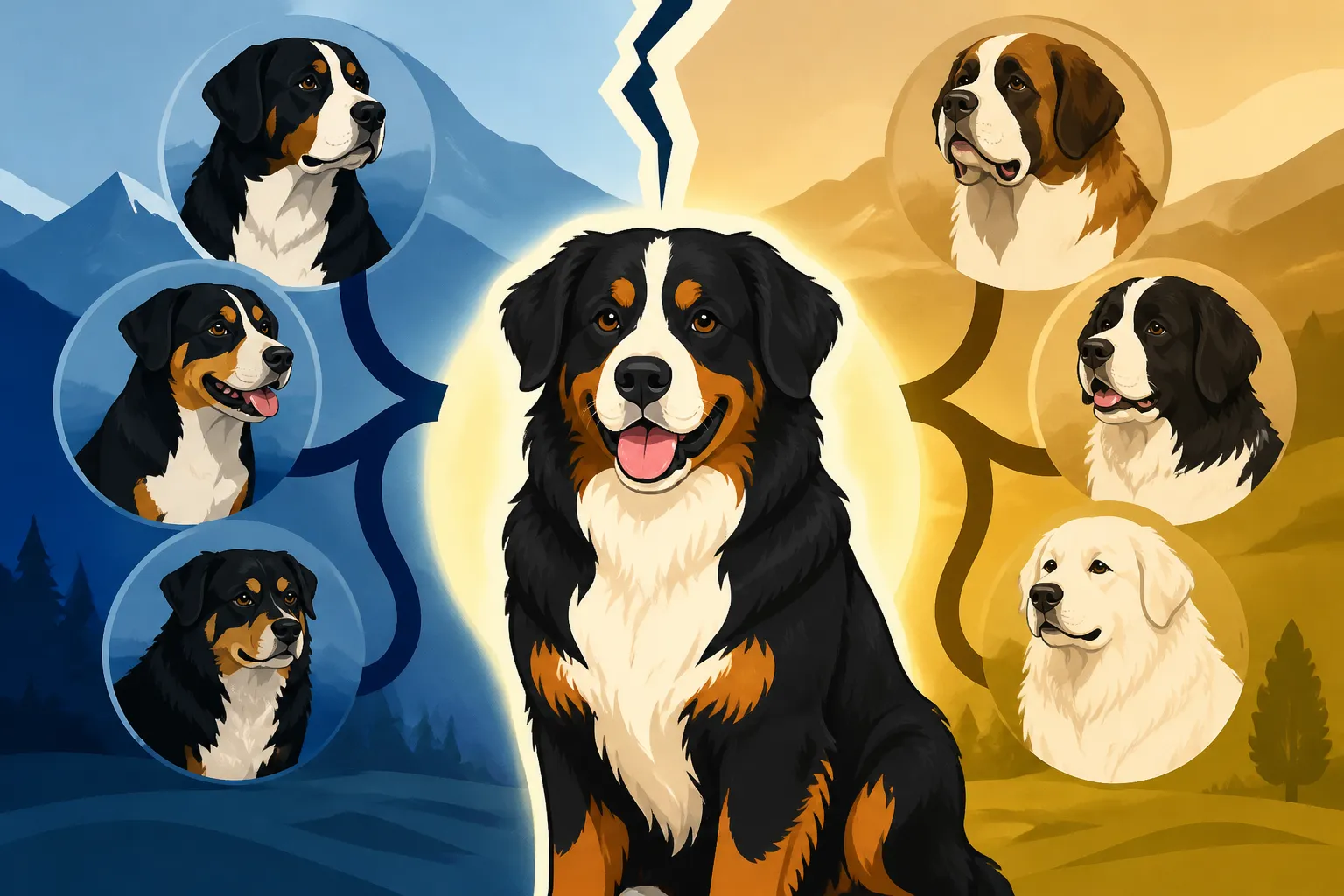
Before the Bernese Mountain Dog, the Greater Swiss Mountain Dog, the Appenzeller, and the Entlebucher Sennenhunds were formally recognized as distinct breeds, they were all simply "Sennenhunds"—Alpine pasture dogs. These robust, intelligent, and versatile dogs were an indispensable part of life for farmers, herders, and dairymen in the rugged Swiss Alps. They shared a common heritage, molded by centuries of working alongside humans in demanding mountain environments.
The Sennenhund Legacy in the Swiss Alps
Imagine the Swiss Alps centuries ago, a landscape dotted with isolated valleys, each with its own farming communities. In these communities, dogs weren't just pets; they were essential members of the workforce. These early Sennenhunds were true jacks-of-all-trades. They herded cattle, keeping the stubborn bovines in line as they moved from pasture to pasture. They guarded the farmstead, their imposing presence and deep barks deterring potential predators or trespassers. And, perhaps most famously, they pulled carts laden with milk, cheese, and other farm produce to market, navigating steep mountain paths with unwavering strength and determination.
This shared working heritage meant that all early Sennenhunds developed certain common traits: a sturdy build, a reliable temperament, and an innate desire to work. They were bred for function, not for fancy show rings. Their tricolor coats, usually black with white and rust markings, provided camouflage in the dappled light of the forests and protection against the elements. While their exact origins are a bit hazy, many believe they descend from large, mastiff-type dogs brought across the Alps by the Romans, which then interbred with native farm dogs. This robust foundation gave all the Sennenhunds their characteristic power and resilience. You can learn more about their beginnings in The Swiss Valley the Bernese Mountain Dog Comes From.
Regional Varieties and Early Recognition Challenges
Because these communities were often quite isolated by mountains and valleys, dogs in different regions developed subtle variations over generations. A farmer in the Dürrbach valley, for instance, might unknowingly favor dogs with slightly longer coats or a particular white marking pattern, simply because those traits seemed to pop up more often in his successful working dogs. Over time, these preferences, combined with a limited gene pool within specific valleys, led to the development of distinct "types" of Sennenhunds, even if no one was calling them "breeds" yet.
Think of it like local dialects: everyone speaks the same language (Sennenhund), but the accents and specific words vary from village to village. The Dürrbachler, as the Bernese Mountain Dog was initially known, was one such regional variant, particularly common in the Dürrbach region of the canton of Bern. These dogs were well-known for their long, beautiful coats, which offered extra insulation in the colder mountain passes. However, without formal breed clubs, written standards, or a centralized registration system, these distinctions remained informal. Farmers simply had "the good dogs from down the valley" or "the big dogs that pull the carts." The challenge, as canine enthusiasts later discovered, was to take these regionally recognized types and formalize them into distinct, reproducible breeds. The history of their specific valley is fascinating, and you can delve deeper into it with The Dürrbach Valley and the Dogs Named After It.
The Formal Divergence: Naming and Standardization
The late 19th and early 20th centuries saw a surge of interest in dog breeding and formalizing distinct breeds across Europe. This era marked a critical turning point for the Swiss Sennenhunds, as dedicated individuals began the process of identifying, preserving, and standardizing the different regional types. This is where the Bernese Mountain Dog truly began to step out as its own entity.
The Rise of the Dürrbachler
The story of the Bernese Mountain Dog's formalization really centers around the Dürrbach region, a small village near Riggisberg in the canton of Bern. Here, the long-haired tricolor farm dogs were particularly beloved and well-established. They were known locally as "Dürrbachler," after their home turf. These dogs caught the eye of a few key figures who recognized their unique qualities and the importance of preserving them.
One such pivotal figure was Franz Schertenleib, an innkeeper and passionate dog lover from Burgdorf. He spent years traveling the Swiss countryside, seeking out the best examples of these traditional Dürrbachler dogs. He gathered them, recognizing their consistent type and gentle temperament, and became a driving force in their preservation. Soon after, Professor Albert Heim, a renowned geologist and cynologist, lent his academic expertise to the cause. Heim played a crucial role in drafting the first official breed standard for these dogs, solidifying their characteristics and advocating for their recognition as a distinct breed. He also suggested changing their name from Dürrbachler to "Berner Sennenhund," meaning Bernese Alpine Dog, to give them a broader, more distinguished identity linked to the canton of Bern itself. These efforts were truly remarkable and are discussed further in Franz Schertenleib and the Bernese Mountain Dogs He Found.
Defining the Other Sennenhunds
While the Berner Sennenhund was finding its footing, similar efforts were underway for its cousins. The Greater Swiss Mountain Dog, for instance, was also rediscovered and championed by Professor Heim. These dogs, initially known as "Butcher's Dogs" or "Metzgerhund," were typically larger, heavier-boned, and had short, dense coats. They shared the tricolor pattern but lacked the Bernese's signature long hair. Their robust build made them excellent draft dogs and guardians, a powerful presence on any farm.
The Appenzeller Sennenhund and Entlebucher Sennenhund, both smaller and more agile, were also distinguished and standardized. The Appenzeller, named after the Appenzell region, is known for its distinctive tightly curled tail and lively, watchful temperament. The Entlebucher, from the Entlebuch valley, is the smallest of the four, often born with a natural bobtail and possessing an incredibly active, intelligent nature.
The key differentiation, from a practical and breed-defining standpoint, often came down to coat length and subtle size variations. While all were tricolor, the Bernese's long coat became its most immediate and defining characteristic, setting it visually apart from the short-haired Greater Swiss, Appenzeller, and Entlebucher. This careful identification and documentation by early breed enthusiasts allowed each "type" to solidify into its own recognized breed. For a comprehensive look at the family, check out The Four Swiss Breeds Beside the Bernese Mountain Dog.
Key Distinguishing Features and Breed Standards
Once the drive for formal recognition began, it became crucial to clearly articulate what made each Sennenhund breed unique. For the Bernese Mountain Dog, its magnificent coat was undoubtedly the star, but other elements of its physical structure and temperament also played a vital role in setting it apart.
The Bernese Mountain Dog's Unique Coat
Without a doubt, the most striking and defining feature that separated the Bernese Mountain Dog from its cousins was its coat. While all four Swiss Mountain Dogs share the iconic tricolor pattern of black, white, and rust, the Bernese is the only one with a long, thick, and luxurious double coat. This flowing fur is not just beautiful; it's highly functional, providing excellent insulation against the cold Swiss winters.
Imagine the effort that goes into grooming this gorgeous coat! It's a commitment, requiring regular brushing to prevent mats and control shedding. Products from places like Chewy are invaluable for maintaining a healthy Bernese coat, offering everything from slicker brushes to deshedding tools designed for long-haired breeds. This long coat gives the Bernese a softer, more elegant appearance compared to the rugged, utilitarian look of its short-haired relatives. The breed standard meticulously describes this coat—how it should be straight or slightly wavy, never curly, and its rich black background with clear white markings on the chest (often forming a "Swiss cross"), blaze, and tip of the tail, complemented by those warm rust-colored accents on the cheeks, over the eyes, and on the legs. These specific markings and the long coat are meticulously detailed in Bernese Mountain Dog Markings and What They Mean.
Size, Build, and Temperament Differences
Beyond the coat, there are noticeable differences in size, build, and even subtle nuances in temperament that further delineate the Bernese from its kin.
The Bernese Mountain Dog is undeniably a large breed, typically weighing between 70 to 115 pounds. Their build is sturdy and well-balanced, giving them an impression of great strength without being overly bulky or clumsy. They possess a noble, kindly expression, which perfectly matches their generally calm, good-natured, and affectionate disposition. Berners are known for being devoted family dogs, often described as "velcro dogs" because they love to be close to their people. This gentle giant persona is a huge part of their appeal.
In contrast, the Greater Swiss Mountain Dog, while also large, often leans towards an even more powerful and muscular build, frequently weighing more than the Bernese. Their short, dense coats highlight their impressive musculature. Their temperament, while loyal and devoted, can sometimes be described as more watchful and perhaps a bit more assertive than the typically softer Bernese. The Appenzeller and Entlebucher, on the other hand, are distinctly smaller and more athletic. They are often more energetic, agile, and possess a higher drive, reflecting their historical roles as more active herding and guarding dogs. The Appenzeller, for example, is often described as having a boundless energy, while the Entlebucher is known for its quick wit and intense focus. Each breed standard outlines these specific physical and character traits, ensuring that breeders aim for consistency within their chosen lines. You can get a deeper understanding of what makes a Berner a Berner by reading The Bernese Mountain Dog Breed Standard.
| Feature | Bernese Mountain Dog | Greater Swiss Mountain Dog | Appenzeller Sennenhund | Entlebucher Sennenhund |
|---|---|---|---|---|
| Coat Type & Length | Long, thick, silky double coat | Short, dense double coat | Short, dense double coat | Short, dense double coat |
| Approximate Weight | 70-115 lbs (32-52 kg) | 85-140 lbs (39-64 kg) | 48-70 lbs (22-32 kg) | 45-65 lbs (20-29 kg) |
| Approximate Height | 23-27.5 inches (58-70 cm) | 25.5-28.5 inches (65-72 cm) | 20-22 inches (50-56 cm) | 16.5-20 inches (42-51 cm) |
| Overall Build | Sturdy, balanced, powerful | More robust, heavy-boned | Agile, muscular, medium | Compact, powerful, medium |
| Key Temperament Trait | Good-natured, calm, affectionate | Confident, watchful, loyal | Lively, agile, watchful | Active, intelligent, devoted |
| Distinctive Feature | Long coat, gentle expression | Larger size, powerful presence | Curled tail, energetic | Often bobtail, very alert |
The Impact of Breed Clubs and Registration
The establishment of breed clubs and the creation of formal registration systems were perhaps the most crucial steps in officially splitting the Bernese Mountain Dog from its cousins. These organizations provided the framework necessary to define, protect, and propagate each breed's unique characteristics, moving them beyond mere regional types.
Formal Recognition and Pedigrees
The process of formal recognition began with passionate individuals, like Professor Heim, forming clubs dedicated to specific types of Sennenhunds. For the Bernese, this started with the Dürrbach Club in 1907, which later became the Swiss Bernese Mountain Dog Club. The primary goal of these clubs was to create and maintain a strict breed standard, a detailed written description of the ideal dog for that particular breed. This standard covered everything from coat texture and color to body proportions, ear set, and even temperament.
Crucially, these clubs also established studbooks and pedigree registration systems. This meant that for the first time, the lineage of individual dogs could be officially recorded and tracked. If you wanted to breed a true Bernese Mountain Dog, you had to ensure its parents and ancestors met the established standard and were registered within the studbook. This system effectively drew clear lines between the emerging breeds. No longer could a farmer simply breed his long-haired Dürrbachler with a short-haired Butcher's Dog and still call them both "Sennenhunds" under a formal breed designation. This dedication to tracking ancestry and maintaining records is what ensures the purity and consistency of the breed to this day. You can read more about these early efforts in The Dürrbach Club Founded in 1907.
Maintaining the Divide Through Breeding
Once these breed standards were set and clubs formed, the divide between the Bernese Mountain Dog and its cousins became actively maintained through careful, deliberate breeding practices. Breeders dedicated themselves to preserving and enhancing the specific traits outlined in their respective breed standards. This meant:
- Selective Breeding: Breeders would choose dogs that best exemplified the breed standard for mating. For Bernese breeders, this meant selecting dogs with the desired long coat, rich tricolor markings, gentle temperament, and sound structure. Conversely, Greater Swiss breeders would select for short coats, heavier bone, and their characteristic confidence.
- Preventing Cross-Breeding: The formalization effectively halted casual cross-breeding between the different Sennenhund types. While genetically similar, they were now distinct entities with distinct goals. Mixing them would dilute the very traits that dedicated individuals had worked so hard to establish.
- Health and Temperament Focus: Beyond appearance, breed clubs also focused on preserving the characteristic temperaments and addressing potential health concerns unique to each breed. This included promoting health testing relevant to the Bernese, such as screenings for hip and elbow dysplasia, eye conditions, and certain cancers. When looking for supplies for your Berner, remember that Chewy often offers breed-specific products or nutritional advice tailored to large breeds, supporting their overall health and development.
In essence, the split wasn't a single event but a gradual process of recognition, definition, and dedicated preservation. The natural regional variations that existed for centuries were finally given formal names and strict guidelines, ensuring that the magnificent Bernese Mountain Dog, with its signature long coat and gentle soul, would forever remain a distinct and cherished breed, a true gem of the Swiss Alps. Today, the commitment of breeders and owners continues to uphold the integrity of these standards, allowing us all to appreciate the unique beauty and character of each of the wonderful Swiss Sennenhunds.
Disclaimer
This article is for general informational purposes only and does not constitute professional advice. Laws, prices and regulations vary by location and change over time. Consult a qualified professional for guidance on your specific situation.