What Swiss Farmers Used Bernese Mountain Dogs For
A Bernese Mountain Dog’s size and gentle expression can make its history seem like a story about a big family pet, but Swiss farmers valued the breed for practical work. They used these dogs to move cattle, pull loaded carts, watch over the farm, and keep company with the people who worked there. This guide explains what those jobs involved—and what they did not.
The Bernese Mountain Dog’s place on a Swiss farm
A versatile worker, not a dog with just one job
The Bernese Mountain Dog developed as a farm dog in Switzerland, particularly in the canton of Bern. On a working farm, usefulness mattered. A dog might be expected to help with livestock, pull a cart, alert the household to visitors, and stay close to the family. The breed’s history is best understood as a combination of jobs rather than a single specialty.
The word Sennenhund reflects that working background. Senn refers to a Swiss alpine herdsman or dairyman, while Hund means dog. That connection helps explain why the breed’s role was tied to people and their farm routines, not simply to guarding a property or moving livestock. For more context on the name and its roots, see What Sennenhund Means in a Bernese Mountain Dog's Name.
A dog’s exact duties would have depended on the farm, the people, and the work at hand. One Berner might have spent more time hauling goods, while another was often around cattle or the farmhouse. It would be misleading to picture every dog performing every task, or to assume that historical farm work looked identical across the region. The breed’s reputation grew from being a capable, adaptable helper.
Why a strong, steady dog suited farm life
Farm work asked for dogs that could manage everyday activity around people, animals, and equipment. Berners have a substantial frame and were used for pulling, but size alone would not have made a dog useful. A practical farm dog also needed to be manageable around the household and able to work near livestock without creating unnecessary disruption.
That dependable, people-oriented working relationship is part of the breed’s story. Farmers did not need a dog that was constantly chasing animals or challenging every visitor. They needed a companion that could take part in the day’s work and remain close to the people directing it. The breed’s history is one reason the Bernese Mountain Dog is often described as a farm helper and family companion together.
For a broader account of the breed’s historical setting, read The Swiss Valley the Bernese Mountain Dog Comes From and What a Bernese Mountain Dog Did on a Swiss Farm. Those details help put individual jobs—like carting or moving cattle—into the larger picture of rural life.
The main jobs Swiss farmers used Bernese Mountain Dogs for
Pulling carts with farm goods
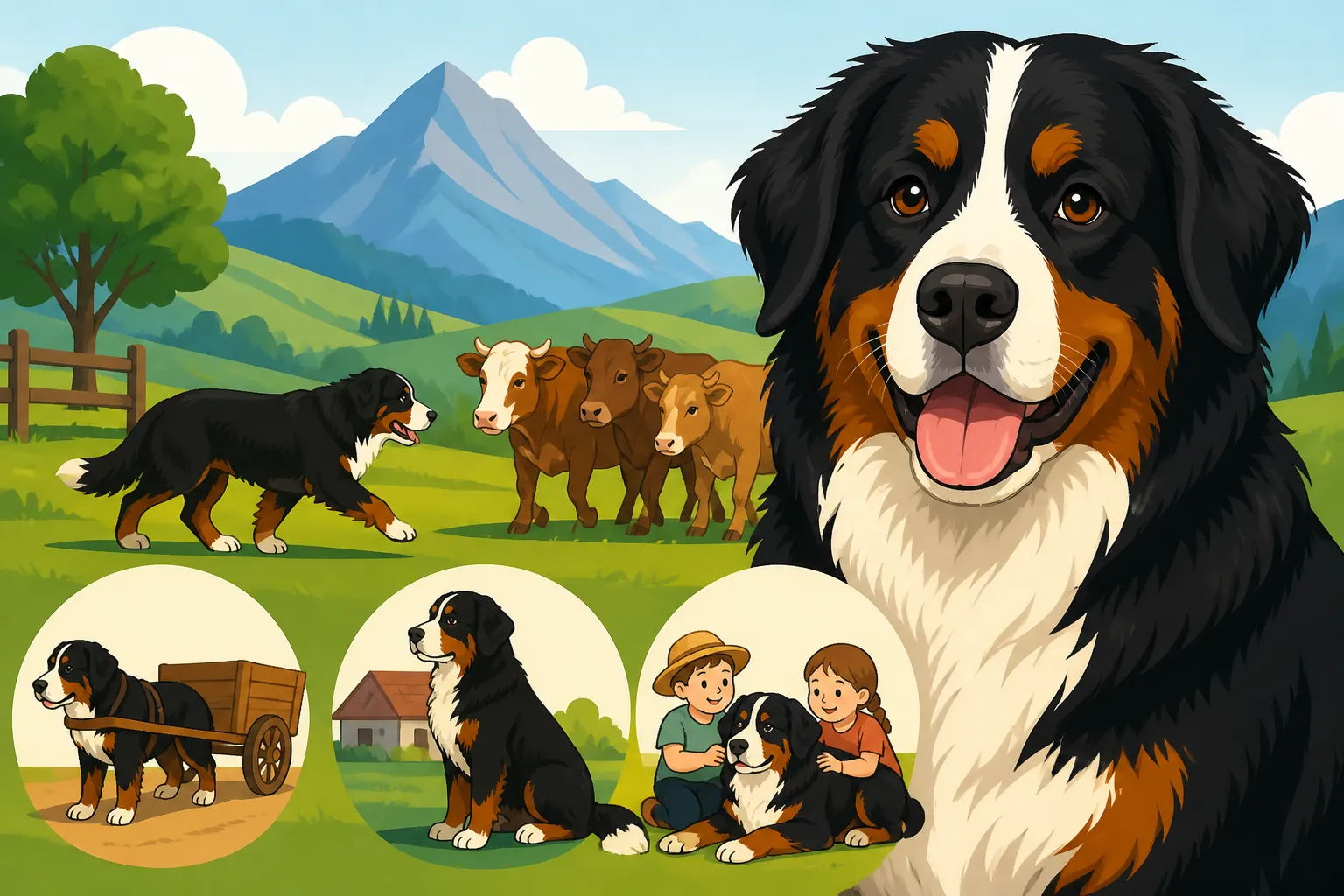
Cart work is one of the jobs most closely associated with Bernese Mountain Dogs. A harnessed dog could pull a small cart carrying goods, helping transport items between a farm, a village, or a market. Milk and dairy products are often linked with this history, along with other farm goods. The basic idea was straightforward: the dog supplied pulling power for a practical load.
This was not the same as asking a dog to haul an unlimited weight or work without regard for its condition. A cart, harness, route, load, and the dog’s fitness all matter. Historical use tells us that the breed was put to draft work; it is not a reason to copy an old task without proper training and attention to safety. A well-fitted harness and gradual conditioning are essential for anyone exploring carting today.
| Farm task | What the dog contributed | What the task did not mean |
|---|---|---|
| Cart pulling | Helped move farm goods along a route | Permission to load a dog heavily or work it when unfit |
| Cattle droving | Helped move livestock from one place to another | The same role as a specialist modern herding dog |
| Farm watch | Alerted people to activity around the property | A guarantee of aggressive guarding or protection |
| Companionship | Stayed close to the people and daily life of the farm | A dog kept separate from the household |
For more detail about the carting tradition, see The Milk Carts Bernese Mountain Dogs Pulled. If the idea inspires you to try modern draft work with a Berner, begin with health, equipment fit, and instruction—not with a loaded cart. Teaching a Bernese Mountain Dog to Pull a Cart covers the practical training side.
Moving cattle and other livestock
Bernese Mountain Dogs were also used around livestock, including for helping move cattle. Droving means guiding animals from one place to another, such as along a route between parts of a farm. In a working setting, a dog could assist the people managing the herd, but that does not mean the Berner’s job was identical to that of a specialist herding breed.
The distinction matters. “Herding” is often used broadly, but dogs vary in how they control livestock. Some breeds are known for specific techniques and intense control of movement; a Bernese Mountain Dog’s farm role was more general and practical. The dog worked as part of a human-led routine, and its behavior around animals depended on training and experience.
A modern Berner should not be placed among unfamiliar livestock simply because its ancestors worked on farms. Livestock can injure dogs, and a large dog can frighten or disrupt animals if it is not under control. To understand this historical role without assuming every Berner is a natural cattle dog, read Cattle Droving and the Bernese Mountain Dog's Old Job.
Watching over the farm and living alongside the family
Alerting the household
A farm dog could be useful as a presence around the property, noticing activity and alerting the people nearby. That is different from imagining the Bernese Mountain Dog as a highly specialized protection dog expected to confront intruders. A dog that barks or becomes attentive when someone approaches can serve as an early warning without being trained or suited to physical guarding.
This distinction can help today’s owners set realistic expectations. A Berner may notice a visitor, make noise, or stay close to its family, but individual temperament varies. The breed’s historical usefulness around farms does not mean every dog will protect a home, nor does it make aggressive behavior desirable. For a closer look at the difference between farm watchfulness and a dedicated guarding role, see Whether a Bernese Mountain Dog Was a Guard Dog.
A working companion who belonged close to people
Farm life was not divided neatly into “work time” and “pet time.” A dog that helped with daily chores would also spend much of its life around the people doing those chores. The Bernese Mountain Dog’s role included companionship: being part of the household and staying near its human family while farm tasks unfolded.
That history helps explain why the breed is often described as people-focused. It also points to a practical consideration for modern homes: a large, social dog needs interaction and a place in everyday family life. A Berner may be less content when left out of household routines for long stretches, regardless of whether its ancestors worked outdoors.
The daily-care side of sharing a home with a long-coated dog is very different from historic farm work, but it is part of the modern commitment. If coat maintenance feels daunting, Chewy can be one place to compare everyday grooming tools such as brushes and combs. Choosing the right tool and using it gently matters more than buying a large collection of supplies.
What this history means for Bernese Mountain Dogs today
Farm heritage does not automatically make a dog a working dog
A breed’s history can explain its build and traditional roles, but it does not tell you exactly what an individual dog will enjoy or be able to do. Health, temperament, training, age, and the dog’s physical condition all matter. A Berner might enjoy structured activities, while another may be happiest with walks and time with its family.
If you are interested in carting, approach it as a trained activity rather than a test of strength. Get guidance on equipment fit, build skills gradually, and stop if the dog shows discomfort or fatigue. A specialist draft harness is not interchangeable with an ordinary walking harness. Chewy may be useful for comparing routine walking gear, but for draft equipment and fitting advice, seek someone experienced in canine carting.
It is also worth remembering that a dog’s enthusiasm is not the only measure of whether an activity is safe. Ask your veterinarian about the dog’s suitability for strenuous work, especially if there are concerns about joints, growth, or previous injuries. The breed’s historical strength should never be treated as proof that a particular dog can safely pull a load.
Everyday care is part of being a Berner owner
The farm setting has changed, but the basics of responsible care have not: a dog needs a safe environment, suitable exercise, regular grooming, and attention to health. Berners have a dense coat that can collect dirt and tangles, especially after outdoor activity. Regular brushing and checking the feathering, ears, feet, and tail can prevent small problems from becoming uncomfortable mats.
For owners sorting out the practical basics, Chewy can be a convenient place to compare general grooming supplies and everyday dog-care items. It is only one option, and product choice should suit the individual dog. A brush that works well for one coat may not be comfortable or effective for another, so look for tools intended for a double coat and introduce grooming calmly.
The breed’s working past is still visible in its sturdy build and close relationship with people, but modern ownership is not a reenactment of farm life. Berners may still take part in draft activities or other structured work, while many are simply companions. To explore how the breed’s role has changed, see Whether Bernese Mountain Dogs Still Work in Switzerland and Whether Any Bernese Mountain Dog Works Today.
Disclaimer
This article is for general informational purposes only and does not constitute professional advice. Laws, prices and regulations vary by location and change over time. Consult a qualified professional for guidance on your specific situation.