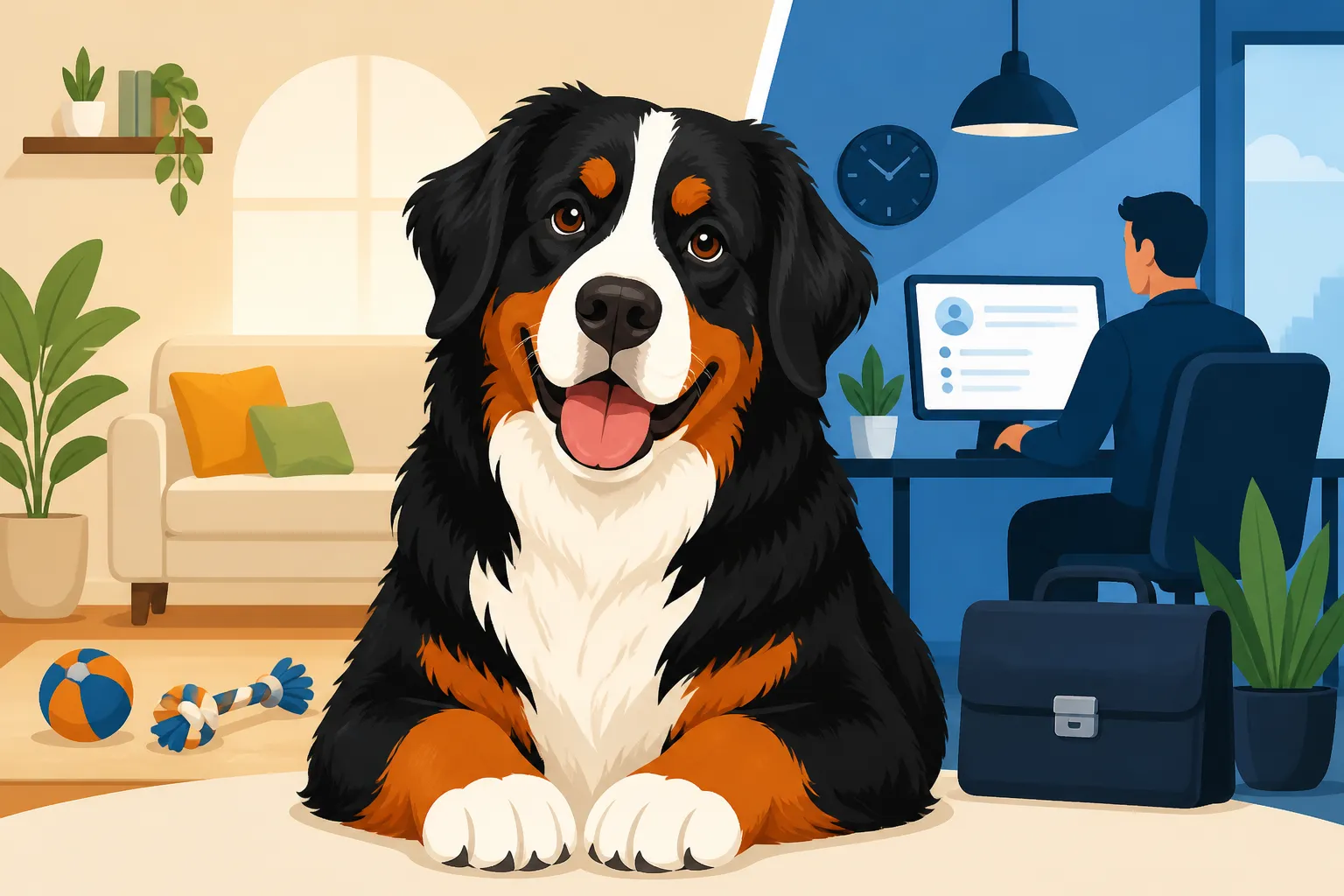
Whether a Bernese Mountain Dog Fits a Working Household
A Bernese Mountain Dog can be a wonderful companion in a working household, but its calm reputation does not mean it can comfortably spend every weekday alone. The real question is whether your routine can cover companionship, exercise, training, grooming, and a reliable plan for the hours you are away. This guide helps you assess the fit before a big, affectionate dog becomes part of your daily schedule.
What a Bernese Mountain Dog needs from a working household
Companionship matters more than having a large house
Berners are people-oriented dogs. Many like to be near their family, whether that means lying beside a desk while someone works from home or following the household from room to room. A spacious yard can be useful, but it does not replace attention and company. A dog left alone in a large yard is still alone.
That does not mean every owner has to stay home all day. Plenty of working households make it work by arranging a predictable routine and giving their dog meaningful contact before and after work. The tougher situation is a young dog left alone for a full workday without a gradual introduction, a midday break, or any change in routine.
Consider what a typical weekday would actually look like. If you leave early, commute, work a full day, and return late, your Berner may be waiting for a long stretch without a bathroom break or interaction. If you work a hybrid schedule, live near a trusted dog walker, or have family members home at different times, the same breed may fit much more easily.
It helps to think beyond the phrase “working household.” Two households with full-time jobs can have very different levels of flexibility. One may have a dog-friendly office and a neighbor who can help. The other may have long, fixed shifts and no backup care. Your arrangements, rather than your job title, are what determine the practical fit.
For a closer look at the breed’s general household needs, see The Kind of Home a Bernese Mountain Dog Belongs In. If you are weighing the breed against your work and family routines, Whether a Bernese Mountain Dog Is Right for You can help you consider the broader lifestyle picture.
Alone-time tolerance has to be built gradually
A puppy should not be expected to arrive home and immediately cope with a long workday alone. Young dogs need frequent bathroom opportunities, supervision, sleep, meals, and patient training. Even an adult dog may need time to adjust after adoption, a change of home, or a shift in the family’s schedule.
Start with brief, calm separations and increase them gradually, while watching how your dog responds. Some dogs settle after a short transition; others pace, bark, scratch at doors, drool, or become distressed. These signs are not simply “bad behavior.” They can indicate that the dog is finding the separation difficult, and the plan may need to be slowed down or supported by a qualified behavior professional.
A crate can be useful for some dogs when it has been introduced positively and is an appropriate place to rest. It is not a way to contain a dog for an entire workday. A secure, dog-proofed room or gated area may suit some adults better. Whatever arrangement you choose, provide water, a comfortable resting place, and enough space to move naturally.
If you are planning to adopt an adult Berner, ask the rescue or previous caregiver what the dog’s alone-time experience has been like. A dog who has lived with someone home most of the day may need a more gradual transition than one accustomed to a predictable routine. A Bernese Mountain Dog Left Alone and Stretching the Hours a Bernese Mountain Dog Copes Alone offer useful ways to think through that adjustment.
Planning the workday around your dog
Build a routine that covers more than bathroom breaks
A workable weekday plan includes time for exercise, toileting, meals, rest, and social contact. Before work, many dogs benefit from a calm walk and a chance to sniff and explore. That does not need to be a forced march: young dogs, older dogs, and dogs with joint or health concerns need activity suited to their individual condition.
A midday visit can make a substantial difference, particularly for a puppy or a dog still learning to be alone. Depending on the dog, that visit might come from a family member, a trusted neighbor, a pet sitter, or a dog walker. The right option is the one that is dependable and comfortable for your particular dog. If a walker is unfamiliar, arrange introductions first and give clear instructions about doors, equipment, cues, and any health concerns.
After work, plan for interaction rather than assuming the dog will be content with a quick trip outside. A walk, short training session, gentle play, or simply relaxed time together can help your Berner reconnect with the household. Dogs also need unstructured rest, so the goal is not to fill every minute with activity. A steady pattern is usually more useful than a packed schedule that changes unpredictably.
| Workday arrangement | What it may offer | What to plan for |
|---|---|---|
| Someone home most of the day | Frequent company and easier supervision | Teach the dog to settle independently, too |
| Hybrid or flexible work | More time for gradual alone-time practice | Avoid making every weekday different |
| Midday dog walker or sitter | A break, toileting, and human contact | Check reliability and make a gradual introduction |
| Dog-friendly workplace | Company and social exposure | Confirm the setting is safe, calm, and suitable for the dog |
| Long shifts with no midday help | Few interruptions to the dog’s day | Consider whether another care arrangement is realistic |
The table is a starting point, not a guarantee. A dog’s age, temperament, health, and previous experience can change what works. A calm adult may rest through part of the day, while a puppy may need much more frequent care. Keep a simple record of when your dog eats, toilets, exercises, and settles; patterns can reveal whether the routine is meeting its needs.
Enrichment helps, but it cannot replace company
Food puzzles, chew items selected for safe use, and short training exercises can give a dog something engaging to do. Introduce any new item while you are present first, especially if your dog tends to swallow objects or destroy toys. Choose activities based on the dog’s size, chewing style, and safety rather than assuming that a product labeled for large dogs is automatically suitable.
Some owners pick up puzzle feeders, food-storage containers, or grooming supplies from retailers such as Chewy. Whatever the source, check that an item is durable enough for your dog and does not have parts that could be chewed off or swallowed. A food puzzle is one small part of the day, not a substitute for a bathroom break, a walk, or companionship.
Training can also make the routine smoother. Teach simple skills such as settling on a mat, waiting at the door, and calmly accepting a person entering the home. Keep sessions brief and positive. A Berner that learns to relax while its owner takes a call or steps into another room may find later separations easier, although training cannot guarantee that every dog will be comfortable alone.
For quiet indoor routines, Teaching a Bernese Mountain Dog to Settle is relevant, while Training a Bernese Mountain Dog Without Breaking It explores an approach suited to a sensitive, people-focused dog. If you are considering daycare, assess the individual facility carefully: group care is not automatically a good match for every dog, and some Berners may prefer a quieter visit from a familiar sitter.
The less obvious demands of owning a Berner while working
Grooming and household care take real time
A Bernese Mountain Dog’s long double coat sheds, and regular brushing helps keep loose hair and tangles under control. The work tends to collect around predictable pressure points: behind the ears, around the feathering, and in areas where dirt or moisture gets trapped. A quick brush several times across the week may be easier than trying to tackle a heavily tangled coat after a busy stretch.
Build grooming into your routine rather than treating it as an occasional emergency. Keep a brush where you will remember to use it, and check the coat after muddy walks or outdoor play. If your dog dislikes handling, teach it gradually to accept brushing, paw checks, and nail care. A large dog that resists grooming can be difficult to manage safely, so cooperative handling is especially useful.
A busy household may benefit from keeping a few supplies close at hand. Chewy is one place some owners use to find routine grooming tools, but product choice matters more than the retailer: use equipment suited to a double coat, and ask a professional groomer or veterinarian if you are unsure. For detailed coat care, see Grooming a Bernese Mountain Dog's Long Tricolor Coat and How Often a Bernese Mountain Dog Should Be Brushed.
Shedding also affects shared spaces. Hair may collect on clothing, car seats, rugs, and the corners of rooms, so a realistic plan includes regular vacuuming and washable covers where they are useful. If you already feel stretched by weekday cleaning, think about whether you are willing to add another recurring task to the household calendar.
Size, health, and age change the daily logistics
A Berner is a large dog, and even a gentle one can be physically challenging if it pulls, jumps up, or refuses to move. Training good leash manners and calm greetings is not just convenient; it helps make walks and visits manageable for everyone. Equipment should fit securely, and children should not be expected to control a dog they cannot safely handle.
Health needs can also disrupt a workday. A dog recovering from surgery, experiencing mobility problems, or needing frequent veterinary visits may require more hands-on care than usual. It is sensible to identify in advance who could help with transportation or supervision if your dog became unwell. For older dogs, even everyday tasks such as getting into a car or navigating slippery floors may need adjustment.
Age matters when planning alone time and exercise. Puppies need more frequent attention, while senior dogs may have medical or mobility needs that make a long stretch alone uncomfortable. A dog’s coat can hide changes in body condition, so regular checks and veterinary care are part of responsible ownership. Caring for a Bernese Mountain Dog After Six offers age-related considerations, and The Running Costs of a Hundred Pound Bernese Mountain Dog covers broader ownership planning.
How to decide whether your schedule is a good fit
Ask practical questions before bringing a dog home
Be honest about your longest ordinary workday, including the commute. Ask who will cover care when a meeting runs late, a train is delayed, or the usual dog walker is unavailable. Backup plans matter because a routine that works only when everything goes perfectly may become stressful quickly.
Also consider how much change your household can absorb. A new puppy can interrupt sleep and require close supervision. An adult rescue may settle more quickly, but its needs and history can be less predictable. If you have children, roommates, or other pets, agree on responsibilities before the dog arrives. “Everyone will help” sounds reassuring, but specific assignments are more dependable.
A practical self-check may look like this:
- Write down your normal weekday from waking up to bedtime.
- Mark the hours the dog would be alone, including travel time.
- Decide who will provide bathroom breaks and companionship during that stretch.
- Identify a backup caregiver for late shifts, illness, and emergencies.
- Set aside time for walks, training, brushing, and quiet company.
- Revisit the plan for puppyhood, adulthood, and the senior years.
If several answers depend on hope rather than a clear arrangement, pause before committing. You may be able to improve the plan by changing work hours, arranging a sitter, or waiting until your schedule is more flexible. That is not a failure; it is a thoughtful way to protect both your household and the dog.
Signs the arrangement may need to change
Watch how your dog behaves before you leave, while you are gone, and after you return. Persistent barking, destructive behavior focused around exits, repeated toileting indoors, or a dog that remains agitated long after you come home can signal distress or an unmet need. These behaviors can have several causes, so avoid assuming the dog is being spiteful. A veterinarian can help rule out medical issues, and a qualified behavior professional can help assess separation-related distress.
Other clues may be quieter. Your dog might seem unusually withdrawn, struggle to settle, or become difficult to manage on evening walks because the day has been too inactive. Keep notes about timing and context. If the dog is calm on days when someone visits at midday but distressed on days without a break, that pattern is useful information for adjusting care.
If you need to update the routine, make one change at a time where possible. Try a shorter absence, a familiar sitter, or a different resting area, then observe the response. A second Chewy purchase or a new toy is unlikely to solve a problem rooted in long isolation, discomfort, or anxiety. Focus first on the dog’s actual needs, then choose supplies that support the plan.
A working household can suit a Bernese Mountain Dog when the people involved can offer reliable companionship, appropriate exercise, patient training, and backup care. It may be a poor fit when the dog would routinely spend very long stretches alone with no realistic way to provide breaks. The kindest decision is the one that matches the dog’s needs to the life you can genuinely offer, not the schedule you hope might eventually appear.
Disclaimer
This article is for general informational purposes only and does not constitute professional advice. Laws, prices and regulations vary by location and change over time. Consult a qualified professional for guidance on your specific situation.