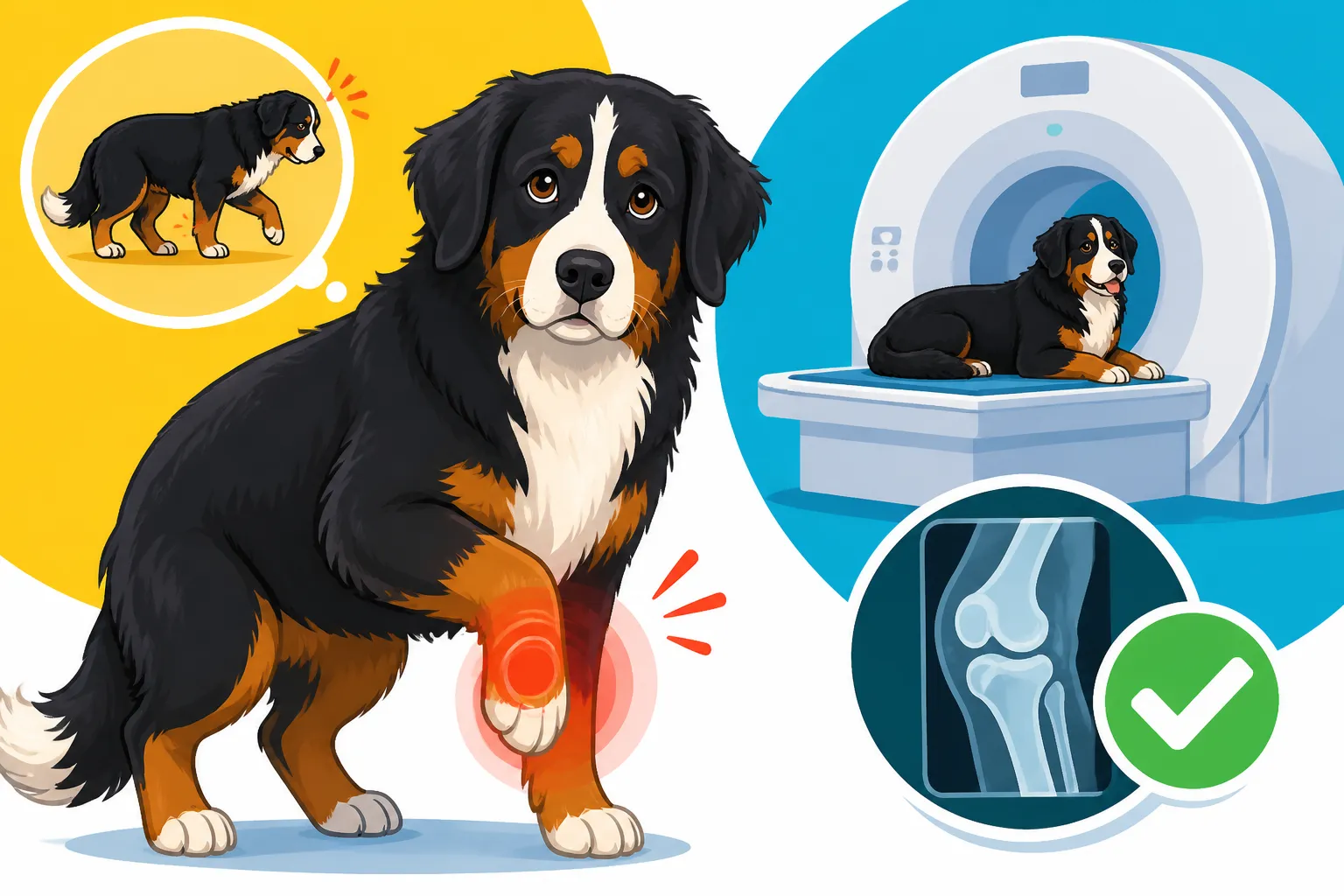
Whether a Limping Bernese Mountain Dog Should Be Scanned
Seeing your big, goofy Bernese Mountain Dog limp can send a jolt of panic through you. Is it just a stumble, or is something more serious brewing beneath that thick, beautiful coat? It’s a common worry for Berner parents, given their predisposition to certain joint and bone issues. This guide is here to walk you through when a limping Bernese Mountain Dog warrants further investigation, specifically through diagnostic scans, helping you understand the signs and next steps.
Understanding the Bernese Mountain Dog's Predisposition to Lameness
Berners, with their impressive size and rapid growth, are unfortunately prone to a host of orthopedic challenges. It’s not just a matter of "big dog problems"; specific genetic factors and the sheer physics of their weight contribute significantly. A limp in a Bernese Mountain Dog isn't always a minor sprain, and understanding their breed-specific vulnerabilities is the first step toward proactive care.
Common Orthopedic Issues in Berners
From the time they are puppies, Bernese Mountain Dogs can be susceptible to conditions that manifest as lameness. The most commonly discussed, and rightly so, are hip and elbow dysplasia. Hip dysplasia, where the hip joint doesn't form correctly, can lead to painful arthritis. Similarly, elbow dysplasia encompasses several conditions that cause abnormal development of the elbow joint, resulting in pain and restricted movement. These aren't always immediately apparent, often developing and worsening over time, and can dramatically impact a dog's quality of life. Owners might notice their Berner having trouble getting up, refusing to jump, or displaying a subtle shift in their gait.
Beyond these well-known culprits, other structural issues can cause a limp. Osteochondritis Dissecans (OCD), a condition affecting cartilage and bone, can occur in the shoulders, elbows, hocks, and knees. It's often seen in large, fast-growing breeds like Berners. Then there’s panosteitis, sometimes called "growing pains," which typically affects young, rapidly growing dogs. While often self-limiting, it can cause severe, shifting lameness that is deeply concerning for owners. It's critical to differentiate these more benign, temporary conditions from chronic, debilitating ones, and this is where a vet's expertise and diagnostic tools become indispensable. For a deeper dive into these kinds of problems, check out our guide on Joint Disease in a Hundred Pound Bernese Mountain Dog.
When a Limp Isn't Just "Growing Pains"
It's tempting to brush off a puppy's limp as simply "growing pains," especially with a breed known for its rapid development. However, relying solely on this assumption can be dangerous. While panosteitis is a real condition that can cause intermittent lameness in young Berners, it's just one possibility. More serious conditions like hip or elbow dysplasia can also begin to manifest during puppyhood or adolescence, even if the symptoms are mild or infrequent at first. Ignoring these early signs could delay crucial intervention that might improve long-term outcomes.
For an adult Bernese Mountain Dog, especially one around four to six years old, a new limp should be taken very seriously. This isn't the age for "growing pains" anymore. This is the age where conditions like cruciate ligament tears—particularly of the anterior cruciate ligament (ACL)—become more prevalent, often causing sudden, severe lameness. Degenerative Myelopathy (DM), a neurological condition, can also begin to show up as weakness or incoordination in the hind limbs, which might initially look like a limp. It's a progressive disease, and early recognition, even if not curable, allows for management and support. Any persistent or recurring lameness, regardless of age, warrants a thorough veterinary examination to rule out the more sinister possibilities and provide peace of mind.
The Urgency of Persistent or Worsening Limps
A limp that doesn't resolve within a day or two, or one that gets progressively worse, is a red flag you absolutely should not ignore in a Bernese Mountain Dog. Unlike a minor bruise or superficial cut that might heal on its own, a persistent limp often points to an underlying structural or inflammatory issue that won't simply disappear. We’re talking about potential conditions that can cause significant pain and severely impact your Berner’s mobility and overall happiness. Imagine your loyal companion, once bounding with joy, now struggling just to get up from a nap. That's a heartache no one wants to experience.
The urgency intensifies if the limp is accompanied by other symptoms like swelling, heat around a joint, vocalization of pain, a reluctance to bear weight, or a general decrease in activity level. These could be indicators of an acute injury, an infection, or even a cancerous process in the bone or soft tissue. Bernese Mountain Dogs, unfortunately, are genetically predisposed to certain aggressive cancers, such as Histiocytic Sarcoma in a Bernese Mountain Dog, which can manifest as lameness if it affects the bones or joints. Time is often of the essence with such diagnoses, making a prompt veterinary visit and potential scanning paramount. Waiting it out could mean the difference between a treatable condition and one that has advanced significantly.
Deciphering the Signs: When to Consider a Scan
Deciding when a limp crosses the line from a wait-and-see situation to one that demands immediate diagnostic imaging can feel overwhelming. It's not always a clear-cut choice, but by observing your Bernese Mountain Dog's behavior and the nature of the limp, you can provide your vet with crucial information that guides the diagnostic process.
Assessing Acute vs. Chronic Limping
First, let’s talk about the difference between an acute limp and a chronic one. An acute limp is sudden onset. Your Berner was fine, then suddenly they’re favoring a leg. Maybe they stepped in a hole, jumped awkwardly, or collided with something during play. This type of limp often has a clear, recent cause, even if you didn't witness it. While some acute limps can resolve with rest and anti-inflammatory medication, if the lameness is severe, non-weight bearing, or doesn't improve after 24-48 hours of strict rest, it warrants a trip to the vet. A scan might be recommended quickly to identify fractures, ligament tears, or severe sprains, particularly in a large, heavy dog where soft tissue injuries can have significant consequences. For example, a sudden, dramatic limp could indicate a torn The Knee a Bernese Mountain Dog Tears at Four which would certainly require imaging for diagnosis.
On the other hand, a chronic limp develops gradually or is intermittent, waxing and waning over weeks or months. You might notice your Berner is stiff after resting, seems less enthusiastic about walks, or consistently favors one leg after certain activities. This is often indicative of conditions like osteoarthritis, which is unfortunately common in the Bernese Mountain Dog, especially as they get older. However, a chronic limp can also be a subtle sign of progressive joint disease, an old injury that never fully healed, or even a slow-growing tumor. If you’ve noticed a persistent, even mild, chronic limp, a scan is almost always a good idea to establish a baseline, identify the underlying cause, and initiate a management plan to keep your beloved companion comfortable for as long as possible. Many Berners experience Arthritis in a Bernese Mountain Dog by Six, and imaging can help understand its severity.
Beyond the Obvious: Subtle Indicators and Behavioral Changes
Sometimes, a limp isn't a dramatic, obvious hop. Bernese Mountain Dogs are famously stoic, and they can be quite adept at hiding discomfort, especially in the early stages of a problem. This is where your keen observation skills as a Berner parent come into play. Look for subtle changes in their normal routine and behavior. Are they hesitating before jumping into the car or onto the sofa? Do they seem less keen to play, or do they cut play sessions short? Perhaps they are shifting their weight differently when standing or sitting, or their gait looks a little "off" – a slight shortening of a stride, a subtle head bob, or a swing of the hip.
Other less obvious signs include a reluctance to use stairs, difficulty getting up from a lying position, or even changes in their personality, such as becoming more withdrawn or irritable due to chronic pain. You might notice muscle atrophy in a particular limb if they’ve been favoring it for a while, indicating that the problem has been ongoing. Pay attention to how they lie down – are they carefully lowering themselves, or avoiding lying on one side? Any unexplained changes in their eating habits or overall energy levels, especially when combined with subtle lameness, should raise a red flag. These are all clues that your Berner is trying to tell you something is wrong, and they certainly warrant a vet visit and a discussion about diagnostic imaging. It's truly heartbreaking to realize your companion has been quietly suffering.
The Role of Age and Activity Level
Your Bernese Mountain Dog’s age and typical activity level play a huge role in interpreting a limp and deciding on scans. For a young, active Berner puppy or adolescent, a limp might be chalked up to typical puppy exuberance or the aforementioned "growing pains" like panosteitis. However, as we discussed, it could also be the early signs of hip or elbow dysplasia, or even a traumatic injury from vigorous play. If your young Berner is experiencing lameness, especially if it’s severe, persists, or causes significant pain, a scan is often recommended to get ahead of potentially debilitating conditions. Early diagnosis allows for more effective management, and in some cases, surgical intervention that can greatly improve their long-term prognosis.
For an older Bernese Mountain Dog, typically anything over six or seven, a limp needs immediate attention. At this age, the likelihood of degenerative conditions like severe arthritis increases significantly. However, it's also the age when more serious conditions like bone cancer or certain soft tissue sarcomas become a real concern. The Cancer That Kills Half of All Bernese Mountain Dogs is a stark reminder of the breed's vulnerabilities. What might seem like "just old age" could be a painful tumor growing in a bone, or the initial signs of Early Degenerative Myelopathy in a Bernese Mountain Dog. An older Berner, even if they've slowed down, still deserves to be pain-free. A scan can help differentiate between treatable age-related issues and more aggressive diseases, allowing you to make informed decisions about their care and comfort.
Types of Scans and What They Reveal
Once you and your veterinarian decide that a scan is warranted for your limping Bernese Mountain Dog, it's helpful to understand the different types of imaging available and what each can reveal. Each modality offers unique insights into what might be causing your Berner's discomfort.
X-rays: The First Line of Defense
When your Berner presents with a limp, conventional X-rays (radiographs) are almost always the first diagnostic tool your vet will reach for. They are relatively quick, non-invasive (though sedation might be necessary for proper positioning in a large, potentially painful dog), and cost-effective compared to more advanced imaging. X-rays are excellent for visualizing bone structures. They can quickly identify fractures, dislocations, significant joint changes indicative of hip or elbow dysplasia, severe arthritis, and certain types of bone tumors. For instance, if your vet suspects Hips That Fail Under a Bernese Mountain Dog's Weight or The Front-End Lameness a Bernese Mountain Dog Develops due to elbow issues, X-rays will provide the crucial initial evidence.
However, it's important to understand the limitations of X-rays. While superb for bone, they aren't great at showing soft tissue detail, such as ligaments, tendons, muscles, or cartilage. So, if a cruciate ligament tear is suspected, X-rays might show secondary signs (like fluid in the joint or early arthritis), but won't directly visualize the tear itself. Similarly, Whether Histiocytic Sarcoma Shows on an X-Ray depends on whether the tumor has invaded bone enough to be visible. Therefore, if X-rays are inconclusive but the clinical signs strongly suggest a soft tissue injury or a subtle problem, your vet might recommend moving on to more advanced imaging.
Advanced Imaging: CT Scans and MRIs
When X-rays don't provide a clear answer or when a soft tissue injury is strongly suspected, your veterinarian may recommend advanced imaging techniques like CT (Computed Tomography) scans or MRI (Magnetic Resonance Imaging). These are more expensive and always require general anesthesia for your Bernese Mountain Dog due to the need for absolute stillness, but they offer vastly superior detail. For example, What a Bernese Mountain Dog CT Scan Costs can be significant, but the information gained can be invaluable.
A CT scan uses X-rays from multiple angles to create cross-sectional images of the body, producing detailed slices of bone, soft tissue, and blood vessels. It excels at bone evaluation, providing a three-dimensional view that can uncover subtle fractures, complex joint issues, or bony tumors that might be missed on standard X-rays. It's often preferred for assessing conditions in areas like the spine or complex joint structures. A MRI uses strong magnetic fields and radio waves to generate incredibly detailed images of soft tissues, making it the gold standard for diagnosing problems with ligaments, tendons, cartilage, spinal cord, and brain. If your Berner has a suspected cruciate tear, meniscal injury, or a neurological issue causing the limp (like a spinal disc problem or early DM), an MRI is typically the preferred choice. Both CT and MRI can provide critical information for surgical planning or targeted treatment, giving you a much clearer picture of what’s truly going on inside your big pal.
Specialized Scans for Soft Tissue and Bone
Beyond general X-rays, CTs, and MRIs, there are other specialized imaging techniques that might be employed depending on the suspected cause of your Berner's limp. For instance, ultrasound can be useful for examining certain soft tissues like tendons, ligaments, and muscle groups, especially when looking for tears, inflammation, or fluid accumulation. It's non-invasive, doesn't require sedation in many cases, and can be performed in real-time, allowing the vet to see structures in motion. While not always used for diagnosing lameness originating from deep within a joint, it can be a valuable tool for superficial soft tissue problems or assessing specific organs.
Another specialized tool is scintigraphy, also known as a bone scan. This procedure involves injecting a small amount of radioactive tracer into your dog's bloodstream. The tracer accumulates in areas of increased bone metabolism, which can indicate inflammation, infection, microfractures, or bone tumors, even before they are visible on X-rays. It's excellent for localizing areas of pain or pathology that are elusive with other methods, especially when the lameness is vague or affects multiple sites. While less common than X-rays or CT/MRI, these specialized scans offer targeted diagnostic capabilities that can be crucial for pinpointing the exact cause of a persistent or puzzling limp in a Bernese Mountain Dog.
| Scan Type | Primary Use | What it Shows Well | Advantages | Limitations |
|---|---|---|---|---|
| X-ray | Initial assessment of bone and joint issues | Fractures, dislocations, arthritis, bone tumors | Relatively inexpensive, quick, widely available | Poor soft tissue detail, 2D view |
| CT Scan | Detailed bone analysis, complex joint structures | 3D view of bone, subtle fractures, spinal conditions | High detail for bone, faster than MRI | Involves radiation, requires anesthesia, expensive |
| MRI | Soft tissue injuries, neurological issues | Ligaments, tendons, cartilage, spinal cord, brain | Excellent soft tissue detail, no radiation | Longer procedure, requires anesthesia, most expensive |
| Ultrasound | Superficial soft tissue, fluid assessment | Tendon/ligament tears, muscle inflammation, joint fluid | Real-time, no radiation, often no sedation | Limited by bone, less useful for deep structures |
| Scintigraphy | Identifying areas of increased bone activity | Early inflammation, microfractures, bone tumors (functional) | Can detect issues not visible on X-ray | Uses radiation, non-specific findings, specialized equipment |
Making the Decision: Consulting Your Veterinarian
Navigating the world of veterinary diagnostics can be daunting, especially when your beloved Bernese Mountain Dog is in pain. The best course of action always begins and ends with an open and honest conversation with your trusted veterinarian. They are your primary resource in deciphering your Berner's symptoms and guiding you through the diagnostic journey.
Preparing for Your Vet Visit
When your Bernese Mountain Dog is limping, the more information you can provide your veterinarian, the better. Before your appointment, take some time to observe your dog carefully and jot down notes. When did the limp start? Was it sudden or gradual? Does it appear after rest or exercise? Is it worse in the morning or evening? Does it affect a specific leg, or does it seem to shift? Note any other accompanying symptoms, like swelling, heat, changes in appetite, energy levels, or behavior. Videos of your dog limping, especially when they are moving naturally at home, can be incredibly helpful for your vet, as dogs often "perform" differently in a clinic setting.
Also, be prepared to discuss your dog's medical history, including any previous injuries, medications, diet, and activity level. Knowing if they've had issues like The Bernese Mountain Dog Whose Back Legs Give Out in the past, or if there's a family history of certain orthopedic conditions, can provide valuable context. Don't be afraid to ask questions during the exam. Your vet will perform a thorough physical and orthopedic assessment, palpating joints, checking range of motion, and observing your dog walk. This comprehensive approach, combined with your detailed observations, will help your vet determine the most appropriate next steps, which may include diagnostic imaging.
Discussing Diagnostic Options and Costs
Once your veterinarian has examined your Bernese Mountain Dog, they will discuss their suspicions and the recommended diagnostic pathway. This is where you need to be prepared to talk about the various scanning options – X-rays, CTs, MRIs – and understand what each can offer in terms of information. Don't hesitate to ask your vet to explain why they are recommending a particular scan over another, and what they hope to learn from it. Sometimes, starting with a simpler X-ray is sufficient; other times, jumping straight to an MRI saves time and provides a definitive answer more quickly.
It's also crucial to have a candid conversation about the associated costs. Diagnostic imaging, especially advanced scans like CTs and MRIs, can be expensive. What Oncology Bills Reach for a Bernese Mountain Dog and other serious diagnoses often start with these imaging steps. Be upfront about your financial considerations. There might be different approaches or staging of diagnostics that your vet can suggest to manage costs while still getting the necessary information. For instance, they might suggest starting with X-rays and only moving to an MRI if the X-rays are inconclusive. Many pet parents find it incredibly helpful to have pet insurance, and companies like Healthy Paws can make a significant difference in alleviating the financial burden of unexpected diagnostic and treatment costs for serious conditions. Having a policy from a reputable provider like Healthy Paws can allow you to make decisions based on your Berner's health needs rather than your wallet.
Considering Pet Insurance for Diagnostic Imaging
The reality is that diagnosing a persistent limp in a Bernese Mountain Dog can quickly become a costly endeavor. X-rays, specialist consultations, sedation, and advanced imaging like CT or MRI can add up to thousands of dollars. This is precisely why pet insurance, and particularly a robust policy, is such a critical consideration for Bernese Mountain Dog owners. Imagine facing a potential diagnosis of a severe joint issue or even cancer, and having to weigh your dog's health against a massive, unexpected vet bill. It's a heartbreaking position no one wants to be in.
A good pet insurance plan, such as those offered by Healthy Paws, can cover a significant portion of these diagnostic costs, including the scans themselves, the specialist fees, and even the necessary anesthesia. While no insurance covers pre-existing conditions, having a policy in place before any symptoms appear means you'll be better prepared when those inevitable health challenges arise. It allows you to say "yes" to the recommended diagnostics without undue stress, knowing that a substantial part of the expense will be reimbursed. When considering Insuring a Bernese Mountain Dog Against Cancer or other serious health issues, understanding what your policy covers for diagnostic imaging is key. Companies like Healthy Paws aim to provide comprehensive coverage for accidents and illnesses, which certainly includes the thorough investigation of a limping Berner. This peace of mind is truly invaluable, ensuring you can focus on your dog's recovery rather than financial strain.
Disclaimer
This article is for general informational purposes only and does not constitute professional advice. Laws, prices and regulations vary by location and change over time. Consult a qualified professional for guidance on your specific situation.